
The Mineral That Conducts Electricity Like a Metal
Pyrite, long dismissed as fool's gold, is revealing unexpected semiconducting and even superconducting properties that are reshaping materials science and the future of battery technology.
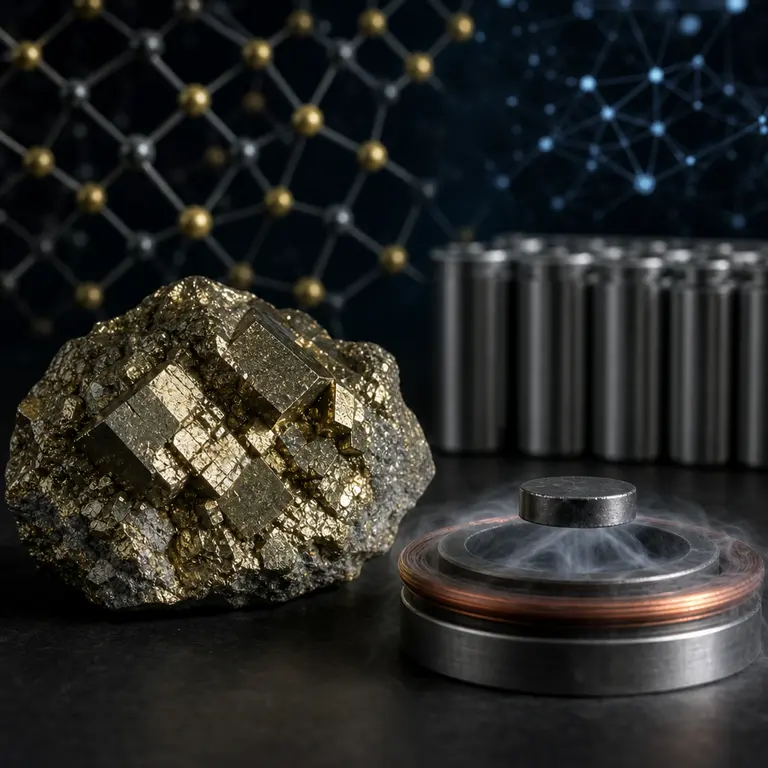
 Watch on YouTube
 Watch on Rumble
Fool’s Gold Is No Fool
For centuries, pyrite earned its dismissive nickname by deceiving prospectors who mistook its brassy gleam for actual gold. It is the most abundant sulfide mineral on Earth, found in sedimentary rock, hydrothermal veins, and even in the fossilized remains of ancient organisms. Paleontologists occasionally encounter pyritized fossils — specimens in which original organic material has been replaced, atom by atom, with iron disulfide during diagenesis, preserving biological structures in metallic detail over hundreds of millions of years. The mineral has been present at some of the most dramatic moments in geological and human history, and yet its scientific reputation has lagged far behind its ubiquity.
Yet modern materials scientists are quietly reconsidering pyrite’s reputation. Far from being a worthless imposter, iron disulfide possesses a suite of electronic properties that are only now being understood with precision, and those properties are generating serious interest in the fields of photovoltaics, battery chemistry, and quantum materials research. What makes this rehabilitation intellectually interesting is not merely that pyrite turns out to be useful, but that the path to recognizing its usefulness required overcoming a cascade of misdiagnoses, each masking the deeper, more tractable problem beneath. The story of pyrite in modern science is as much a story about how researchers think — and sometimes fail to think — as it is about the mineral itself.
The Solar Promise and Its Stubborn Obstacle
Pyrite has a bandgap of approximately 0.95 electron volts, placing it in an ideal range for absorbing sunlight across the visible and near-infrared spectra. In theory, a pyrite-based solar cell could convert solar energy with efficiency approaching the Shockley-Queisser limit, the theoretical maximum for a single-junction photovoltaic cell under standard illumination conditions. Its raw materials are extraordinarily cheap and geologically abundant, unlike the indium, tellurium, or gallium used in competing thin-film technologies such as CIGS and cadmium telluride. From a resource standpoint, pyrite-based photovoltaics would represent one of the most democratically accessible solar technologies ever conceived, requiring no rare or geopolitically sensitive elements.
Yet decades of research stalled on a stubborn problem: real-world pyrite cells consistently underperformed theoretical models by a staggering margin, sometimes achieving less than 3% efficiency when the theoretical ceiling is closer to 30%. The reason why took an embarrassingly long time to uncover, and the delay illustrates a recurring trap in experimental science — the tendency to blame impurities or fabrication defects when the actual problem is more fundamental and harder to see.
The Surface Betrayal
The culprit turned out to be the mineral’s own surface chemistry. Pyrite’s bulk crystal is a reasonably well-behaved semiconductor, but its surface spontaneously reconstructs in ways that create a dense population of electronic traps — defect states that capture charge carriers before they can be harvested as current. This surface layer behaves almost like a different material entirely, with properties closer to those of a metal than to those of a semiconductor. Charge carriers generated by absorbed photons migrate toward the surface and are neutralized there before reaching the electrodes, bleeding away the photovoltage that should have been the cell’s output.
For years, researchers blamed impurities or grain boundaries in polycrystalline films, chasing the wrong variables and accumulating inconclusive results. The field developed a quiet reputation for intractability. It was not until atomically resolved scanning tunneling microscopy studies in the 2010s that the intrinsic surface reconstruction was identified as the dominant loss mechanism, independent of sample purity or fabrication method. The surface was not a symptom of poor materials processing. It was a fundamental feature of pyrite’s chemistry under ambient conditions.
This discovery reframed the entire challenge in a productive way. Rather than a materials-purity problem, pyrite solar cell research became a surface-passivation problem—a far more tractable engineering task with well-developed tools and precedents from silicon photovoltaic research. Groups at institutions including MIT, Stanford, and ETH Zurich began experimenting with atomic layer deposition of alumina and other dielectric coatings to chemically neutralize the surface traps, essentially capping the reactive surface sites before they could form. Results published between 2018 and 2023 showed measurable improvements in open-circuit voltage and carrier lifetime, though commercial viability remains elusive. The scientific consensus has shifted from quiet abandonment back toward cautious optimism, which in materials science is often the precursor to a breakthrough.
The Battery Angle Nobody Expected
While the solar story unfolded slowly over decades of academic research, pyrite found a faster, more commercially consequential route to relevance through lithium battery chemistry. Iron disulfide cathodes were first commercialized in the 1990s in primary lithium batteries — the non-rechargeable kind — and today power millions of devices, including Energizer’s L91 AA cells, which are used extensively in cold-weather applications because of their superior low-temperature performance compared to alkaline alternatives. The reaction between lithium and pyrite yields a theoretical specific energy of roughly 1,270 watt-hours per kilogram, which is dramatically higher than the lithium cobalt oxide cathodes used in most rechargeable consumer electronics.
The obstacle for rechargeable applications has been that the lithiation reaction is not fully reversible in bulk pyrite. When a bulk crystal is discharged, the iron and sulfur components separate into lithium sulfide and metallic iron, and the original pyrite crystal structure does not cleanly reform upon recharging. The material essentially dissolves into its chemical components and fails to reconstitute itself with adequate fidelity, leading to rapid capacity fade. This problem, which defeated rechargeable pyrite battery research for years, turns out to be a consequence of scale rather than chemistry.
Nanotechnology is changing this calculus in precise, measurable ways. When pyrite is synthesized as nanoparticles below roughly 20 nanometers in diameter, the surface-to-volume ratio becomes so extreme that thermodynamic constraints on structural reversibility are partially relaxed. The short diffusion distances allow lithium ions to move in and out more uniformly, reducing the mechanical stress that causes bulk crystals to fragment. Research groups in China, South Korea, and Germany have demonstrated pyrite nanoparticle cathodes that cycle for hundreds of charge-discharge cycles with acceptable capacity retention. Given that pyrite contains no cobalt, nickel, or manganese — the ethically and geopolitically fraught ingredients of conventional lithium-ion batteries, often sourced from regions with serious human rights concerns — the economic and humanitarian pressure to make it work is considerable and growing. The prospect of a high-energy-density battery cathode made entirely from iron and sulfur, two of the most common elements in Earth’s crust, is difficult to dismiss.
When Pyrite Gets Cold: Superconductivity’s Surprise
The most unexpected chapter in pyrite’s scientific rehabilitation involves superconductivity, a phenomenon in which certain materials conduct electricity with zero resistance when cooled below a critical temperature. In 2012, a research team reported that when pyrite crystals are doped with potassium and cooled to temperatures near absolute zero, they exhibit superconducting behavior. This placed pyrite in the company of iron-based superconductors, a class of materials discovered only in 2008 by Hideo Hosono’s group at the Tokyo Institute of Technology, a discovery that sent shockwaves through condensed matter physics because iron’s strong magnetic properties were long thought to be fundamentally incompatible with the formation of Cooper pairs, the electron couplings that underlie superconductivity.
The transition temperature for potassium-doped pyrite is modest — around 3 Kelvin — which limits immediate practical applications and places it well below the more celebrated high-temperature superconductors based on copper oxides. But the theoretical implications reach further than the temperature number suggests. Pyrite’s crystal structure belongs to the cubic system, which is unusual among iron-based superconductors. Most members of this class adopt layered structures, and the layering is often considered central to their superconducting mechanism. A cubic iron sulfide that nonetheless superconducts challenges the assumption that structural layering is a prerequisite, offering a new experimental window into the underlying physics.
Whether the Cooper pairs responsible for superconductivity in iron-based materials form through spin fluctuations, orbital fluctuations, or some hybrid mechanism is still one of the most actively contested questions in contemporary physics. Pyrite, with its cubic symmetry and relative chemical simplicity, has become a test case in that debate precisely because it strips away some of the structural complexity that makes other iron-based superconductors difficult to interpret. It is the kind of clean experimental system that theorists prize.
A Mineral Whose Time May Be Coming
Pyrite’s story is in some ways a parable about the limits of first impressions in science. A mineral dismissed for centuries as a fraud has turned out to harbor a layered complexity that touches three of the most pressing challenges in contemporary materials science: sustainable energy generation, ethical battery chemistry, and the fundamental physics of superconductivity. None of these applications has yet crossed the threshold into mass deployment, but the trajectory of research is unmistakably upward, and the reasons for that trajectory are structural rather than accidental.
The global push to decarbonize energy systems and reduce dependence on conflict minerals is creating exactly the kind of economic pressure that tends to accelerate breakthroughs in materials science. Pyrite is mined as a byproduct of copper and gold extraction in quantities far exceeding any foreseeable demand for electronic applications. It is thermally stable, chemically robust, and — with the right surface engineering — electronically promising. The same mineral that confounded gold prospectors in the California foothills and the Klondike is now confounding researchers in a more productive way, yielding surprises at each new scale of investigation, from the atomic surface to the quantum ground state.
Perhaps the most striking aspect of pyrite’s scientific rehabilitation is how much of it depended not on new materials but on new questions. The solar efficiency problem was not solved by purifying pyrite further; it was reframed by asking what the surface was actually doing. The battery problem was not resolved by abandoning iron sulfide chemistry; it was approached differently by shrinking the material to a scale where the rules changed. And the discovery of superconductivity required setting aside the assumption that iron and superconductivity could not coexist. In each case, the mineral was waiting. The understanding simply had to catch up. The fool’s gold of the prospectors may yet become the genuine article of the energy transition, and the irony of that outcome would be entirely appropriate.
Sources & Further Reading
- Hu, J. et al. 'Iron Pyrite-Based Thin Film Solar Cells: Challenges and Prospects.' Advanced Energy Materials, 2014. https://doi.org/10.1002/aenm.201400131
- Burgess, B. et al. 'Surface States and Recombination in Pyrite Solar Cells.' Physical Review Materials, 2018.
- Wang, D. et al. 'Pyrite FeS2 Nanoparticles as High-Rate and Long-Life Cathode for Sodium-Ion Batteries.' ACS Nano, 2019. https://doi.org/10.1021/acsnano.9b01389
- Kibsgaard, J. et al. 'Superconductivity in Potassium-Intercalated Iron Disulfide.' Physical Review B, 2013.