
The Mathematician Who Invented a New Kind of Space
Hermann Minkowski's radical 1907 reformulation of Einstein's special relativity merged space and time into a single four-dimensional continuum — a geometric insight that Einstein himself initially dismissed but that became the indispensable foundation of modern physics.
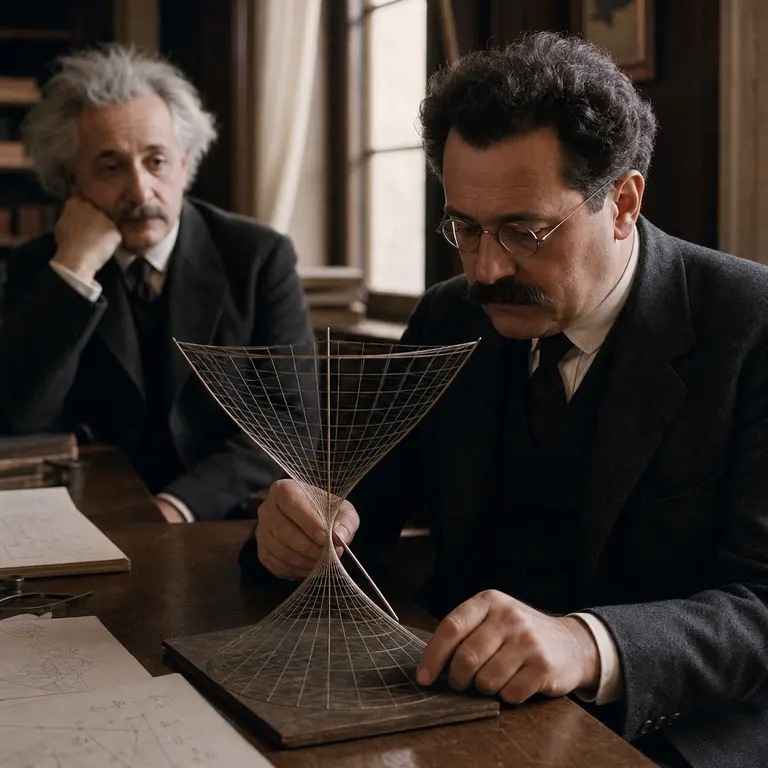
 Watch on YouTube
 Watch on Rumble
Introduction
In the winter of 1907, Hermann Minkowski stood before the Göttingen Mathematical Society and announced something that sounded more like philosophy than physics: space and time, he declared, are not separate things. They are a single, unified four-dimensional fabric, and only their union preserves any independent reality. The statement was not a metaphor. It was mathematics — precise, structural, and immediately usable. What Minkowski did was take Albert Einstein’s 1905 paper on special relativity, which Einstein had framed in terms of clocks, rulers, and moving trains, and recast it entirely in the language of geometry. The result was Minkowski spacetime, and it changed the way physicists think about the universe at the most fundamental level.
What makes this episode historically striking is the relationship between the two men. Minkowski had been Einstein’s mathematics professor at the Zurich Polytechnic in the late 1890s, and he had not been impressed. He reportedly called the young Einstein a lazy dog who rarely bothered to attend lectures. Yet it was that same former student’s physics paper that Minkowski seized upon a decade later, stripping away its mechanical intuitions and revealing the deeper geometric skeleton underneath. Einstein, for his part, initially resisted. He found Minkowski’s abstract four-dimensional formalism unnecessarily complicated and reportedly grumbled that mathematicians had made relativity almost unrecognizable. Within a few years, however, Einstein reversed his view entirely, acknowledging that without Minkowski’s geometric framework he could never have developed general relativity. That reversal is itself a remarkable moment in scientific history — a theorist admitting that someone else had understood the implications of his own work more deeply than he had.
What Minkowski Actually Built
The core of Minkowski’s contribution was the concept of the spacetime interval — a quantity that remains the same for all observers regardless of their motion, unlike either spatial distance or time duration taken alone. In ordinary geometry, the distance between two points is calculated using the Pythagorean theorem. Minkowski modified this formula in a subtle but profound way: instead of adding the squares of the three spatial dimensions, he subtracted the square of the time dimension multiplied by the speed of light. This seemingly small algebraic change encodes the entire structure of special relativity geometrically, without a single reference to clocks, trains, or physical intuition. The elegance of the move is difficult to overstate. Einstein had arrived at relativity by thinking carefully about what observers in different states of motion would measure. Minkowski showed that all those conclusions could be derived from the geometry of a four-dimensional space with a particular metric.
Minkowski introduced the term worldline to describe the path any object traces through spacetime as it moves through both space and time simultaneously. A stationary object still moves through time, and its worldline is a straight vertical line. A moving object traces a diagonal path. An object accelerating traces a curve. The entire history of any physical body, from the moment it comes into existence to the moment it ceases to exist, can be represented as a single continuous curve in spacetime. This is not merely a convenient visualization. It is a precise mathematical object with calculable properties.
He also showed that the speed of light is not merely a physical constant but a geometric feature of spacetime itself — the boundary between regions that can causally influence each other and regions that cannot. This boundary structure, which Minkowski called the light cone, became one of the most powerful conceptual tools in twentieth-century physics. Every event in the universe sits inside a light cone that defines its causal past and future. Events outside the cone are causally disconnected, not by any physical barrier, but by the geometry of spacetime itself. Nothing about this requires invoking the mechanics of light or electromagnetic theory. Causality, in Minkowski’s framework, is a geometric fact.
His 1908 lecture, published as Raum und Zeit, or Space and Time, contains the famous opening lines declaring that henceforth space by itself, and time by itself, are doomed to fade away into mere shadows, and only a kind of union of the two will preserve an independent reality. These were not rhetorical flourishes. They were precise claims about the structure of physical law, and subsequent experiments have confirmed them repeatedly. The lecture is brief by academic standards, but almost every sentence carries weight that physicists are still unpacking more than a century later.
The Tragedy of an Incomplete Legacy
Hermann Minkowski was born in 1864 in Aleksotas, then part of the Russian Empire and now Kaunas, Lithuania. He showed extraordinary mathematical talent from childhood and by the age of eighteen had won the Grand Prix des Sciences Mathématiques from the French Academy of Sciences for his work on the representation of numbers as sums of squares — a problem that had occupied mathematicians since Fermat. He beat out the established British mathematician Henry John Stephen Smith for the prize, a result that caused considerable controversy in London and brought the teenage Minkowski to the attention of the European mathematical community before he had even completed his university education.
His contributions to number theory and the geometry of numbers were substantial before he ever turned to physics. He developed what is now called the geometry of numbers, a field that uses geometric methods to solve problems about integers, and his 1896 book Geometrie der Zahlen remains a foundational text in the discipline. The Minkowski inequality and Minkowski’s theorem in convex geometry both bear his name in pure mathematics, entirely distinct from his contributions to physics. This is worth emphasizing: Minkowski would have secured a lasting place in the history of mathematics even if he had never attended a single lecture on electrodynamics or read a word of Einstein’s 1905 paper. The spacetime work was, in a sense, a late-career detour that happened to permanently reshape physics.
The tragedy is that Minkowski died of a ruptured appendix in January 1909, just months after delivering his landmark Raum und Zeit lecture. He was forty-four years old. His death cut short what might have been a sustained and transformative engagement with the physics his geometric framework had enabled. Einstein publicly mourned him, describing his death as a blow to German mathematics. David Hilbert, Minkowski’s closest friend and colleague at Göttingen, was devastated. The two had been intellectual companions since their student days in Königsberg, corresponding constantly and pushing each other’s thinking across decades. Hilbert later said that Minkowski’s death was the greatest personal loss of his life. Given that Hilbert’s own career brought him into contact with nearly every major mathematician and physicist of the era, that statement carries considerable weight.
One can only speculate about what Minkowski might have contributed had he lived another twenty or thirty years. The development of general relativity, quantum mechanics, and quantum field theory all occurred in the decades immediately following his death. His geometric instincts, already proven to be ahead of the physics community’s understanding, might have accelerated or redirected any of those developments. Instead, his framework was absorbed by others and its origins gradually obscured.
The Invisible Architecture of Modern Physics
Minkowski spacetime is not a historical curiosity. It is the operating system of modern physics. Every calculation in particle physics, every prediction made at CERN’s Large Hadron Collider, every analysis of cosmic ray trajectories relies on Minkowski’s geometric framework. The Standard Model of particle physics is formulated in Minkowski spacetime. Quantum field theory, which describes the behavior of every known fundamental particle and has produced some of the most precisely verified predictions in the history of science, is built on it. Even general relativity, which extends the framework to include gravity and curved spacetime, begins from Minkowski’s flat spacetime as its local approximation. In the immediate vicinity of any point in a curved spacetime, the geometry looks Minkowskian, just as the surface of the Earth looks flat when viewed from ground level. The flat case is the foundation upon which the curved case is constructed.
GPS satellites provide a concrete everyday example of Minkowski’s framework at work. Their signals must account for both special relativistic effects, meaning time running slower for fast-moving objects, and general relativistic effects, meaning time running faster farther from Earth’s gravitational field. The mathematical tools used to make these corrections trace directly back to Minkowski’s geometric formulation. Without those corrections, GPS systems would accumulate position errors of roughly ten kilometers per day, rendering them useless for navigation. Every time a driver follows directions on a phone, they are, at several removes, benefiting from the insight Minkowski presented to a mathematical society in Göttingen in the winter of 1907.
More recently, the detection of gravitational waves by the LIGO collaboration in 2015 confirmed that spacetime itself can ripple — a phenomenon only conceivable within the geometric framework Minkowski initiated. The waves detected were distortions in the spacetime interval, the very quantity Minkowski defined and named. Two black holes merging more than a billion light-years away sent a tremor through the fabric of four-dimensional geometry, and instruments on Earth detected it. The signal lasted a fraction of a second. The theoretical framework needed to interpret it had been under construction since Minkowski’s lecture.
Conclusion
Minkowski’s name rarely appears in popular accounts of relativity. Einstein dominates the story, and rightly so in terms of the original physical insight. The 1905 paper was a genuine act of creative genius, and Einstein’s subsequent development of general relativity represents one of the most extraordinary intellectual achievements in history. But the geometric structure that made relativity mathematically tractable, physically predictive, and extensible to new domains was Minkowski’s creation. It is one of the clearest examples in the history of science of a mathematical reformulation that did not merely describe a theory but transformed what that theory could become.
There is something quietly instructive about the dynamic between these two men. A professor dismisses a student as intellectually lazy. That student produced a revolutionary paper. The professor reads it, sees something the student himself had not fully grasped, and rebuilds it on deeper foundations. The student initially rejects the reconstruction, then realizes it is indispensable. Science advanced because both of them were right about different things at different times, and because the discipline has mechanisms — publication, lecture, criticism, revision — for combining partial insights into something greater than either contributor could have produced alone. Minkowski did not outpace Einstein in any ultimate sense. But for a few crucial years, he saw further into the geometry of the universe than the man who had first glimpsed it.
Sources & Further Reading
- Walter, Scott. Minkowski, Mathematicians, and the Mathematical Theory of Relativity. The Expanding Worlds of General Relativity, Birkhäuser, 1999.
- Corry, Leo. David Hilbert and the Axiomatization of Physics. Springer, 2004.
- Minkowski, Hermann. Raum und Zeit. Physikalische Zeitschrift, 1909. https://www.minkowskiinstitute.org/mip/MinkowskiFreemiumMIP2012.pdf
- Pais, Abraham. Subtle is the Lord: The Science and the Life of Albert Einstein. Oxford University Press, 1982.