
Breaking Light's Speed Limit: Lene Hau's Revolutionary Work
Lene Hau slowed light to bicycle speed and then stopped it entirely — a feat once considered physically impossible that is reshaping quantum communication and memory storage.
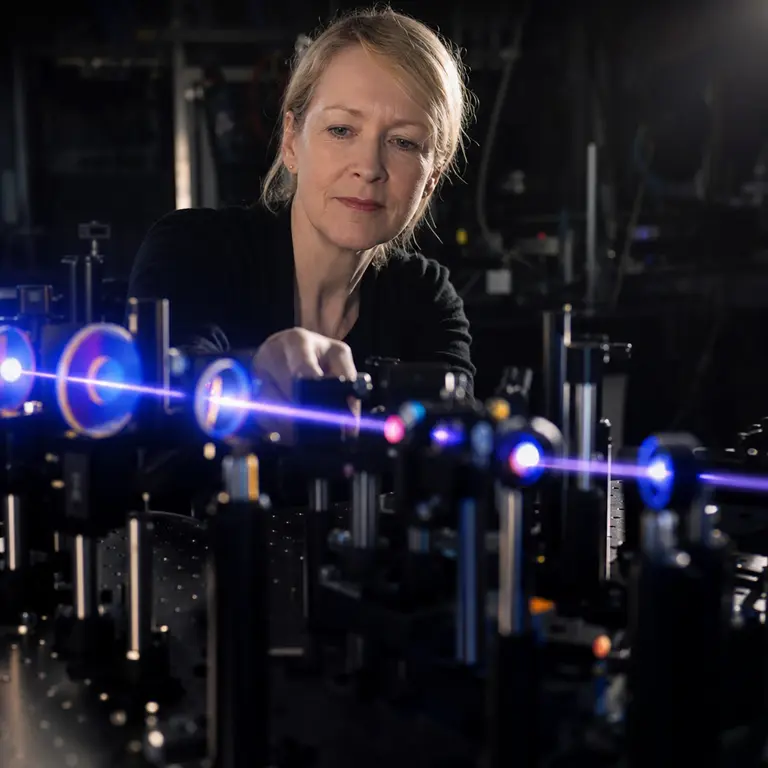
 Watch on YouTube
 Watch on Rumble
The Speed Limit Nobody Thought Could Break
Light travels at approximately 299,792 kilometers per second in a vacuum. For most of the twentieth century, this figure was treated not merely as a constant but as a kind of cosmic law — a ceiling that nothing could meaningfully challenge. It appeared in textbooks as a fundamental boundary, the kind of number that students memorized and physicists built entire theories around. The idea that this speed might be reduced, let alone halted entirely, belonged more to science fiction than to any credible experimental program.
When Danish physicist Lene Vestergaard Hau announced in 1999 that her team at Harvard University had slowed a pulse of light to 17 meters per second — roughly the speed of a leisurely bicycle ride — the physics community reacted with a mixture of disbelief and fascination. Journalists reached for superlatives. Physicists reached for the paper. Two years later, in 2001, Hau went further. She stopped light completely, trapping it inside a cloud of ultracold sodium atoms for a fraction of a second before releasing it intact. The light had been, in effect, stored.
What made these experiments so striking was not simply the technical achievement. It was the implication that one of nature’s most fundamental quantities — the speed of light in a medium — could be manipulated to an almost absurd degree using quantum mechanical effects that had barely been considered practical a decade earlier. The work forced a quiet but significant revision in how physicists thought about light, matter, and their relationship.
Bose-Einstein Condensates and the Quantum Trick Behind It
The mechanism Hau exploited is called electromagnetically induced transparency, or EIT. The phenomenon had been theoretically predicted in the late 1980s by Stephen Harris at Stanford University, who showed that, under the right conditions, a normally opaque atomic medium could be made transparent to a probe laser by simultaneously illuminating it with a second, coupling laser. The two beams interact with the atoms' quantum states, creating destructive interference in light absorption, effectively opening a narrow spectral window through which light can pass — but very slowly.
The physics underlying EIT is subtle enough to reward closer examination. In an ordinary material, light slows down because it is continuously absorbed and re-emitted by atoms as it passes through. The refractive index of glass, water, or any transparent medium reflects this process. EIT works differently. The coupling laser puts the atoms into a quantum superposition of states that cancels out their tendency to absorb the probe laser’s photons. The result is a medium that is simultaneously transparent and extraordinarily dispersive — meaning that different frequencies of light travel at very different speeds through it. Near the center of the EIT transparency window, the group velocity of a light pulse can drop to almost nothing.
Hau’s innovation was to push this effect to an extreme by cooling sodium atoms to within a few billionths of a degree above absolute zero, creating a Bose-Einstein condensate. In this exotic state of matter, first realized experimentally in 1995 by Eric Cornell and Carl Wieman at JILA in Colorado, atoms lose their individual identities and behave as a single quantum entity. The condensate dramatically amplified the EIT effect, producing a medium with a refractive index so enormous that light’s group velocity — the speed at which the pulse’s energy envelope travels — dropped from 300 million meters per second to just 17.
The 1999 results were published in Nature and immediately attracted global attention. Hau’s team, which included graduate student Zachary Dutton and postdoctoral researchers Cyrus Behroozi and Michael Budde, had spent years refining the apparatus in a basement laboratory that colleagues described as looking more like a plumber’s workshop than a physics facility. The combination of laser cooling equipment, magnetic traps, and precision optics required to sustain a Bose-Einstein condensate under experimental conditions was formidable, and the group’s success owed as much to engineering patience as to theoretical insight.
Stopping and Reviving a Pulse of Light
The 2001 experiment, also published in Nature, added a conceptually stranger step. By gradually reducing the intensity of the coupling laser to zero while a light pulse was traveling through the condensate, Hau’s team transferred the pulse’s quantum information entirely into the collective spin state of the atomic cloud. The light, as a propagating electromagnetic wave, ceased to exist. Its information — its phase, amplitude, and polarization — was encoded in the atoms themselves.
When the coupling laser was switched back on, the atomic excitation was converted back into a photon pulse that emerged from the other side of the condensate with its original properties intact. The light had been stored and retrieved, not merely slowed. This distinction matters enormously. Slowing light is a remarkable trick, but storing it implies that the information carried by a photon can be transferred into matter and recovered without loss, which has consequences far beyond any single experiment.
A parallel experiment published the same week by Ron Walsworth and Mikhail Lukin at the Harvard-Smithsonian Center for Astrophysics achieved a similar result using warm rubidium vapor rather than a condensate, demonstrating that stopped light was not dependent on the extreme conditions of Bose-Einstein condensation. The two results together suggested that EIT-based light storage was a general phenomenon accessible via multiple experimental routes.
Hau extended the concept further in a 2007 paper in Nature, demonstrating that a stopped light pulse could be transferred from one atomic cloud to a physically separate cloud — effectively teleporting the light’s information across a small gap using matter as an intermediary. The pulse traveled through the second condensate and emerged as if it had passed through the first, without ever existing as light in the space between the two clouds. The implications of this result were not lost on researchers working in quantum information science. If light’s quantum state could be moved through matter without the light itself traveling, the boundary between optical and material storage of information would become genuinely blurry.
From Curiosity to Quantum Memory
For several years, the stopped light remained a spectacular laboratory curiosity with no obvious application. That changed as quantum computing and quantum communication matured as fields. One of the central engineering challenges in building a quantum network — a system that transmits information encoded in individual photons — is the quantum memory problem. Classical networks use repeaters to amplify signals over long distances, but quantum states cannot be copied without destroying them, a restriction known as the no-cloning theorem. Quantum networks, therefore, need a way to store a photon’s quantum state briefly while routing decisions are made or while entanglement is established across nodes.
EIT-based light storage is now one of the leading candidate technologies for exactly this function. Research groups in China, Germany, the United States, and Australia have demonstrated storage times that have grown from microseconds to milliseconds and, in some systems using rare-earth-doped crystals rather than atomic vapors, approaching seconds. A 2015 experiment at the Australian National University stored a light pulse in a europium-doped crystal for six hours — a figure that would have seemed fantastical in 1999.
The fidelity of retrieval — how faithfully the stored quantum state is recovered — has also improved substantially. Early demonstrations were limited to classical light pulses, but more recent experiments have achieved storage and retrieval of single photons and entangled photon pairs, which are the actual currency of quantum communication. Groups working on quantum repeater networks, which would allow quantum-encrypted communication over intercontinental distances, now routinely cite Hau’s foundational work as the conceptual origin of their memory architectures.
There is also a less obvious application that has attracted attention in recent years. Slow-light systems based on EIT have been proposed as the basis for optical delay lines — devices that hold a signal for a precisely controlled interval before releasing it. In classical photonic circuits, where timing and synchronization matter, the ability to delay a light pulse by a tunable amount without converting it to an electrical signal has engineering value. The gap between fundamental physics and practical photonics has narrowed considerably since 1999.
A Career Built on Unlikely Combinations
Lene Hau was born in Vejle, Denmark, in 1959 and completed her doctorate in physics at Aarhus University in 1991. Her early work focused on theoretical condensed-matter physics, and her pivot toward ultracold-atom experiments came through a collaboration with physicist John Golovchenko at Harvard, where she eventually joined the faculty. She has described her approach as deliberately interdisciplinary — her group has included physicists, chemists, and engineers working on problems that do not fit neatly into any single department.
This interdisciplinary orientation is not incidental to her success. The stopped-light experiments required expertise in laser physics, atomic physics, cryogenics, and quantum optics simultaneously. No single specialist tradition would have produced the combination of techniques her team assembled. The basement laboratory that colleagues found so charmingly chaotic was, in a sense, a physical manifestation of a research philosophy that refused to be confined by departmental boundaries.
Her recognition has come steadily, if not always loudly. She received a MacArthur Fellowship in 2001, was elected to the Royal Danish Academy of Sciences and Letters, and holds the Mallinckrodt Professorship of Physics and Applied Physics at Harvard. Yet outside specialist circles, her name remains considerably less familiar than the scale of her contribution might suggest. The 1999 Nature paper has been cited thousands of times, and the field of quantum memory it helped inaugurate now involves hundreds of research groups worldwide.
The broader lesson of her work may be this: the constants of nature are not always as fixed as they appear in textbooks. What appears immutable in a vacuum can be profoundly altered inside matter, and the boundary between storing information and storing light — between memory and physics — is narrower than anyone expected. A bicycle-speed beam of light, coaxed through a cloud of atoms colder than deep space, turned out to be one of the more consequential experiments of the past thirty years.
Sources & Further Reading
- Hau, L. V., Harris, S. E., Dutton, Z., & Behroozi, C. H. Light speed reduction to 17 metres per second in an ultracold atomic gas. Nature, 1999. https://doi.org/10.1038/17561
- Liu, C., Dutton, Z., Behroozi, C. H., & Hau, L. V. Observation of coherent optical information storage in an atomic medium using halted light pulses. Nature, 2001. https://doi.org/10.1038/35054017
- Hau, L. V. Frozen light. Scientific American, 2001.
- Heim, B., et al. Long-lived solid-state optical memory for photonic polarization qubit. Physical Review Letters, 2015.