Knot Theory: from Smoke Rings to Quantum Computing
Peter Guthrie Tait's obsession with smoke rings in the 1860s launched knot theory as a branch of mathematics — a field now central to DNA biology, quantum computing, and the study of protein folding.
 Watch on YouTube
 Watch on Rumble
Smoke Rings, Ether, and a Mathematical Obsession
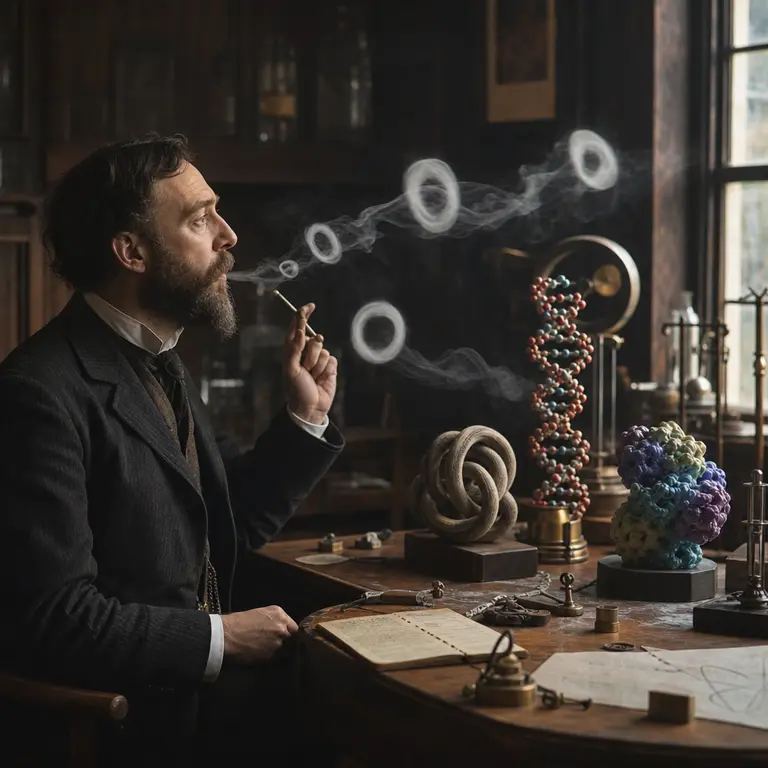
In 1867, the Scottish physicist Peter Guthrie Tait watched a colleague blow smoke rings in an Edinburgh laboratory and became convinced he was witnessing the fundamental structure of matter. His colleague was Hermann von Helmholtz, who had just published a paper describing vortex rings in frictionless fluids. The physicist William Thomson, later known as Lord Kelvin, seized on the idea and proposed that atoms were actually knotted tubes of ether — a then-hypothetical medium thought to fill all space. If atoms were knots, then the periodic table itself was a table of knots, and chemistry was secretly topology.
The theory was wrong. Ether does not exist. But in attempting to classify every possible knot so that chemists could match them to elements, Tait accidentally founded one of the most consequential branches of pure mathematics ever created. Between 1877 and 1885, he produced the first systematic tables of knots, cataloging forms with up to ten crossings and establishing rules — now called the Tait conjectures — that would not be formally proven until a century later. The story of how this error became a cornerstone of modern science is one of the stranger and more instructive episodes in intellectual history.
What a Knot Actually Is, Mathematically Speaking
In everyday life, a knot is a tangle in a piece of string with two loose ends. In mathematics, a knot is a closed loop — imagine tying a knot and then fusing the two ends together — embedded in three-dimensional space. The central problem of knot theory is deceptively simple: given two knots, are they actually the same knot in disguise, merely stretched or twisted differently, or are they genuinely distinct?
This question turns out to be extraordinarily difficult. Tait’s approach was largely visual and combinatorial. He drew knot diagrams — two-dimensional projections of three-dimensional knots — and tried to count crossings and classify configurations. His three conjectures about reduced alternating knots, those whose crossings alternate between over and under in a regular pattern, seemed obvious from his tables but resisted proof for over a hundred years. They were finally confirmed in 1987 using a tool Tait could never have imagined: the Jones polynomial, discovered by New Zealand mathematician Vaughan Jones, which assigns an algebraic expression to each knot in a way that remains unchanged regardless of how the knot is deformed.
The Jones polynomial’s discovery in 1984 was itself startling because Jones found it while studying operator algebras in quantum mechanics — a field with no apparent connection to topology. He had been working on a problem related to von Neumann algebras, a branch of functional analysis concerned with infinite-dimensional spaces of operators, when he noticed that the algebraic structures he was manipulating bore a suspicious resemblance to the relations that govern how knot diagrams can be transformed into one another. The resulting invariant was not just a curiosity. It could distinguish knots that all previous tools had failed to separate, and its emergence from an entirely unrelated domain is considered one of the more remarkable cross-disciplinary surprises in modern mathematics.
What makes knot invariants so valuable, and so difficult to construct, is the nature of the equivalence they must capture. Two knot diagrams represent the same knot if one can be transformed into the other through a finite sequence of local moves, known as Reidemeister moves after the German mathematician Kurt Reidemeister, who cataloged them in 1927. A good invariant must remain stable across all such moves while still being sensitive enough to distinguish genuinely different knots. Finding invariants that strike this balance has occupied mathematicians for over a century, and the search continues to produce unexpected results.
When Biology Needed Knot Theory
The vortex atom theory collapsed within two decades of its proposal, but knot theory survived as pure mathematics, largely ignored by applied science until the 1970s and 1980s. Then biologists made an uncomfortable discovery: DNA is knotted.
The double helix of DNA inside a human cell, if fully unspooled, would stretch roughly two meters. This enormous molecule must be compacted into a nucleus just six micrometers across, and when cells divide, the DNA must be replicated and separated without the strands becoming hopelessly entangled. Enzymes called topoisomerases manage this by cutting DNA strands, passing other strands through the gap, and resealing the cut — operations that are precisely the moves mathematicians use to transform one knot into another. The cell, in other words, is continuously performing knot theory at a molecular scale, and it has been doing so for billions of years.
Researchers, including Nicholas Cozzarelli at the University of California, Berkeley, demonstrated in the 1980s that the action of specific topoisomerases could be described and predicted using knot-theoretic invariants. This was not a metaphor. The mathematics Tait had developed to catalog imaginary ether atoms turned out to describe the actual mechanical behavior of the molecule of life. By analyzing the knot type of circular DNA before and after an enzyme acted on it, researchers could determine precisely which topological operation the enzyme performed — how many strands it cut, in what orientation, and how it resealed them. This gave molecular biology a new kind of precision tool, one borrowed wholesale from a branch of pure mathematics that had spent most of its existence answering questions no one in a laboratory had thought to ask.
Today, pharmaceutical researchers use knot theory to design drugs that target topoisomerases in cancer cells, exploiting the fact that rapidly dividing cells are especially dependent on these enzymes to manage the topological stress of repeated replication. Several approved chemotherapy agents, including camptothecin derivatives, work by trapping topoisomerases in the act of cutting DNA, preventing resealing, and causing the cell to self-destruct. The topological insight behind these drugs traces a direct, if winding, line back to Tait’s knot tables.
Protein folding presents a related challenge. Proteins are long chains of amino acids that must fold into precise three-dimensional shapes to function, and some of those shapes are topologically knotted in ways that are only now being cataloged. A 2020 survey published in the journal Proteins identified dozens of deeply knotted protein structures whose folding pathways remain poorly understood. The existence of knotted proteins was itself surprising to many structural biologists, since the conventional picture of protein folding did not obviously predict that a linear chain would fold back on itself. Understanding how and why this happens, and what functional advantage a knot might confer, suggests that knot theory will be a growing tool in structural biology for decades to come.
Knots in Quantum Physics and Computing
The connection between knot theory and quantum mechanics, first hinted at by the Jones polynomial, has deepened considerably since the 1990s. Physicist Edward Witten at the Institute for Advanced Study in Princeton showed in 1989 that the Jones polynomial could be derived from a quantum field theory — specifically, a three-dimensional gauge theory called Chern-Simons theory. This was a remarkable result for multiple reasons. It meant that a purely combinatorial object, a polynomial computed by manipulating diagrams on paper, had a natural home in the language of quantum fields. It also meant that physical intuition from quantum mechanics could be imported into topology, and vice versa, opening a two-way channel between disciplines that had previously had little to say to each other.
This work earned Witten the Fields Medal in 1990, the only time the prize has been awarded to a physicist, and it cemented knot theory’s place at the intersection of mathematics and theoretical physics. The Fields Medal citation noted that Witten’s results had not only solved long-standing mathematical problems but had also generated entirely new ones, a pattern that has continued in the decades since. The interaction between quantum field theory and low-dimensional topology has become one of the most active areas in both subjects, producing invariants of three-dimensional manifolds, new approaches to string theory, and a growing body of conjectures connecting quantum invariants to the classical geometry of hyperbolic spaces.
More recently, a class of quantum computing architectures called topological quantum computers has proposed using knotted quantum states — specifically, exotic quasiparticles called non-Abelian anyons — as the physical medium for storing and processing information. The appeal is that knotted states are inherently resistant to the small perturbations that cause ordinary quantum bits to lose their information, a problem known as decoherence. In a topological quantum computer, information would be encoded not in the fragile state of a single particle but in the global topological configuration of many particles, a property that cannot be disrupted by any local disturbance. This makes the architecture theoretically far more robust than conventional approaches. Microsoft has invested substantially in this direction through its Station Q research program, though practical topological quantum computers remain a future goal rather than a present reality as of 2025.
The Legacy of a Wrong Idea
The story of knot theory is a useful corrective to the assumption that scientific progress moves in straight lines from question to answer. Tait’s tables were motivated by a physical hypothesis that was falsified within his own lifetime. Yet the mathematical infrastructure he built to support that hypothesis outlasted it by more than a century and continues to generate new results.
Tait himself died in 1901, long before any of these applications were imaginable. He is remembered primarily as a physicist — he co-authored a foundational textbook with Lord Kelvin and made important contributions to thermodynamics and the physics of golf balls, including the first scientific analysis of why dimpled balls fly farther. His knot tables, compiled with painstaking care for a theory of matter that turned out to be entirely mistaken, became the seed of a mathematical discipline that now touches molecular biology, materials science, cryptography, and the architecture of quantum machines.
This pattern — wrong theory, lasting mathematics — appears elsewhere in the history of science. The caloric theory of heat produced thermodynamic equations that survived the theory’s collapse. Ptolemaic astronomy generated trigonometric tools that astronomers still use. What Tait’s case adds to this pattern is the peculiar irony of scale: he was trying to explain the smallest things in nature, atoms, and the mathematics he developed turned out to be most urgently needed to understand molecules of biological life and the quantum behavior of matter at temperatures near absolute zero. The gap between the motivation and the eventual application is so wide that no one could have predicted it, and that unpredictability is itself part of the lesson.
The first complete knot table, extending Tait’s work to knots with up to sixteen crossings, was not finished until 1998, when mathematicians using computer assistance cataloged more than 1.7 million distinct knot types. The question of how to determine, in general, whether two arbitrary knots are equivalent remains one of the genuinely hard open problems in mathematics. No algorithm is known to solve this problem efficiently for all cases, and whether such an algorithm exists remains unresolved. Tait’s smoke-ring afternoon in Edinburgh set in motion a line of inquiry that shows no sign of ending, driven forward not by any single application but by the persistent strangeness of the question itself — the question of when two tangles in space are, at bottom, the same thing.
Sources & Further Reading
- Adams, Colin C. The Knot Book: An Elementary Introduction to the Mathematical Theory of Knots. American Mathematical Society, 2004.
- Witten, Edward. Quantum Field Theory and the Jones Polynomial. Communications in Mathematical Physics, Vol. 121, 1989. https://link.springer.com/article/10.1007/BF01217730
- Sumpter, David. Outnumbered: From Facebook and Google to Fake News and Filter-Bubbles. Bloomsbury Sigma, 2018. [For context on mathematical modeling in biology.]
- Knot Atlas. The Knot Atlas: A Wiki-Based Knot Theory Resource. katlas.org, ongoing. http://katlas.org