
The Woman Who Mapped the Ocean Floor Nobody Believed
Marie Tharp's meticulous hand-drawn maps of the Atlantic seafloor revealed the Mid-Ocean Ridge and helped prove continental drift — yet her male colleagues initially dismissed her findings as 'girl talk.'
 Watch on YouTube
 Watch on Rumble
The Invisible Cartographer of the Deep
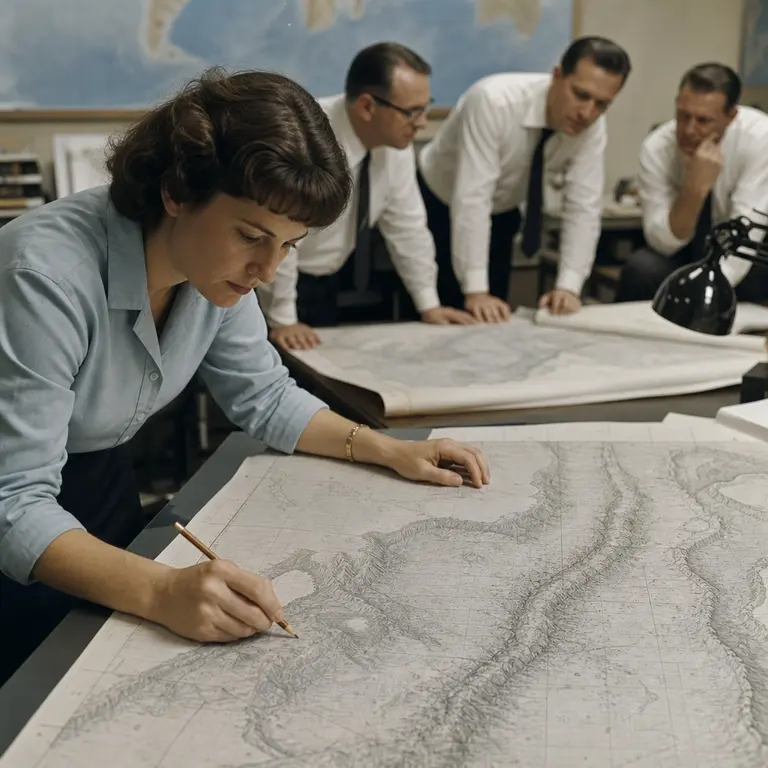
In 1952, a young geologist named Marie Tharp sat at a drafting table at Columbia University’s Lamont Geological Observatory in Palisades, New York, doing work that women were formally barred from doing at sea. While her male colleagues collected sonar data aboard research vessels, Tharp was confined to shore — tasked with translating columns of raw echo-sounding measurements into something visual. What she produced over the next several years would permanently alter humanity's understanding of the planet it lives on.
Working with data gathered by oceanographer Bruce Heezen, Tharp began plotting the depth profiles of the Atlantic Ocean floor in meticulous detail. No one had attempted this at scale before. The ocean was assumed to be a flat, featureless plain — geologically inert and scientifically uninteresting beneath its surface currents. What Tharp’s hand-drawn profiles revealed was something entirely different: a continuous, enormous mountain range running down the center of the Atlantic, bisected by a deep central rift valley. The implications of that discovery would take years to fully register across the scientific community, but the evidence was there from the beginning, encoded in the curves and contours of her drafting work.
Tharp had come to the work through an unusual path. She had earned a master’s degree in geology from the University of Michigan in 1945, at a time when women were actively encouraged to enter scientific programs because wartime labor shortages had depleted the usual pool of male applicants. When the war ended, and men returned, many of those opportunities evaporated. Tharp found a position at Lamont not because the institution had fully embraced women as scientific equals, but because her technical precision made her indispensable for the painstaking interpretive work that the observatory’s expanding data collection demanded. She was, in the language of the era, a draftsperson. What she actually was, as history would confirm, was a geographer of the unknown world.
The Rift That Changed Everything
The feature Tharp identified in 1952 was the Mid-Atlantic Ridge — a 40,000-mile-long underwater mountain chain that is now recognized as the longest mountain range on Earth. More critically, the rift valley running through its center was structurally identical to the East African Rift Valley, a region where tectonic plates are actively pulling apart. Tharp immediately recognized what this implied: the seafloor was spreading. New crust was being generated at the rift and pushing the continents apart — a mechanism that could finally explain continental drift, the theory proposed by Alfred Wegener in 1912 that had been ridiculed by most of the scientific establishment for four decades.
When Tharp brought her interpretation to Heezen, he dismissed it. His exact response, as she later recalled in a 1999 essay published in the Lamont-Doherty Earth Observatory’s newsletter, was that it was “girl talk.” The idea of seafloor spreading was considered too radical, too associated with the discredited Wegener hypothesis. Heezen himself had publicly argued against continental drift. Yet Tharp’s structural argument was geometrically precise and reproducible — it was not speculation but cartographic evidence built from thousands of individual depth soundings, each one a data point in a portrait of a hidden world.
What shifted Heezen’s position was an unexpected convergence of data. When he overlaid earthquake epicenter maps onto Tharp’s seafloor profiles, the seismic activity aligned almost perfectly with the rift valley she had drawn. Earthquakes were clustering exactly where she said the crust was pulling apart. The pattern was not subtle or ambiguous. It was a near-perfect correspondence between two independent datasets, the kind of convergence that in science functions as close to proof as observation can get. Within two years, Heezen had reversed his position entirely and became one of the theory’s advocates.
This episode illustrates an important aspect of how paradigm shifts actually occur in science. The intellectual infrastructure for accepting seafloor spreading had to be built before the theory could be accepted. Tharp’s maps were part of that infrastructure. They gave researchers a concrete visual framework onto which other data — seismic records, magnetic anomaly surveys, sediment core analyses — could be layered and compared. The theory of plate tectonics did not emerge from a single eureka moment but from the slow accumulation of compatible evidence, and Tharp’s drafting table was one of the places where that accumulation began.
A Map That Became a Scientific Monument
In 1977, Tharp and Heezen, in collaboration with Austrian-American painter Heinrich Berann, published a panoramic physiographic map of the entire ocean floor — a document that National Geographic distributed to its millions of subscribers. It was the first time most people had ever seen what lay beneath the world’s oceans. The map depicted not just the Mid-Atlantic Ridge but the full global system of underwater ridges, trenches, and abyssal plains in a style that combined scientific accuracy with painterly depth. It remains one of the most reproduced scientific illustrations in history.
Berann’s contribution to the project deserves recognition in its own right. He had previously worked on panoramic landscape paintings for ski resorts and tourism boards, developing a technique for rendering three-dimensional terrain in ways that felt both accurate and emotionally immediate. Applied to the ocean floor, his approach transformed Tharp’s precise yet abstract depth profiles into something a general audience could intuitively grasp. The collaboration between a geologist, an oceanographer, and a landscape painter produced a document that functioned simultaneously as science and as art — and in doing so, reached an audience that a conventional scientific publication never could have.
The map also provided visual confirmation of plate tectonics — a theory formally synthesized in the 1960s — at a moment when the scientific community was still absorbing its implications. Geologist J. Tuzo Wilson, who developed the concept of transform faults in 1965, later credited Tharp's visual clarity in ocean-floor mapping as instrumental in making the plate tectonics revolution comprehensible to researchers across disciplines. There is a recurring pattern in the history of science where a visualization, rather than a paper or a proof, becomes the pivot point around which a new consensus forms. Tharp’s map was one of those pivots.
Despite this, Tharp received almost no formal credit for decades. The Lamont Observatory’s official publications frequently listed only Heezen’s name. She was classified as a technical assistant rather than a scientist, and her salary reflected that categorization. It was not until 1997 that the Library of Congress named her one of the four greatest cartographers of the twentieth century. She received the Woods Hole Oceanographic Institution’s Mary Sears Woman Pioneer in Oceanography Award in 1999, and in 2001, Columbia University’s Lamont-Doherty Earth Observatory awarded her its first annual Lamont Heritage Award. These were meaningful recognitions, but they arrived late — decades after the work had reshaped an entire scientific field.
The Structural Barrier and the Women Who Worked Around It
Tharp’s exclusion from research vessels was not unique to her or to Lamont. U.S. Navy regulations and institutional customs throughout the 1950s and 1960s barred women from most oceanographic ships, citing superstition, practicality, and custom in roughly equal measure. The result was a peculiar division of labor: women processed and interpreted the data that men collected, often performing the more analytically demanding portions of research while receiving subordinate credit. This arrangement was not accidental. It was the product of institutional structures that simultaneously relied on women’s intellectual labor and refused to formally acknowledge it.
This dynamic shaped several major discoveries of the mid-twentieth century. Oceanographer Mildred Sears contributed substantially to biological oceanography at Woods Hole. Geologist Tanya Atwater, working at Scripps Institution of Oceanography in the late 1960s, produced foundational work on Pacific plate tectonics, including a 1970 paper in the Geological Society of America Bulletin that remains a citation landmark. Atwater was permitted aboard some vessels by that point, but only after years of navigating explicit institutional resistance. Her experience illustrates that, when it came, progress was uneven and incremental — a matter of individual exceptions rather than structural change.
The deeper irony in Tharp’s case is that her exclusion from the sea may have inadvertently sharpened her analytical contribution. Because she could not collect data herself, she became extraordinarily skilled at reading and interpreting the data others brought back. She developed a spatial intuition for ocean floor topography that was built not from direct observation but from the patient, sustained engagement with numbers on a page. Her confinement to the drafting table forced a kind of concentrated expertise that might not have developed in quite the same way had she been dividing her attention between fieldwork and analysis.
A Legacy Still Being Mapped
Tharp outlived Heezen, who died of a heart attack in 1977 aboard a submarine near Iceland — a fitting if melancholy end for a man whose career had been defined by the deep ocean. She spent her later years digitizing her maps and donating her original hand-drawn documents to the Library of Congress, where they are preserved today. The act of preservation was itself a statement. She understood that the physical artifacts of her work carried historical weight that transcended their scientific content, and she ensured they would survive.
She died on August 23, 2006, in Nyack, New York, at the age of 86. The seafloor she spent her life mapping is still being refined by satellite altimetry and autonomous underwater vehicles — technologies that can resolve features her echo-sounding data could only approximate. But its fundamental architecture, the ridges, rifts, and abyssal plains that define the tectonic structure of the planet, was first sketched by a woman at a drafting table who was not allowed to go to sea. That architecture has not changed. It was there in the data all along, waiting for someone with the skill and the patience to see it, and to draw it into the light.
Sources & Further Reading
- Tharp, Marie. 'Connect the Dots: Mapping the Seafloor and Discovering the Mid-ocean Ridge.' Lamont-Doherty Earth Observatory of Columbia University, 1999.
- Heffernan, Olive. 'The Ocean's Depths Revealed.' Nature, 2010. https://www.nature.com/articles/467354a
- Lambert, Bruce. 'Marie Tharp, Pioneering Mapmaker of the Ocean Floor, Dies at 86.' The New York Times, August 26, 2006.
- Atwater, Tanya. 'Implications of Plate Tectonics for the Cenozoic Tectonic Evolution of Western North America.' Geological Society of America Bulletin, 1970.