
The Forgotten Physicist Who Proved Parity Is a Lie
Chien-Shiung Wu's 1956 experiment shattered one of physics' most sacred assumptions — that nature has no left-right preference — yet she was excluded from the Nobel Prize awarded to the men whose theory she proved.
 Watch on YouTube
 Watch on Rumble
A Law That Everyone Assumed Was Unbreakable
For decades, physicists operated under a comfortable assumption known as the conservation of parity. The idea was elegant and intuitive: the laws of physics should look identical whether viewed in a mirror or not. If a particle decays in a particular way, its mirror image should decay identically. Nature, the thinking went, has no inherent handedness. A left-handed universe and a right-handed universe should be physically indistinguishable, governed by the same rules, producing the same outcomes. This principle had never been seriously challenged, and most physicists treated it less like a hypothesis and more like a geometric truth, something so self-evidently correct that testing it seemed almost unnecessary.
The assumption had deep roots. Parity conservation had held firm across every interaction physicists had examined, including those involving the electromagnetic and strong nuclear forces. It had the feel of a universal law rather than a provisional claim. Even as quantum mechanics dismantled classical intuitions about particle behavior, parity remained untouched. It was one of the few principles that seemed to survive intact from the old Newtonian world into the strange new territory of subatomic physics. Then, in 1956, a single experiment in a Washington, D.C. laboratory destroyed it entirely.
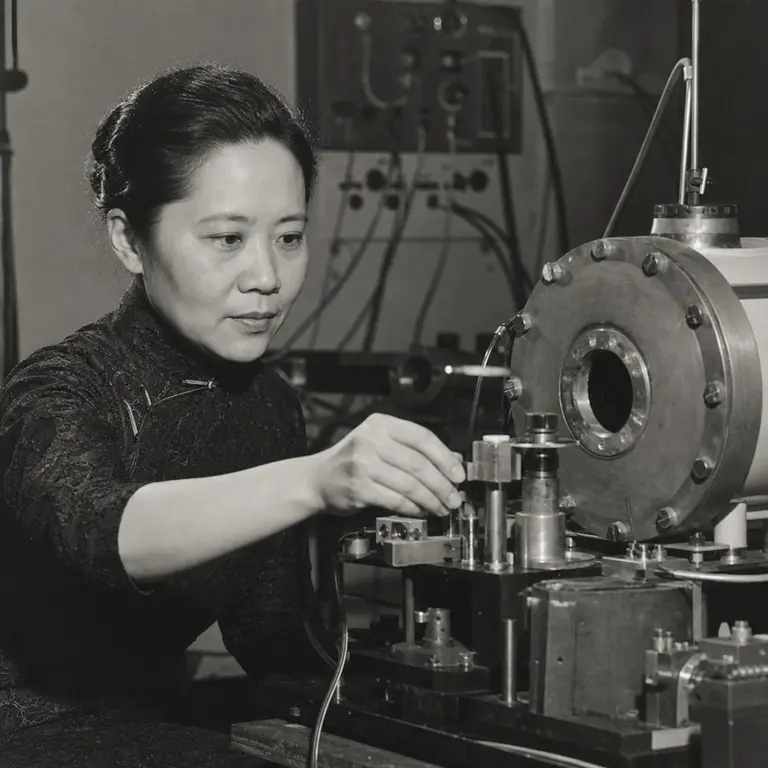
The experiment was designed and executed by Chien-Shiung Wu, a Chinese-American experimental physicist at Columbia University. Working with researchers at the National Bureau of Standards, Wu cooled cobalt-60 atoms to near absolute zero, specifically 0.01 degrees Kelvin, using a technique called adiabatic demagnetization. This process aligned the nuclear spins of the cobalt atoms uniformly along a single axis using a magnetic field. The logic of the experiment was precise: if parity were conserved, the electrons emitted during beta decay should shoot out equally in both directions relative to the spin axis, because any asymmetry would imply that nature distinguishes between left and right at a fundamental level. The electrons did not behave symmetrically. They overwhelmingly preferred one direction. Nature, it turned out, is left-handed at the subatomic level, and no amount of theoretical elegance could change that fact.
The Theorists Got the Prize. The Experimenter Did Not.
The theoretical prediction that parity might be violated in weak nuclear interactions was made by Tsung-Dao Lee and Chen-Ning Yang, two physicists who published a landmark paper in 1956 arguing that, while parity conservation had been verified for strong and electromagnetic interactions, it had never been rigorously tested for the weak nuclear force. Their paper was bold and intellectually provocative. It identified a gap in the experimental record that the physics community had overlooked, and proposed several experiments to resolve the question. But identifying a gap and filling it are different acts, and it was Wu who took the theoretical challenge and turned it into physical reality.
She chose the hardest possible experimental path, cryogenic nuclear alignment, when simpler methods might have been attempted first. This was a deliberate choice. Wu understood that a result of this magnitude would face intense scrutiny, and she wanted the evidence to be unambiguous. The technical demands of her approach were formidable. Maintaining cobalt-60 at 0.01 Kelvin while conducting precise measurements of electron emission required extraordinary experimental control, and the collaboration between Columbia and the National Bureau of Standards was essential to making it work. The result, when it came, was not subtle. The asymmetry was dramatic and reproducible.
In 1957, Lee and Yang received the Nobel Prize in Physics for their theoretical work. Wu received nothing. The Nobel Committee did not award her the prize that year or in any subsequent year, despite the fact that experimental confirmation is a foundational requirement of scientific validity in physics. A theory that predicts an effect is not physics until someone measures the effect. Wu measured it. Her exclusion was noted by colleagues at the time and has been analyzed extensively by historians of science in the decades since. Several physicists who worked alongside her expressed their frustration with the Nobel Committee’s decision, though the committee’s deliberations remain confidential for 50 years, meaning the full reasoning may only recently have become accessible to researchers. Wu was, by any standard, one of the most technically skilled experimental physicists of the twentieth century, and her omission from the Nobel is now widely cited as one of the prize’s most glaring historical oversights, a case study in how institutional recognition can fail to track actual scientific contribution.
A Career Built on Doing What Others Said Was Too Hard
Wu was born in 1912 in Liuhe, a small town near Shanghai, China. Her father, Wu Zhongyi, was an engineer who founded a school for girls at a time when female education in rural China was far from the norm. That early environment, shaped by a parent who believed in expanding access to learning, likely had a lasting influence. She studied physics at the National Central University in Nanjing, where she graduated at the top of her class, and emigrated to the United States in 1936 with the intention of pursuing a doctorate at the University of Michigan. A bureaucratic detail changed her trajectory: women were reportedly barred from using the main entrance of the Michigan student union. She enrolled instead at the University of California, Berkeley, where she studied under Ernest Lawrence, the inventor of the cyclotron and one of the most influential experimental physicists in American history. Berkeley proved to be an exceptional environment, and Wu thrived there, developing the meticulous experimental instincts that would define her career.
During World War II, Wu joined the Manhattan Project’s Substitute Alloy Materials Laboratory at Columbia, where she worked on uranium enrichment processes. Her contribution during this period extended beyond enrichment. She helped solve a critical operational problem that threatened to derail the entire plutonium production effort: the unexpected poisoning of nuclear reactors by xenon-135, a fission byproduct that absorbs neutrons and halts chain reactions. When the Hanford Site reactors in Washington State mysteriously shut down shortly after startup, Wu’s understanding of nuclear physics helped diagnose the problem. The xenon-135 issue, if unresolved, could have significantly delayed the Manhattan Project’s timeline. Her wartime contributions remained classified for years, further obscuring her profile in the public record and leaving a substantial portion of her most consequential early work unacknowledged outside government and military channels.
After the war, she returned to Columbia and built a reputation as perhaps the most precise beta-decay experimenter in the world. Enrico Fermi, who had developed the foundational theory of beta decay, reportedly consulted Wu when his theoretical predictions needed experimental verification, a remarkable testament to the trust her peers placed in her measurements. Richard Feynman, not known for excessive praise of colleagues, acknowledged her skill directly. Her laboratory at Columbia became a place where difficult experiments were done correctly, and her standards for experimental rigor influenced a generation of physicists who trained under her or worked alongside her.
The Lasting Impact of a Left-Handed Universe
The discovery that parity is violated in weak interactions was not merely a correction to a textbook entry or a footnote in the history of physics. It reshaped the entire conceptual foundation of fundamental physics and opened lines of inquiry that continue to drive research today. Most significantly, it provided the first empirical evidence that nature does not treat all symmetries as inviolable, which had profound implications for cosmology. The deepest problem in modern cosmology is why the observable universe contains vastly more matter than antimatter. If the laws of physics were perfectly symmetric between matter and antimatter, the Big Bang should have produced equal quantities of both, and they would have annihilated each other completely, leaving behind nothing but radiation. The fact that matter dominates suggests that some fundamental asymmetry exists, and Wu’s experiment was the first empirical crack in what had seemed like an unbreakable mirror.
Parity violation is now embedded in the Standard Model of particle physics, the theoretical framework that describes all known fundamental particles and forces. The weak nuclear force, which governs radioactive decay and powers the fusion reactions that make the sun shine, is the only fundamental force known to violate parity. This asymmetry is described mathematically by the V-A theory developed by Richard Feynman and Murray Gell-Mann in 1958, a theory that would not have been possible without Wu’s experimental confirmation two years earlier. The V-A framework in turn became a cornerstone of the electroweak theory developed by Sheldon Glashow, Abdus Salam, and Steven Weinberg, which unified electromagnetism and the weak force and earned those three physicists the Nobel Prize in 1979. The chain of theoretical development that runs from Wu’s cobalt-60 experiment through to the electroweak unification is one of the clearest examples in modern science of how a single experimental result can redirect an entire field.
A Recognition That Came Too Late, and a Legacy That Did Not
Wu received many honors in the later decades of her career, and the physics community’s regard for her work was never in serious doubt among those who understood what she had done. She received the first Wolf Prize in Physics in 1978, the National Medal of Science in 1975, and the Comstock Prize from the National Academy of Sciences. She was the first woman to serve as president of the American Physical Society, a position that reflected the respect of her professional peers even as the Nobel Committee had passed her over. She continued working and speaking publicly about science and the barriers facing women in physics until late in her life. She died in New York City in February 1997.
The posthumous recognition has been substantial, if necessarily symbolic. In 2021, a newly identified asteroid was named 2752 Wu Chien-Shiung in her honor, placing her name permanently in the astronomical record. Her childhood home in Liuhe was converted into a museum, and she has become a significant figure in Chinese and Chinese-American educational culture, cited frequently as a model for young women entering science. In 2023, Columbia University formally named a building after her, decades after the experiment that changed physics was conducted in those same halls. These gestures matter, not because they correct the historical record in any material sense, but because they shape how future scientists understand who does the work of science and what that work actually looks like.
What Wu’s story ultimately illustrates is an uncomfortable aspect of the relationship between recognition and reality in science. The experiment she designed and executed was one of the most consequential in twentieth-century physics. It demolished a principle that had been treated as axiomatic, opened the door to the modern understanding of fundamental symmetries, and provided the experimental foundation for theoretical developments that reshaped particle physics for generations. That the Nobel Committee awarded the prize for this discovery to the theorists who suggested the experiment was possible, while overlooking the experimenter who proved it was true, is not merely an administrative oversight. It reflects a persistent tendency to value the elegant idea over the painstaking work of verifying whether it is actually correct. In science, both matter. But it is the measurement that makes physics real, and Chien-Shiung Wu made it real.
Sources & Further Reading
- Hakim, Joy. The Story of Science: Einstein Adds a New Dimension. Smithsonian Books, 2007.
- Wang, Zuoyue. Chien-Shiung Wu: An Experimentalist's Life. Physics Today, 2021. https://physicstoday.scitation.org/doi/10.1063/PT.3.4741
- Lee, T.D. and Yang, C.N. Question of Parity Conservation in Weak Interactions. Physical Review, 1956. https://journals.aps.org/pr/abstract/10.1103/PhysRev.104.254
- Wu, C.S. et al. Experimental Test of Parity Conservation in Beta Decay. Physical Review, 1957. https://journals.aps.org/pr/abstract/10.1103/PhysRev.105.1413