
The Largest Living Structure: The Great Barrier Reef
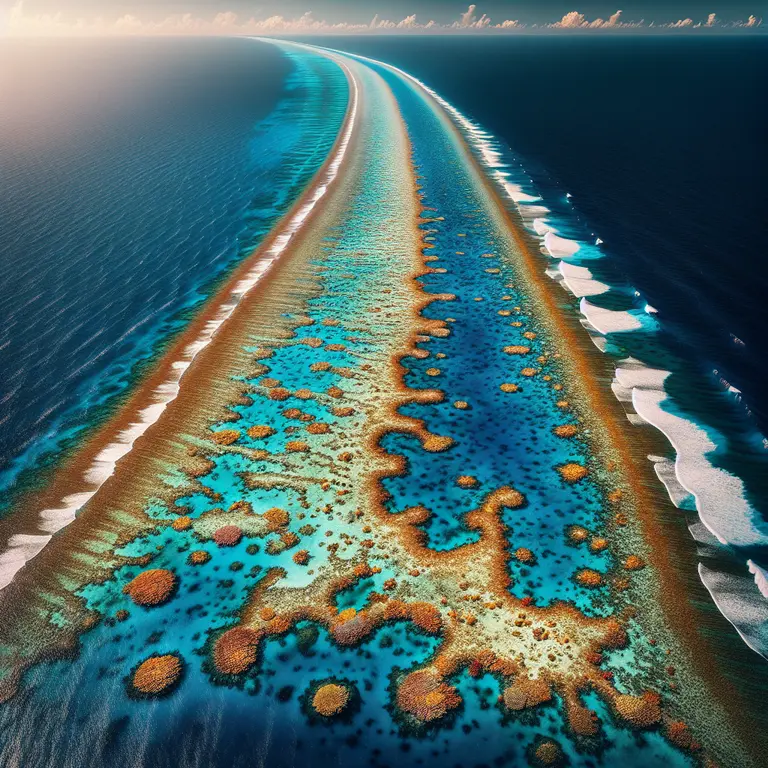
Spanning over 2,300 kilometers, the Great Barrier Reef is not only the largest coral reef system in the world but also the biggest single structure made by living organisms.
 Watch on YouTube
 Watch on Rumble
The Great Barrier Reef is one of Earth’s most astonishing marine phenomena, a sprawling underwater world so vast it can be seen from space. Located off the northeastern coast of Queensland, Australia, it stretches over 2,300 kilometers and covers approximately 344,400 square kilometers. Comprising nearly 3,000 individual reefs and around 900 islands, it forms a unique and irreplaceable habitat that supports an extraordinary variety of marine life. What makes the reef particularly remarkable is not simply its size, but the intricate web of biological relationships it sustains. It is simultaneously a geological record, a cultural landmark, an ecological engine, and a barometer for the health of the world’s oceans.
Historical Background
The formation of the Great Barrier Reef is a story that unfolds across geological time. While coral reefs have existed in this region for as long as 25 million years, the structure we recognize today began taking shape approximately 600,000 years ago through repeated glacial cycles. During ice ages, when sea levels dropped dramatically, the exposed limestone platforms would dry out, and the coral colonies living upon them would die. Then, as the planet warmed during interglacial periods and sea levels rose once again, new generations of coral would colonize the ancient skeletal frameworks left behind. This cycle of death and renewal repeated itself many times over, each layer of new growth building upon the calcium carbonate foundations of its predecessors. The result is a structure of staggering geological complexity, one that functions as a living archive of Earth’s climatic history.
Indigenous Australians have lived alongside this natural wonder for tens of thousands of years, long predating any European awareness of its existence. The Traditional Custodians of the reef, including the Aboriginal and Torres Strait Islander peoples, possess extraordinarily detailed ecological knowledge accumulated over countless generations. Their understanding of seasonal fish migrations, tidal patterns, and the behavioral rhythms of marine animals was not merely practical but deeply spiritual. The reef was not simply a resource to be harvested; it was a living entity woven into the fabric of their identity, law, and cosmology. This relationship, sustained over millennia, represents one of the longest ongoing human interactions with a marine ecosystem anywhere on Earth.
Ecological Significance
The ecological importance of the Great Barrier Reef cannot be overstated. It is one of the most biodiverse marine environments on the planet, functioning as a nursery, feeding ground, migration corridor, and refuge for an almost incomprehensible number of species. The reef hosts over 1,500 species of fish, more than 400 types of hard coral, at least 4,000 species of mollusk, and around 240 species of birds. Dugongs, one of the world’s most endangered marine mammals, graze on the seagrass meadows that fringe the reef system. Humpback whales migrate through their northern passages each year, using the warmer waters as calving grounds before returning to Antarctic feeding zones.
Less commonly appreciated is the role coral reefs play in global ocean chemistry. Coral polyps, the tiny animals responsible for building reef structures, extract calcium and carbonate ions from seawater to construct their hard skeletons. This process helps regulate ocean alkalinity and, by extension, influences the global carbon cycle. The reef also produces compounds that have attracted significant interest from medical researchers. Several anti-cancer and anti-inflammatory agents have been derived from reef organisms, and scientists believe the reef’s largely unexplored species may hold further pharmaceutical potential. In this sense, the Great Barrier Reef is not only an ecological treasure but a biological library whose full contents remain unknown.
Marine Life Diversity
The sheer diversity of life within the reef system defies easy summary. Among the fish, one finds species adapted to almost every conceivable ecological niche. Clownfish shelter among the stinging tentacles of sea anemones in a relationship of mutual benefit, one of the most recognizable examples of symbiosis in the natural world. Groupers and red bass occupy higher positions in the food web, while tiny gobies and blennies inhabit the crevices and overhangs of the coral architecture. Reef sharks, including whitetip and blacktip species, patrol the outer edges of the reef, playing a critical role in maintaining the balance of prey populations below them.
The corals themselves are far more than passive scaffolding. Each coral colony is a living organism, or more precisely, a community of organisms, since coral polyps live in intimate partnership with microscopic algae called zooxanthellae. These algae photosynthesize sunlight and provide the coral with the majority of its energy, while the coral offers the algae shelter and access to nutrients. This partnership is extraordinarily sensitive to temperature. When water temperatures rise even slightly above normal seasonal averages, the coral expels its zooxanthellae, turning white in a process known as bleaching. Without the algae, the coral begins to starve. If temperatures remain elevated for too long, the coral dies entirely, leaving behind ghostly white skeletons that offer little ecological value to the species that once depended on them.
Beyond fish and coral, the reef supports an array of reptiles, including six of the world’s seven species of marine turtle. Green turtles, in particular, return to the sandy cays of the reef to nest, sometimes traveling thousands of kilometers from their feeding grounds. The loggerhead, hawksbill, and flatback turtles also use the reef’s islands and surrounding waters. These ancient animals, whose lineage stretches back over 100 million years, now face threats from entanglement in fishing gear, plastic ingestion, and the feminization of hatchlings caused by rising sand temperatures, a direct consequence of climate change.
Conservation Efforts and Cultural Importance
The threats facing the Great Barrier Reef are numerous and interconnected. Rising ocean temperatures, driven by climate change, have caused four mass bleaching events since 1998, with the most severe occurring in 2016, 2017, 2020, and 2022. Agricultural runoff from Queensland’s coastal farms introduces excess nutrients into reef waters, promoting algae growth that smothers coral. Crown-of-thorns starfish, which feed on coral tissue, periodically undergo population explosions that devastate large sections of reef. Coastal development, shipping traffic, and illegal fishing add further pressure to an already stressed ecosystem.
In response, the Australian government has invested billions of dollars into reef protection programs through the Great Barrier Reef Marine Park Authority. These efforts include water-quality improvement schemes, crown-of-thorns starfish control programs, and research on coral restoration techniques. Scientists are now experimenting with breeding heat-tolerant coral strains in laboratories and transplanting them onto damaged sections of the reef, a form of assisted evolution that may help the ecosystem adapt to warmer conditions. While these interventions are promising, most reef scientists agree that without significant reductions in global greenhouse gas emissions, long-term recovery remains uncertain.
For the Traditional Custodians of the reef, conservation is not a modern concept but an ancient responsibility. Torres Strait Islander and Aboriginal communities have long advocated for greater recognition of their role as stewards of the reef, and in recent years, there has been a growing integration of Traditional Ecological Knowledge into formal management frameworks. This collaboration acknowledges that the most durable form of conservation is one that respects the deep human relationships that have shaped these ecosystems over thousands of years.
Tourism also plays a complex role in the reef’s future. Approximately two million visitors travel to the reef each year, generating an estimated six billion Australian dollars in economic activity. This revenue funds conservation programs and creates strong local incentives to protect the reef. At the same time, poorly managed tourism can cause physical damage to coral and disturb sensitive wildlife. Striking the right balance between access and protection remains an ongoing challenge for reef managers.
Conclusion
The Great Barrier Reef stands as one of the most compelling arguments for protecting the natural world. Its geological history spanning millions of years, its unmatched biodiversity, its cultural depth, and its global ecological significance make it irreplaceable in every meaningful sense. The threats it faces are real and accelerating, but so too is the scientific ingenuity and growing political will being directed toward its survival. The reef’s future will ultimately be determined not only by what happens in the waters off Queensland but by decisions made in boardrooms, parliaments, and individual households around the world. To lose it would be to lose something that took the planet millions of years to build, and that no human effort could ever fully reconstruct.