
Mysterious Fairy Circles: Nature's Enigmatic Phenomenon
Fairy circles are a strange natural phenomenon that consist of small patches of barren land in grassy areas, most commonly seen in the deserts of Southern Africa but also spotted elsewhere
The Enigma of Fairy Circles: Nature’s Most Puzzling Patterns
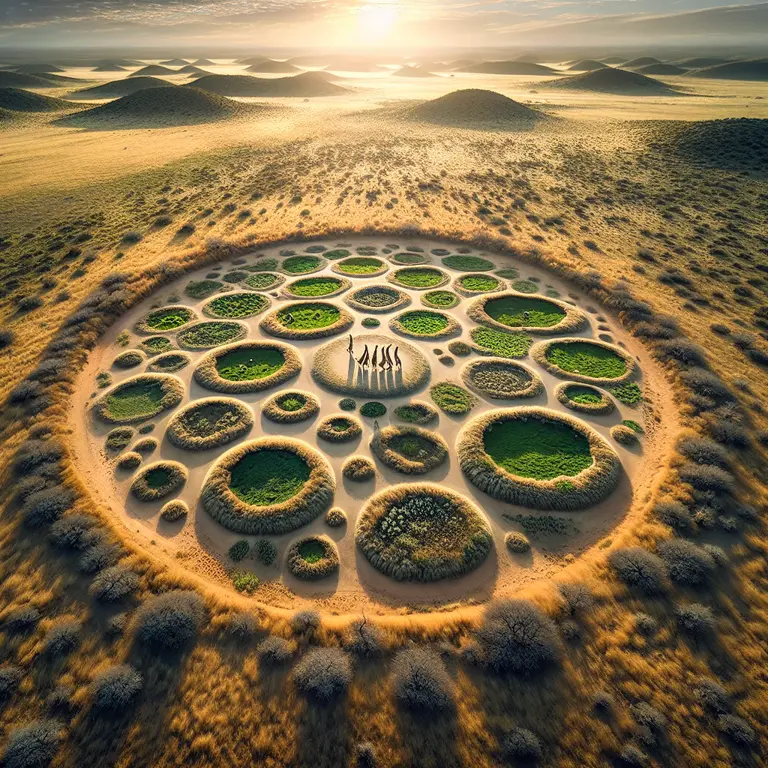
Fairy circles are not mere products of childhood fantasy or a playful wonderland. Instead, they are large-scale, bizarre patterns visible in the grasslands of Namibia and, more recently, their Australian counterparts. These evenly distributed, barren patches, surrounded by tall grasses and dense root systems, form conspicuous circular arrangements that rival the geometric precision of crop circles. Transforming rural landscapes into vast, dotted compositions reminiscent of cellular structures or polka dots, fairy circles have intrigued scientists across multiple disciplines for decades. What makes them so compelling is not simply their visual strangeness, but the deeper questions they raise about how life organizes itself under pressure, how ecosystems respond to scarcity, and how patterns that appear almost deliberate can emerge from purely natural processes. To understand fairy circles is to peer into one of ecology’s most captivating unsolved problems.
The Scientific Mystery Behind the Circles
For years, the origin of fairy circles has been one of the most controversial mysteries in ecological science. Theories surrounding their formation range from fantastical folk explanations, including tales of dragon breath scorching the earth and divine footprints left by gods walking through the wilderness, to more grounded scientific hypotheses involving sand termites, toxic gases seeping from underground, or radioactive soil patches. Each theory has attracted both enthusiastic supporters and determined critics, and no single explanation has achieved scientific consensus.
The termite hypothesis, championed most notably by biologist Norbert Juergens of the University of Hamburg, proposed that sand termites of the species Psammotermes allocerus are the primary architects of fairy circles. According to this view, termites consume the roots of grasses growing in specific patches, creating barren zones that act as moisture reservoirs. The bare soil, free from vegetation, allows rainwater to percolate deep into the ground rather than being absorbed by plant roots, effectively creating underground water stores that sustain the termite colony through dry seasons. Juergens found termites present in nearly every fairy circle he examined, and the correlation appeared compelling. However, correlation alone does not establish causation, and the termite theory left many researchers unsatisfied, particularly because it struggled to account for the extraordinary regularity and spacing of the circles across vast landscapes.
Other scientists pointed to entirely different mechanisms. Some proposed that allelopathy, a biological phenomenon in which plants release chemical compounds that inhibit the growth of neighboring vegetation, might explain the barren interiors. Others suggested that underground hydrocarbon gases, or even the soil's structural properties, could create conditions hostile to plant growth in localized areas. The sheer number of competing explanations reflected not scientific confusion so much as genuine complexity, a reminder that nature rarely submits to simple, single-cause explanations.
Recent Research and the Self-Organization Theory
The most significant shift in scientific understanding came through research led by Stephan Getzin from the Helmholtz Center for Environmental Research in Germany. Published in Science Advances, Getzin’s team directly challenged the notion that termites alone could account for the spatial patterning of fairy circles. While acknowledging a correlation between termite presence and the circles, the researchers argued that termite activity does not fully account for how such a remarkably regular and evenly distributed spatial pattern develops over such large geographic areas.
Instead, Getzin and his colleagues proposed that plant-soil interactions drive the formation of fairy circles through a process of self-organization driven by scale-dependent feedback. This concept, drawn from theoretical ecology and complexity science, describes how local interactions between individual organisms and their environment can spontaneously generate large-scale, ordered patterns without any central coordinating mechanism. In other words, no architect is required. The pattern emerges from the bottom up.
The mechanics of this process are rooted in the harsh realities of arid environments. In regions where rainfall is scarce and unpredictable, grasses compete intensely for water. Seedlings tend to establish themselves more successfully in areas where existing grass communities have developed root networks that capture moisture. This creates a positive feedback loop in which established grass patches grow denser while neighboring areas, stripped of available water by the surrounding vegetation, become increasingly inhospitable. The interior of a forming fairy circle becomes a zone of ecological exclusion, too dry to sustain plant life, while the outer ring of grasses actually benefits from the moisture differential, growing taller and more robust than grasses found further away from the circle’s edge. The result is the characteristic ring formation, a lush border surrounding a barren core, repeated with startling regularity across the landscape.
This self-organization model aligns with mathematical frameworks developed decades earlier by the British mathematician Alan Turing, who demonstrated theoretically that simple reaction-diffusion systems could produce complex, repeating spatial patterns. The fact that ecological systems appear to follow similar mathematical principles is itself a remarkable discovery, suggesting that the same underlying logic governs pattern formation across vastly different domains of nature.
Australian Discoveries and Global Implications
Until 2016, fairy circles were considered largely an African phenomenon, with the Namib Desert serving as their defining habitat. The discovery that year of structurally similar formations in remote Western Australia fundamentally changed the conversation. An ecological survey conducted around Shark Bay and the eastern Pilbara region, published in the journal Nature, documented these formations in native spinifex grasslands, thousands of kilometers from their African counterparts and in a completely different ecosystem with distinct soil types, plant species, and ecological histories.
This discovery was significant for several reasons. First, it demonstrated that fairy circles are not a localized curiosity tied to one specific environment or one particular set of species. Instead, they appear to be a repeatable outcome of ecological dynamics that can arise independently in different parts of the world whenever the right conditions are met. The Australian circles, like their Namibian counterparts, displayed the same regular spacing and characteristic barren interiors, surrounded by denser vegetation at the margins. This convergence strongly supported the self-organization hypothesis, since it would be far more difficult to argue that the same termite species or the same geological quirk was responsible for formations separated by an entire ocean.
Second, the Australian discovery opened new avenues for comparative research. Scientists could now study fairy circles in two distinct ecosystems simultaneously, controlling for variables and testing hypotheses across different biological and geological contexts. Researchers noted that in Australia, native termites were present in some circles but absent in others, further undermining the idea that termite activity is a universal or necessary cause. The Australian findings reinforced the view that fairy circles are fundamentally a product of vegetation dynamics under water stress, with termites potentially playing a secondary or opportunistic role in some locations rather than serving as the primary cause.
The global implications extend beyond academic curiosity. Understanding how ecosystems self-organize under conditions of aridity has direct relevance to questions about desertification, land degradation, and the long-term effects of climate change on grassland ecosystems worldwide. Fairy circles may, in this sense, serve as visible indicators of the thresholds at which vegetation systems transition between stable states, offering scientists a natural laboratory for studying ecological resilience.
Conclusion: What the Circles Teach Us
Despite substantial scientific progress, fairy circles remain genuinely mysterious. The self-organization hypothesis is compelling and mathematically elegant, but it has not fully displaced competing theories, and researchers continue to debate the relative contributions of plant competition, termite activity, soil properties, and other factors. The circles resist the kind of clear, definitive explanation that scientists prefer, and in doing so, they continue to generate productive disagreement and innovative research.
There is something philosophically instructive about fairy circles. They appear to be designed, yet no designer is responsible. They look deliberate, yet they emerge from chaos and competition. They are found in two of the world’s most remote and inhospitable landscapes, and yet they follow mathematical rules that a mid-twentieth-century theorist predicted from first principles. Their surreal beauty leaves numerous questions unanswered and hints that nature conceals other mysteries waiting to be uncovered. The hard-to-believe reality of their existence continues to challenge human curiosity, and perhaps that is precisely their most important function: reminding us that the natural world is far stranger, and far more ordered, than we have yet learned to fully explain.