
The Astonishing Story of the Dancing Baby Jesus Artwork
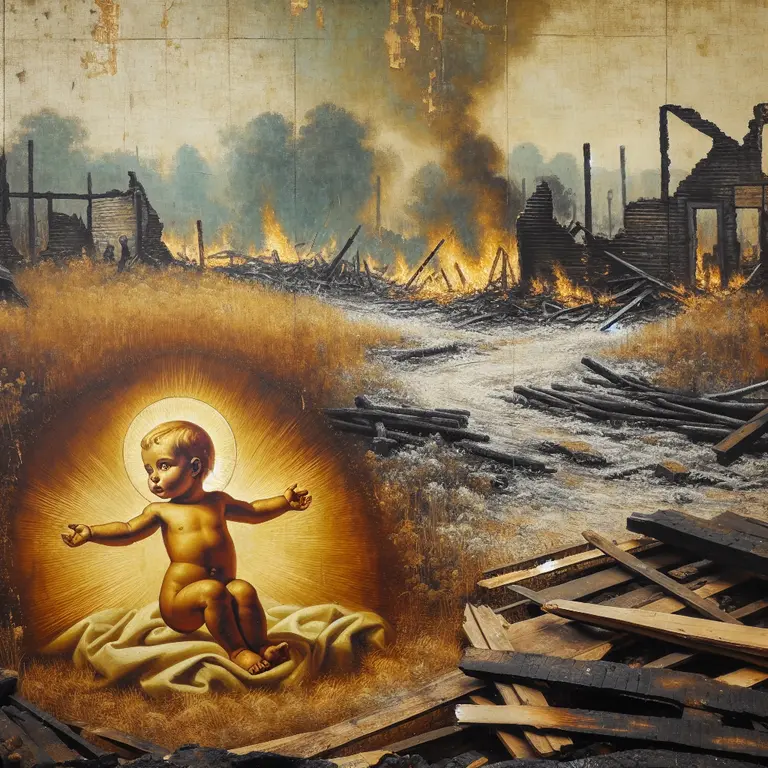
A yellowed painting depicting a baby Jesus figure survived a fire intact and unscathed that happened in 1973 in the small Guatemalan village of Escuintla
Introduction
In 1973, the quiet town of Escuintla, Guatemala, was shaken by a catastrophic explosion that tore through one of its most beloved landmarks. A small, unassuming church at the heart of the community was consumed in a matter of moments, swallowed by fire and reduced to little more than ash and blackened debris. The blast was powerful enough to level the structure entirely, and the firestorm that followed left virtually nothing recognizable in its wake. For the townspeople of Escuintla, it was a moment of profound loss. A place of gathering, of prayer, of shared memory had been erased from the landscape almost instantaneously.
Yet what emerged from that devastation would go on to define the town’s identity for generations. Among the smoldering ruins, rescuers and onlookers discovered a painting that had, by all physical reasoning, no business surviving. A sepia-toned depiction of the infant Jesus sat amid the wreckage, largely untouched by the inferno that had consumed everything around it. The discovery sparked immediate reverence and has since grown into one of Central America’s most enduring religious legends. The story of El Niño de los Milagros, the Miracle Child, is not simply a tale of an object surviving a fire. It is a window into how communities construct meaning from disaster, how faith intersects with the inexplicable, and how a single artifact can become the spiritual anchor of an entire culture.
The Explosion and Its Aftermath
To understand the weight of what was discovered, it is important to appreciate the scale of the destruction that preceded it. The 1973 explosion in Escuintla was not a minor incident. Eyewitness accounts describe a blast of considerable force, followed by a fire that spread rapidly through the church’s wooden interior and structural materials. Churches of that era in rural Guatemala were often built with a combination of adobe, timber, and plaster, materials that, while sturdy under ordinary circumstances, offered little resistance to a sustained inferno. The heat generated in such fires routinely exceeds the temperatures that can warp metal, shatter stone, and reduce organic materials like canvas and wood to nothing.
The church contained various religious objects, decorative items, and furnishings accumulated over many years of community life. Nearly all of it was destroyed. Investigators who later examined the site noted the thoroughness of the damage, describing a scene of near-total devastation. The structural walls had collapsed, the roof had caved inward, and the interior had been gutted by flame. It was in this context, against this backdrop of comprehensive destruction, that the survival of a painted image seemed not merely unlikely, but genuinely extraordinary.
The Miraculous Discovery
When rescuers and community members began sifting through the debris in the hours and days that followed, the discovery of the painting stopped them cold. The image, a sepia-toned rendering of the Christ child rendered in what appeared to be traditional devotional style, showed no signs of burning. The canvas or surface on which it was painted had not curled or blistered. The colors, muted and warm, had not faded or darkened from smoke damage in the way one would expect from an object exposed to such intense heat. Surrounding materials had been reduced to cinders, yet this image remained.
Word spread quickly. In a community already reeling from the loss of its church, the painting’s survival was interpreted not as a coincidence but as a message. Locals began to describe what they had witnessed in increasingly vivid terms. Some claimed the painting had been seen surrounded by flame without being consumed, an image that carried unmistakable resonance with the biblical account of the burning bush. Others spoke of the painting appearing to move, or of a light emanating from it during the fire itself. Whether these accounts reflect literal observation or the natural embellishment that accompanies deeply emotional events, they cemented the painting’s status as something beyond ordinary explanation.
The community named the image El Niño de los Milagros, the Miracle Child, and almost immediately it became an object of veneration. People traveled to see it, to touch it, to pray before it. The ruins of the church became an open-air shrine, and the painting itself was eventually housed with great care and ceremony.
A Testament to Faith and Community Identity
The significance of El Niño de los Milagros cannot be understood purely through the lens of the physical object. What the painting represented, and continues to represent, is something far more complex. For the people of Escuintla, it became proof of divine presence in a moment of communal suffering. The destruction of a church is not merely the loss of a building. It is the loss of a gathering place, a repository of memory, a physical expression of a community’s spiritual life. To have something emerge from that destruction intact was to have hope returned in tangible form.
Religious scholars and anthropologists who study Latin American Catholicism have noted that this kind of event fits within a broader tradition of miraculous images, known in Spanish as imágenes milagrosas, that have shaped devotional practice throughout the region for centuries. From the Virgin of Guadalupe in Mexico to the Black Christ of Esquipulas in Guatemala itself, the Catholic tradition in Latin America has long incorporated sacred images that are believed to possess supernatural qualities or to have been touched by divine intervention. El Niño de los Milagros joined this lineage, becoming part of a living tradition rather than a curiosity.
The painting also served a deeply practical social function. Communities that experience sudden, violent loss require focal points around which to rebuild their sense of collective identity. The painting gave Escuintla exactly that. It transformed a moment of destruction into a narrative of resilience and divine favor, reframing the disaster not as abandonment but as a kind of trial from which something sacred had emerged.
Reverence, Replication, and Regional Spread
As the legend of El Niño de los Milagros grew, it began to travel. Replicas of the image were commissioned and distributed, first throughout Guatemala and then into neighboring countries, with Mexico becoming a particularly receptive home for the image’s veneration. This spread is not unusual in the context of Latin American religious culture, where reproducing miraculous images is considered an act of faith and a means of extending the original's protective power.
In Mexico, devotion to the Christ child, or Santo Niño, already had deep roots, most famously expressed in the veneration of the Santo Niño de Atocha. The arrival of El Niño de los Milagros into this existing devotional landscape gave communities a new image through which to express familiar spiritual longings. Chapels and home altars across several Mexican states now display reproductions of the Escuintla painting, often surrounded by offerings, photographs of loved ones, and handwritten petitions for healing or protection.
This geographic expansion of the image’s influence underscores a key point about how religious meaning travels. It is not the object itself that moves so much as the story attached to it. Each replica carries with it the narrative of the 1973 fire, the inexplicable survival, and the community’s interpretation of that survival as divine. In this way, the painting functions almost like a transmitted memory, connecting distant communities to a specific moment in Guatemalan history.
The Unsolved Mystery
Despite the passage of more than five decades, no scientific investigation has produced a fully satisfying explanation for the painting’s survival. Various theories have been proposed over the years. Some researchers have suggested that the painting may have been shielded by a combination of factors, including its position within the church, the direction of the blast, and the possibility that certain materials used in its creation offered unexpected resistance to heat. Others have pointed to documented cases in which oil-based pigments and certain types of treated canvas have shown surprising durability under specific fire conditions.
However, none of these explanations have been confirmed through rigorous testing of the original artifact, and the painting’s provenance, including the precise materials used and its age at the time of the explosion, remains incompletely documented. This gap in the evidentiary record is itself significant. It means that the mystery remains genuinely open, not simply a matter of faith refusing to engage with science, but a case where science has not yet been given the tools or access necessary to render a verdict.
For believers, of course, the absence of a scientific explanation is not a problem to be solved but a confirmation of what they already know. The painting survived because it was meant to survive. The mystery is the point.
Conclusion
The story of El Niño de los Milagros is ultimately about more than a painting that survived a fire. It is about the human need to find meaning in catastrophe, to locate signs of hope within destruction, and to build community identity around shared moments of the inexplicable. Escuintla lost its church in 1973, but it gained something in return that no explosion could produce on its own: a story powerful enough to outlast the disaster that created it.
That story has now spread across Latin America, carried in the form of replicas, prayers, and pilgrimage. It has become part of the broader tapestry of miraculous images that define Catholic devotional life in the region, sitting alongside centuries-old traditions while remaining distinctly rooted in a specific, modern, and documented historical event. Whether one approaches it as a matter of faith or as a subject of cultural and historical inquiry, El Niño de los Milagros demands attention. It reminds us that in the aftermath of loss, communities reach for whatever survives, and sometimes, what survives is exactly what they needed most.