
Meet the Inventive Mind Behind Modern Wifi Technology
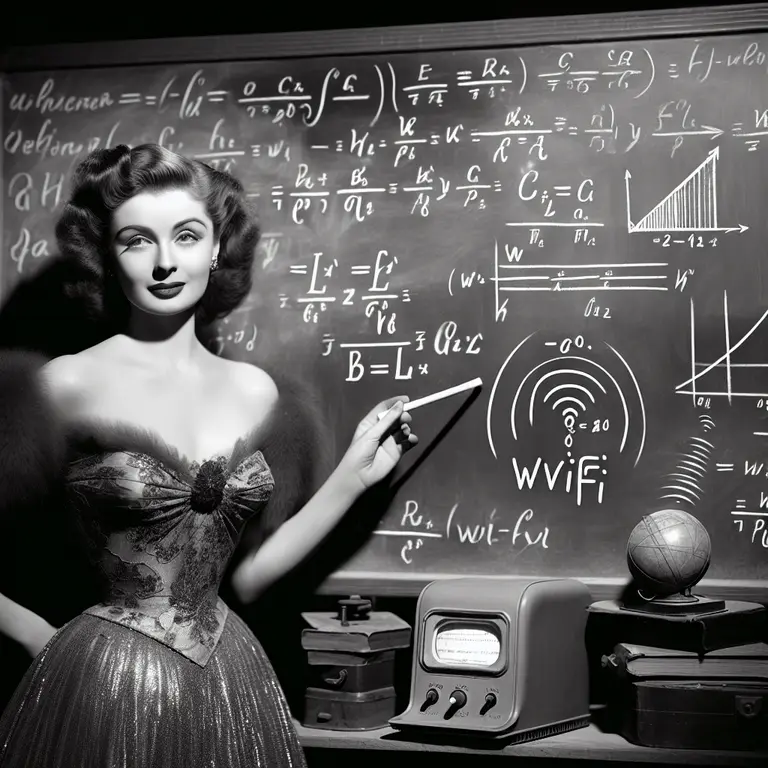
Hedy Lamarr: Hollywood star and inventor who co-developed frequency hopping technology, crucial for modern wireless communications, showcasing beauty and brilliance.
Introduction
Hedy Lamarr is a name synonymous with classic Hollywood. Known for her striking beauty and compelling performances, Lamarr graced the silver screen in films such as “Algiers” (1938) and “Ziegfeld Girl” (1941). Her allure and talent made her one of the most recognizable faces in film history, captivating audiences worldwide and leaving an indelible mark on the entertainment industry. To most people, she was simply a glamorous actress living a charmed life under the studio lights of Golden Age Hollywood. But that image, however accurate on its surface, tells only half the story of a woman whose mind was quietly reshaping the future of human communication.
What is far less commonly known is that the same woman who appeared on magazine covers and red carpets spent her evenings hunched over a drafting table, sketching out ideas that would eventually find their way into the wireless technologies billions of people use every single day. Lamarr’s life represents one of history’s most remarkable cases of a towering intellectual contribution being overlooked, misattributed, or simply buried beneath the glittering surface of celebrity. Understanding her full story requires looking beyond the silver screen and into the laboratory of a restless, brilliant, and deeply underestimated mind.
Beyond the Silver Screen: The Inventive Mind
Born Hedwig Eva Maria Kiesler in Vienna, Austria, in 1914, Lamarr grew up in a cultured, intellectually stimulating household. Her father was a bank director with a deep love of technology, and he encouraged his daughter’s curiosity from an early age, taking her on long walks during which he would explain the mechanics of the world around them, from printing presses to streetcars. That early intellectual nourishment planted seeds that would grow quietly alongside her artistic ambitions for decades.
Lamarr began her acting career in Europe, gaining international notoriety for her appearance in the 1933 Czech film “Ecstase,” before catching the attention of MGM studio head Louis B. Mayer. She immigrated to America just before the outbreak of World War II, reinventing herself under the stage name Hedy Lamarr and quickly ascending to the heights of Hollywood stardom. But even as she memorized scripts and posed for publicity photographs, her mind continued to wander toward more technical problems.
A self-taught inventor, Lamarr kept an inventor’s drafting table in her home and regularly worked on ideas during her off hours. She reportedly told friends that she found acting easy and somewhat unfulfilling intellectually, and that her real excitement came from solving problems. She had an intuitive grasp of engineering principles that she had never formally studied, and she approached mechanical and scientific challenges with the same intensity she brought to her performances. This dual life, glamorous by day and analytically rigorous by night, was not a contradiction to Lamarr but simply a full expression of who she was.
Pioneering Frequency Hopping Technology
During the early years of World War II, the threat of submarine warfare posed a grave and urgent danger to Allied forces. German U-boats were devastating supply lines across the Atlantic, and one promising countermeasure involved radio-guided torpedoes. However, these weapons were vulnerable to jamming. An enemy could detect the radio frequency controlling a torpedo and broadcast interference on that same frequency, rendering the weapon useless or, worse, redirecting it entirely. The problem was as dangerous as it was technically complex.
Lamarr, who had been married before her emigration to Friedrich Mandl, a prominent Austrian arms manufacturer with close ties to the Nazi regime, had absorbed a surprising amount of weapons technology knowledge simply by attending her husband’s business meetings. She had listened carefully to discussions among engineers and military officials, filing away information that she would later draw upon in a very different context. That firsthand exposure to the mechanics of warfare gave her a practical foundation that most inventors of the era lacked.
In collaboration with avant-garde composer George Antheil, who had experimented with synchronizing multiple player pianos in his compositions, Lamarr developed a revolutionary communication system she called frequency-hopping. The concept was elegantly simple in principle but technically sophisticated in execution. Rather than transmitting a signal on a single, easily detectable frequency, the system would cause the signal to jump rapidly and unpredictably between 88 different frequencies, mirroring the number of keys on a piano. The transmitter and receiver would be synchronized to hop in the same pattern simultaneously, making the signal nearly impossible for an enemy to detect or jam, because by the time interference was introduced on one frequency, the signal had already moved on to another.
Lamarr and Antheil filed for and received a patent for this frequency hopping system in 1942, assigning it to the United States government free of charge as their contribution to the war effort. The Navy, however, declined to adopt the technology at the time, reportedly in part because the synchronization mechanism was deemed too bulky for practical use aboard a torpedo. The patent expired in 1959, with Lamarr never receiving a cent in royalties or meaningful public recognition for the invention.
Decades later, engineers working on secure military communications rediscovered the concept and recognized its extraordinary potential. By the 1980s, frequency hopping had become a foundational principle in what is now called spread-spectrum communication, a technology that underpins Bluetooth connectivity, Wi-Fi networks, GPS systems, and modern cellular communications. Every time a smartphone connects to a wireless network, it is operating on principles that Hedy Lamarr helped establish in a Hollywood home studio during the darkest years of the Second World War.
Recognition and Legacy
The recognition that Lamarr deserved came slowly and, in some respects, too late. She lived until the year 2000, and while she received some belated acknowledgment in her later years, the full weight of her contribution to modern technology was not widely appreciated until after her death. In 1997, the Electronic Frontier Foundation awarded her and Antheil the Pioneer Award, and she was inducted into the National Inventors Hall of Fame in 2014. That same year, Google honored her with an animated Google Doodle on what would have been her 101st birthday, depicting her transformation from a glamorous movie star into an inventive engineer, a visual metaphor for the dual identity she had carried quietly throughout her life.
In the United States, National Inventors Day has been celebrated annually on November 9th since 2005, a date chosen in part to honor Lamarr’s contributions to the field. Her story has also inspired documentaries, most notably the 2017 film “Bombshell: The Hedy Lamarr Story,” which brought renewed public attention to the gap between her historical reputation and her actual legacy. It is a gap that reflects broader patterns in how society has historically evaluated the intellectual contributions of women, particularly those whose public identities were defined by their appearance rather than their accomplishments.
A Story of Beauty and Intelligence
Hedy Lamarr’s story is a powerful testament to the dynamic interplay between beauty and intelligence, and to the dangers of allowing one to obscure the other. For most of her life, the world saw only the surface, the luminous face, the elegant bearing, the carefully crafted Hollywood persona. The inventor working quietly behind that image was largely invisible to the public, and even to the institutions that might have benefited most from her ideas.
Her journey exemplifies that beauty and intellectual brilliance are not mutually exclusive qualities but can coexist and flourish within the same person. The tendency to assume otherwise is not merely a cultural bias but an actively harmful one, because it causes society to miss the contributions of people who do not fit its preconceived notions of what a scientist, engineer, or inventor is supposed to look like. Lamarr’s tale is an inspiring reminder of the profound contributions women have made and continue to make in historically male-dominated fields, often without recognition, often without compensation, and often in the margins of lives the world insists on defining in other terms entirely.
Her legacy now belongs to both worlds she inhabited. She is remembered as a Hollywood icon and a technological pioneer, and the full truth of who she was requires holding both identities at once, without diminishing either. In an age defined by the wireless technologies she helped imagine, that recognition is not merely sentimental. It is overdue.