
The Mathematician Who Taught Machines to See Color
Long before digital cameras or computer vision, Yann LeCun's foundational work on convolutional neural networks drew directly from a forgotten 1959 neuroscience experiment — one that revealed how the mammalian brain actually processes visual information, layer by layer.
Introduction
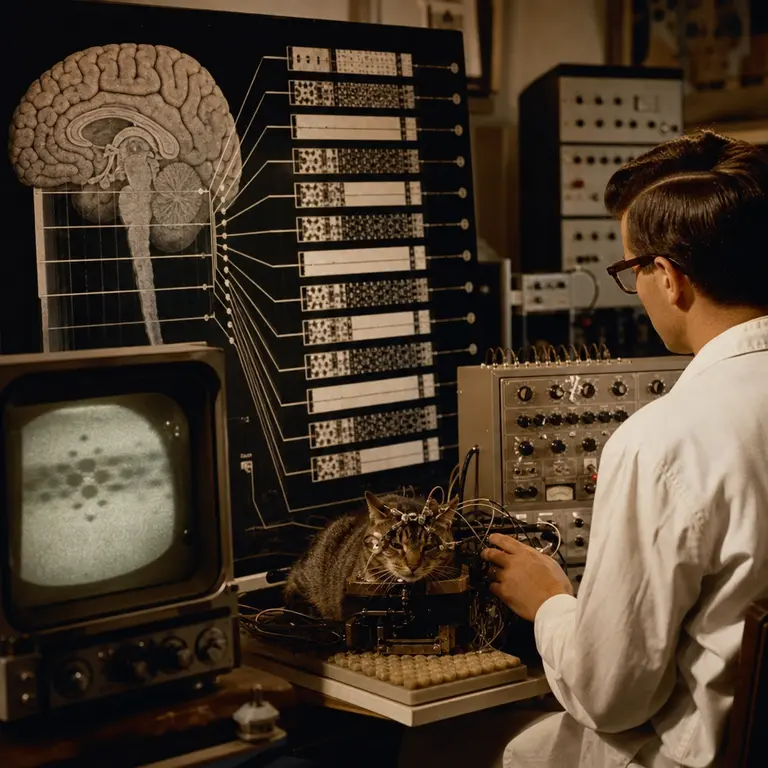
In 1959, two neurophysiologists at Johns Hopkins University — David Hubel and Torsten Wiesel — slid a glass slide by accident across a projector while a cat’s visual cortex was being monitored by electrodes. They noticed that a specific neuron fired not at a dot of light, but at the edge of the slide as it moved. That accidental observation revealed that the mammalian visual cortex is organized in hierarchical layers of cells, each responding to increasingly complex features: edges, then curves, then shapes, then whole objects. Hubel and Wiesel won the Nobel Prize in Physiology or Medicine in 1981 for this discovery. What fewer people know is that this same experiment, conducted on cats in a darkened Baltimore laboratory, became the direct biological blueprint for one of the most consequential inventions in the history of artificial intelligence.
The path from that laboratory accident to the technology powering facial recognition, medical diagnostics, and self-driving vehicles is neither straight nor simple. It winds through decades of obscurity, a community of researchers largely dismissed, and a pivotal 2012 competition that rewrote the assumptions of an entire field. It is also a story that is far from finished. The very neuroscience that launched the revolution is now pointing toward the next one.
From Neurons to Networks: The Architecture Nobody Wanted
In the late 1980s, a French mathematician and computer scientist named Yann LeCun, then working at Bell Labs in Murray Hill, New Jersey, was trying to solve a very practical problem: how to get a machine to reliably read handwritten ZIP codes on envelopes for the United States Postal Service. The dominant approach at the time used fully connected neural networks that treated every pixel in an image as an independent input, making them computationally explosive and brittle. A modest photograph, even by the standards of the era, could contain tens of thousands of pixels, and connecting each of those to every neuron in a subsequent layer produced a combinatorial explosion that overwhelmed the hardware of the day. The resulting systems were slow, expensive, and prone to catastrophic failure when presented with images that differed even slightly from their training data.
LeCun took a different path, one explicitly modeled on Hubel and Wiesel’s cortical hierarchy. He designed a network in which small filters — analogous to the edge-detecting neurons in a cat’s visual cortex — would scan across an image in overlapping patches, passing increasingly abstract representations upward through stacked layers. A filter in the first layer might detect a horizontal edge. A filter in the second layer might combine several such edges into a curve. A filter deeper still might recognize that a particular arrangement of curves constitutes a numeral. He called this architecture a convolutional neural network, or CNN, after the mathematical operation of convolution, which describes how filters sweep across the input.
In 1989, LeCun published the first working implementation, and by 1998, his team at Bell Labs had produced LeNet-5, a CNN capable of reading handwritten digits with an error rate below 1%. The system was deployed commercially and, at its peak, was processing roughly ten to twenty percent of all checks cashed in the United States. The practical success was remarkable. Yet the broader machine learning community largely ignored the architecture for over a decade. The computational power required to scale it was simply unavailable, and the dominant fashion in the field had shifted toward support vector machines, which had cleaner mathematical guarantees and required far less processing power to train. LeCun’s work sat in a kind of productive obscurity, sustained by a small group of believers who were frequently told they were wasting their time.
This period of neglect is worth dwelling on, because it illustrates something important about how scientific progress actually works. The ideas behind CNNs were not wrong. They were simply ahead of the infrastructure required to demonstrate their potential. LeCun, along with colleagues Geoffrey Hinton at the University of Toronto and Yoshua Bengio at the University of Montreal, continued developing the theoretical foundations of deep learning through the 1990s and 2000s, often working against the grain of mainstream opinion in their field. Hinton in particular was told by peers and funding bodies that neural networks were a dead end. The three of them persisted, and the vindication, when it finally arrived, was dramatic.
The ImageNet Moment and a Vindication Decades in the Making
The turning point came in 2012, when researchers Alex Krizhevsky, Ilya Sutskever, and Geoffrey Hinton at the University of Toronto entered a CNN called AlexNet into the ImageNet Large-Scale Visual Recognition Challenge, a benchmark competition involving over 1.2 million labeled photographs spanning 1,000 distinct categories. The task was to correctly identify the primary subject of each image from among that enormous range of possibilities. AlexNet achieved a top-five error rate of 15.3 percent, compared to 26.2 percent for the second-place entry. The gap was so large it was initially suspected to be a scoring error. It was not.
AlexNet was a direct descendant of LeCun’s architecture, scaled up using graphics processing units (GPUs), originally designed for rendering video game environments. This detail is itself a minor miracle of technological serendipity. GPUs are built to perform millions of simple mathematical operations simultaneously, because rendering a three-dimensional game world in real time requires exactly that kind of parallel computation. It turned out that training a convolutional neural network also requires exactly that kind of parallel computation, specifically, the multiplication of large matrices. The gaming industry had, entirely inadvertently, spent decades and billions of dollars developing the hardware that deep learning needed to become viable.
The response to AlexNet’s performance was swift and sweeping. Within two years, every major technology company had reorganized significant portions of their research around convolutional neural networks. Google, Facebook, Microsoft, Baidu, and Apple all launched or dramatically expanded dedicated deep learning research groups. The same architecture that read ZIP codes in 1989 now underlies facial recognition systems used by law enforcement agencies and consumer devices alike. It powers the perception systems in autonomous vehicles that must identify pedestrians, traffic signs, and lane markings in real time. It drives medical imaging diagnostics capable of detecting diabetic retinopathy in retinal photographs with accuracy comparable to that of trained ophthalmologists, and identifying early-stage cancers in radiological scans. It also runs the content moderation systems that scan billions of social media images every day, making decisions about what billions of people are permitted to see.
In 2018, LeCun, Hinton, and Bengio were jointly awarded the Turing Award — computing’s highest honor, often described as the Nobel Prize of computer science — for their foundational contributions to deep learning. The citation acknowledged work that had been dismissed, underfunded, and marginalized for the better part of three decades before reshaping nearly every corner of the technology industry.
The Color Problem and What Machines Still Cannot Do
Despite the extraordinary success of CNNs, LeCun has been publicly and persistently outspoken about what they fundamentally cannot do — and this is where the story becomes genuinely counterintuitive. CNNs learn statistical correlations between pixel patterns and labels. They do not build internal models of the world in the way biological visual systems do. A CNN trained to identify school buses by their yellow color and rectangular shape can be fooled by a photograph of a yellow school bus printed on paper and held in front of a camera. It cannot reason that a flat image of a bus is not a bus. More troublingly, CNNs can be deceived by adversarial examples — images that have been modified by adding carefully calculated, invisible-to-the-human-eye noise that causes the network to misidentify a cat as guacamole or a stop sign as a speed limit sign. These vulnerabilities are not engineering oversights. They are symptoms of a deeper conceptual limitation.
LeCun refers to this gap as the missing piece of the puzzle and has spent the last several years at Meta AI Research developing what he calls a world model architecture — a system that, like a child learning to walk, builds predictive internal representations of how the physical world behaves, not just what it looks like. The distinction matters enormously. A child who has never seen a glass of water fall off a table will still flinch when one teeters near an edge, because they have internalized a model of gravity, fragility, and consequence. No existing CNN has anything resembling this capacity. It processes images. It does not understand the world those images depict.
This ambition connects back, once again, to the neuroscience that started everything. Hubel and Wiesel’s original work described only the early visual cortex, the region that processes raw sensory input. Later research revealed that the primate brain has at least two distinct visual pathways extending beyond that early processing stage. The ventral stream, running along the bottom of the brain, handles object recognition — identifying what something is. The dorsal stream, running along the top, handles spatial relationships, motion, and the kind of physical intuition that tells you a coffee cup will fall if you push it off a table. Current CNNs approximate the ventral stream reasonably well. The dorsal stream remains largely unmodeled by existing AI systems, and the consequences of this gap are significant for any application that requires a machine to interact with the physical world rather than simply classify images of it.
Conclusion
The story of the convolutional neural network is, at its core, a story about the unexpected fertility of a single accidental observation. A glass slide slipped across a projector in a darkened laboratory, a cat’s neuron fired, and two scientists paused to ask why. That pause set in motion a chain of inquiry that, sixty-five years later, has produced technology embedded in nearly every dimension of modern life. It is also a story about the long and nonlinear nature of scientific progress, about ideas that are correct before they are useful, and about the importance of the small group of researchers willing to defend those ideas against the prevailing consensus.
What makes the story still more interesting is that it has not ended. The neuroscience that inspired the first revolution is now pointing to the limitations of what that revolution produced and to the architecture of the next one. The cat in the Baltimore laboratory, it turns out, still has more to teach us. The visual system that evolution spent hundreds of millions of years refining remains, in crucial respects, more sophisticated than anything we have yet managed to build in silicon. Understanding why is the central challenge of the next era of artificial intelligence research — and the answer, in all likelihood, will begin once again with biology.
Sources & Further Reading
- Hubel, D.H. and Wiesel, T.N. Receptive fields of single neurones in the cat's striate cortex. Journal of Physiology, 1959. https://doi.org/10.1113/jphysiol.1959.sp006308
- LeCun, Y., Bottou, L., Bengio, Y., and Haffner, P. Gradient-based learning applied to document recognition. Proceedings of the IEEE, 1998. https://doi.org/10.1109/5.726791
- Krizhevsky, A., Sutskever, I., and Hinton, G.E. ImageNet Classification with Deep Convolutional Neural Networks. Advances in Neural Information Processing Systems, 2012. https://papers.nips.cc/paper/2012/hash/c399862d3b9d6b76c8436e924a68c45b-Abstract.html
- Association for Computing Machinery. ACM Turing Award 2018 — Bengio, Hinton, LeCun. ACM, 2019. https://amturing.acm.org/