
Dangerous Waters: The Strid at Historic Bolton Abbey
A seemingly harmless stretch of water in Yorkshire, England is one of the deadliest bodies of water on earth.
Introduction
Tucked within the pastoral landscape of the Yorkshire Dales, surrounded by ancient woodland and the ruins of a twelfth-century priory, lies a stretch of water so unassuming that visitors routinely mistake it for a quaint garden stream. The Strid, a narrow channel carved from the River Wharfe near Bolton Abbey, measures only a few feet across at its widest points. On a calm day, it shimmers with the kind of quiet beauty that invites a person to linger, to crouch at its mossy edge, or perhaps to attempt a casual leap to the other side. That impulse, however innocent, has proven fatal with a consistency that no other body of water in Britain can match. The Strid holds a grim and largely unverified but widely repeated claim: that no one who has ever fallen into it has survived. Whether that statistic is precisely accurate or not, the historical record of deaths associated with this narrow corridor of water is sobering enough to warrant serious attention. It is, without question, one of the most dangerous stretches of water in the world, and its danger is almost entirely invisible to the casual observer.
Origin and Geography
The Strid is not a separate river or independent body of water. It is simply a section of the River Wharfe, one of the principal rivers of North Yorkshire, that has been forced through an extraordinarily narrow gap in the surrounding millstone grit rock. The name itself derives from an old Norse or Old English word meaning “turmoil” or “strife,” a linguistic clue that the people who named this place understood something about its character long before modern hydrology could explain it.
For most of its length, the River Wharfe flows at a relatively modest width, spreading across its bed in the way most rivers do. But as it approaches the section near Bolton Abbey, the geography conspires to compress the entire volume of the river into a channel that can appear, from a standing position on its bank, to be no wider than a garden path. In reality, the river has not narrowed in the way a stream might narrow as it loses volume. The full force and flow of the Wharfe is still present. It has simply been redirected downward, plunging into a channel that is far deeper than it is wide. The visible surface of the water, which moves with what can appear to be gentle, almost lazy momentum, represents only the topmost layer of a much larger and far more violent system operating beneath the surface.
Geological Features
The geology beneath the Strid is what transforms it from a merely fast-moving river into something genuinely labyrinthine and lethal. Over thousands of years, the relentless pressure of the Wharfe’s flow has eroded the underlying rock into a complex network of caverns, tunnels, and submerged passages. The bedrock in this area, though commonly described as limestone in popular accounts, is more accurately characterized as millstone grit, a coarse-grained sedimentary rock that, while harder than pure limestone, remains susceptible to hydraulic erosion over geological timescales. The result is a subterranean architecture of considerable complexity, with passages running horizontally beneath the riverbed, chambers opening unexpectedly beneath the surface, and overhanging rock ledges that can trap debris and bodies beneath the waterline.
This geological reality explains one of the Strid’s most disturbing characteristics: the fact that people who fall in are frequently never recovered. A river that simply flows fast and deep will eventually carry a body downstream to a point where it can be retrieved. The Strid’s submerged cave system creates the possibility of permanent entrapment, with currents powerful enough to pin an object against a submerged ledge or force it into a passage from which it cannot escape without the kind of intervention that is impossible to perform underwater in active current. Hydrologists and geologists who have studied the site note that the narrowing of the channel dramatically increases the velocity of the water, a principle described by the continuity equation in fluid dynamics, which holds that when the cross-sectional area of a flow decreases, the velocity must increase proportionally to conserve the volume of water moving through the system. The Strid is, in engineering terms, an extreme example of this phenomenon applied to a natural watercourse.
Dangers Beneath the Surface
What makes the Strid uniquely treacherous, beyond its geological complexity, is the profound mismatch between its appearance and its actual behavior. Most dangerous bodies of water announce themselves. Ocean rip currents produce visible disturbance. Whitewater rapids are loud and visually chaotic. Flooded rivers run brown and turbulent. The Strid does none of these things consistently. On many days, its surface appears almost glassy, moving with a quiet confidence that reads to the untrained eye as calm. The banks are low in places, the moss-covered rocks smooth and inviting. The opposite bank, just a meter or two away, seems entirely reachable.
Beneath that surface, however, the water is moving at a velocity and in a pattern that a human body cannot resist. The downward component of the flow is particularly significant. Unlike a river that moves primarily horizontally, the Strid’s compressed channel forces water downward as well as forward, creating a hydraulic action that pulls submerged objects toward the cave system below rather than carrying them along the surface and downstream. A person who enters the water, even feet-first and fully conscious, may be pulled immediately below the surface before they can orient themselves. The low temperature of the Wharfe compounds this danger significantly. Cold water shock, a physiological response to sudden immersion in water below fifteen degrees Celsius, can cause involuntary gasping, hyperventilation, and cardiac disruption within seconds, all of which dramatically reduce a person’s ability to swim or self-rescue even if they possess the physical ability to do so under normal conditions.
Historical Accounts
The historical record of the Strid’s victims stretches back at least to the medieval period. The most famous account involves William de Romilly, the young son of a twelfth-century noblewoman named Alice de Romilly, who is said to have attempted to leap the Strid while out hunting and fell to his death in the water below. His grieving mother, the story goes, donated land to the Augustinian monks who subsequently built Bolton Priory, whose ruins still stand nearby, as a memorial to her son. Historians debate the precise details of this account, and some regard it as partially legendary, but it speaks to the deep roots of the Strid’s reputation in the local consciousness.
Local folklore from subsequent centuries is filled with accounts of travelers, children, and adventurers who underestimated the crossing and paid with their lives. The pattern in these stories is remarkably consistent: a moment of confidence, a misjudgment of distance or footing, and then nothing. In many of the older accounts, the bodies are simply never found. This detail, repeated across centuries and across sources that had no connection to one another, aligns precisely with what modern understanding of the Strid’s geology would predict.
Modern-Day Warnings and Continuing Risk
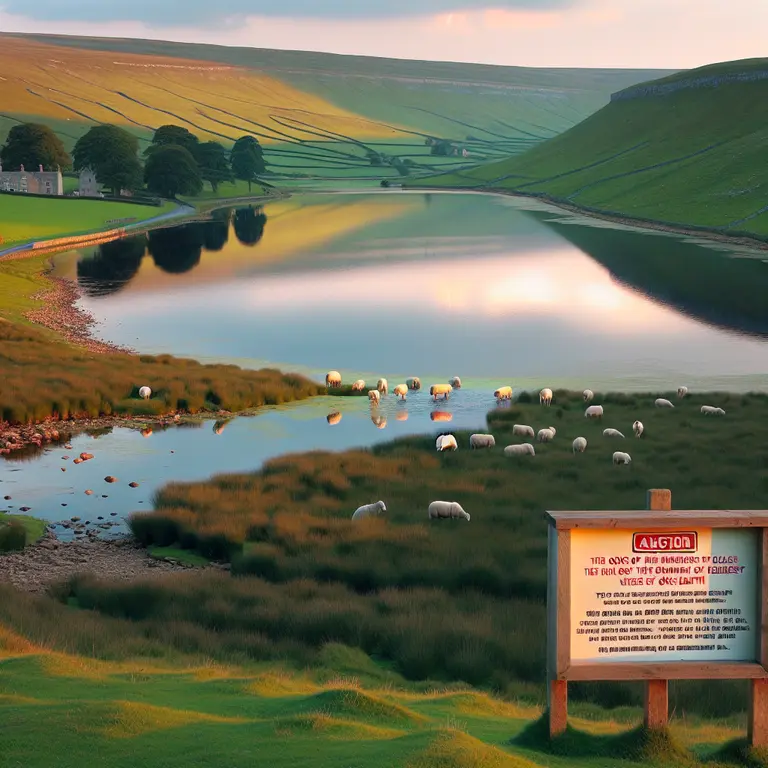
The Bolton Abbey estate, which manages the land surrounding the Strid, has installed warning signs at multiple points along the banks. The signage is clear and direct, informing visitors that the water is extremely dangerous and that entry is prohibited. The path along the Strid is a popular walking route, drawing thousands of visitors annually, and the estate takes the duty of warning seriously. Despite this, incidents continue to occur with troubling regularity. The combination of the Strid’s beauty, its apparent accessibility, and the very human tendency to underestimate risks that are not visually obvious creates a persistent pattern of dangerous behavior at the site.
Conclusion
The Strid at Bolton Abbey is a place that rewards careful attention and punishes casual confidence. Its beauty is entirely genuine, set within one of Yorkshire’s most scenic river valleys, framed by ancient trees and historic stone. But that beauty exists in direct, unresolved tension with a physical reality that has claimed lives for many centuries. The Strid asks nothing more of its visitors than respect and restraint, two qualities that are, in the end, the only reliable protection against the violence concealed beneath its quiet surface. In a world that often treats natural spaces as backdrops for recreation and adventure, the Strid stands as a pointed reminder that some landscapes are not indifferent to human presence. They are actively, structurally, and geologically dangerous, and no amount of confidence or athleticism changes that fundamental fact.