
Fiji's Guardians: Sustaining Coral Reefs Through Gardening
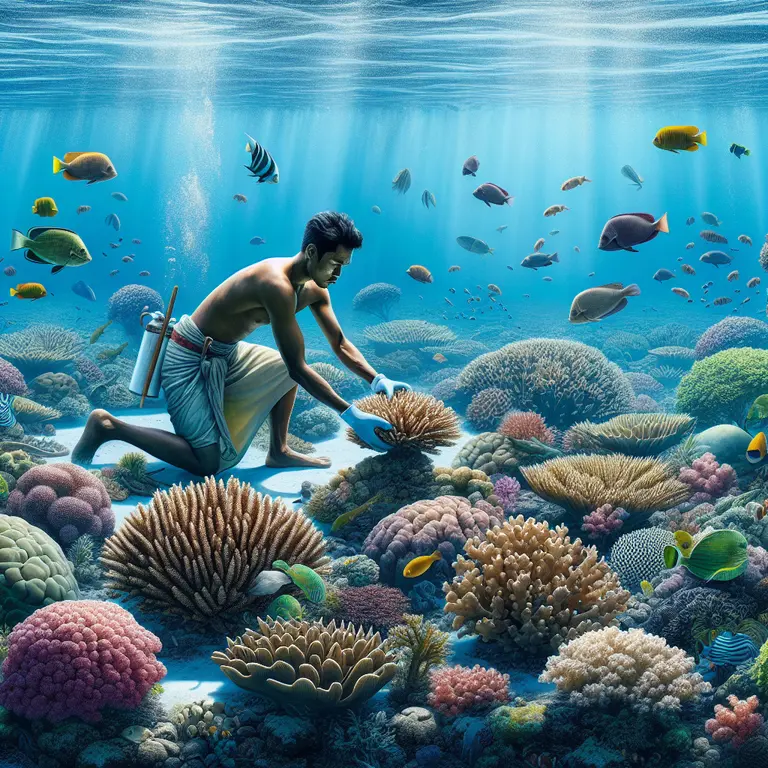
Fijian communities are restoring coral reefs through a simple yet effective method, often referred to as 'coral gardening'.
 Watch on YouTube
 Watch on Rumble
Coral Gardening: How Fiji’s Communities Are Rebuilding the Ocean’s Rainforests
Coral reefs are among the most biodiverse ecosystems on Earth, often compared to tropical rainforests for the sheer density and variety of life they support. Covering less than one percent of the ocean floor, they are home to an estimated twenty-five percent of all marine species. Yet despite their ecological significance, coral reefs globally are in serious decline. Climate change, ocean acidification, excessive nutrient runoff from agriculture, overfishing, and direct physical damage from coastal development have all contributed to the degradation of these vital ecosystems. Scientists estimate that roughly 50% of the world’s coral reefs have been lost since the 1950s, and projections suggest that without meaningful intervention, the majority of the remaining reefs could be severely compromised by mid-century. The consequences extend far beyond the ocean itself. Reefs buffer coastlines from storm surges, support fishing industries that feed hundreds of millions of people, and underpin tourism economies worth billions of dollars annually. Finding scalable, community-driven solutions to reef degradation has therefore become one of the more urgent challenges in marine conservation. One approach that has attracted growing attention for its simplicity and effectiveness is coral gardening, pioneered in Fiji and now practiced in reef ecosystems worldwide.
The Origins of Coral Gardening in Fiji
The technique of coral gardening was developed around the year 2000 by Austin Bowden-Kerby, an American marine biologist working in Fiji under the auspices of the conservation organization Counterpart International. Bowden-Kerby recognized that traditional reef restoration methods, which often relied on expensive technology and centralized scientific infrastructure, were simply not viable in remote Pacific island communities with limited resources. His insight was to develop a method that could be taught to local fishers and community members, one that required minimal equipment and could be sustained by the communities themselves rather than depending on ongoing external funding or expertise.
Fiji proved to be an ideal testing ground for this approach. The country’s coastal communities have deep cultural and economic ties to the reef, and many villages have already established traditional marine protected areas known as tabu zones, where fishing is restricted to allow ecosystems to recover. Bowden-Kerby’s coral gardening method aligned naturally with these existing conservation traditions, giving communities a proactive role not just in protecting reefs but in actively rebuilding them. What began as a small experimental project in a handful of Fijian villages gradually expanded into a broader movement, drawing in NGOs, government agencies, and academic researchers who helped refine and document the technique.
How the Process Works
Coral gardening follows a carefully structured sequence of steps, each of which plays a critical role in the success of the restoration effort. The process begins with identifying suitable donor corals on existing reef sections that remain relatively healthy. Scientists and trained community members look specifically for corals that show signs of resilience, meaning those that have survived bleaching events or disease outbreaks without significant tissue loss. This selective approach is important because it increases the likelihood that the fragments being cultivated carry genetic traits that may confer some degree of tolerance to environmental stressors, including elevated water temperatures associated with climate change.
Once suitable donor corals are identified, small fragments are carefully broken or cut from the parent colony. This step must be done with precision to avoid unnecessary damage to the donor coral, which typically recovers quickly from minor fragmentation. The collected fragments, sometimes called nubs or propagules, are then transported to underwater nurseries located in sheltered, well-oxygenated areas of the lagoon. In these nurseries, the fragments are attached to structures such as suspended ropes, wire mesh frames, or cement plugs. The choice of nursery structure can vary depending on the coral species being cultivated and the local conditions, but the underlying principle is the same: to provide a stable, protected environment where the fragments can grow without the physical disturbance or grazing pressure they might face on a degraded reef.
Over several months to a year, the coral fragments grow substantially in size. During this nursery phase, community members make regular visits to monitor the corals, remove algae or sediment that might smother the growing fragments, and check for signs of disease. This ongoing care is one of the features that distinguishes coral gardening from more passive conservation strategies. When the corals reach a sufficient size, typically a few centimeters across depending on the species, they are ready for outplanting. Community divers prepare the target reef sites by clearing away algae and debris, then use underwater epoxy or other adhesives to secure the young corals to the substrate. With proper placement and continued monitoring, these transplanted corals begin to integrate into the reef structure and contribute to its recovery.
Challenges Facing the Method
Coral gardening is not without its difficulties, and practitioners in Fiji and elsewhere have had to contend with a range of obstacles that can undermine the success of individual projects. Storm damage represents one of the most significant physical threats to nursery structures, particularly in the Pacific, where tropical cyclones can be severe and unpredictable. A single major storm can destroy months of careful cultivation work, wiping out nursery frames and scattering the coral fragments that have been painstakingly grown. Disease outbreaks in nurseries are another concern. Because coral fragments are often grown in relatively close proximity to one another, pathogens can spread rapidly through a nursery population if conditions are not carefully managed.
There are also scientific questions about the long-term effectiveness of outplanted corals. Critics have pointed out that transplanted corals may not always survive at the rates needed to meaningfully accelerate reef recovery at scale, particularly in locations where underlying stressors, such as poor water quality or continued overfishing, have not been addressed. Some researchers have emphasized that coral gardening works best as one component of a broader conservation strategy rather than as a standalone solution. Ensuring that nursery-grown corals represent sufficient genetic diversity is also an important consideration, as planting large numbers of genetically identical individuals could leave restored reef sections vulnerable to disease or future bleaching events.
Despite these challenges, evidence from Fiji and other locations where coral gardening has been practiced suggests that, when implemented thoughtfully and embedded within a broader community conservation framework, the technique can yield meaningful results. Monitoring studies have documented increased coral cover at outplanting sites, and, in some cases, restored areas have begun to attract fish species that were previously absent.
Global Adoption and Future Potential
From its origins in Fiji, coral gardening has spread to reef restoration programs across Southeast Asia, the Caribbean, Latin America, and East Africa. Organizations in countries including Indonesia, the Philippines, Kenya, and Mexico have adapted the technique to suit local species, conditions, and cultural contexts. This geographic spread is a testament to the method's adaptability and to the urgency felt by coastal communities around the world who are watching their reefs deteriorate.
Researchers are now exploring ways to enhance coral gardening by incorporating advances in coral science. One promising direction involves the selective cultivation of coral genotypes that have demonstrated measurable tolerance to higher water temperatures, a practice sometimes called assisted evolution. By combining the community-based logistics of coral gardening with more targeted genetic selection, scientists hope to produce restored reefs that are better equipped to withstand continued ocean warming. Other innovations include the use of three-dimensional-printed reef structures to provide more complex habitat for outplanted corals and the development of coral spawning techniques that enable restoration practitioners to work with a wider range of species.
Coral gardening represents something genuinely rare in the field of environmental conservation: a restoration technique that is simultaneously scientifically grounded, economically accessible, and capable of generating meaningful community ownership over natural resource management. In Fiji, where the health of the reef is inseparable from the cultural and economic life of coastal villages, the method has helped to forge a new relationship between people and the ocean, one in which communities are not merely observers of reef decline but active participants in its reversal. As climate pressures on reef ecosystems continue to intensify, that kind of local investment and agency may prove to be as important as any technological solution science can offer.