
Aral Sea's Eastern Revival: A Story of Unexpected Resilience
How unexpected ecological restoration is occurring in Kazakhstan's portion of the once-dying Aral Sea, challenging predictions about one of Earth's worst environmental disasters.
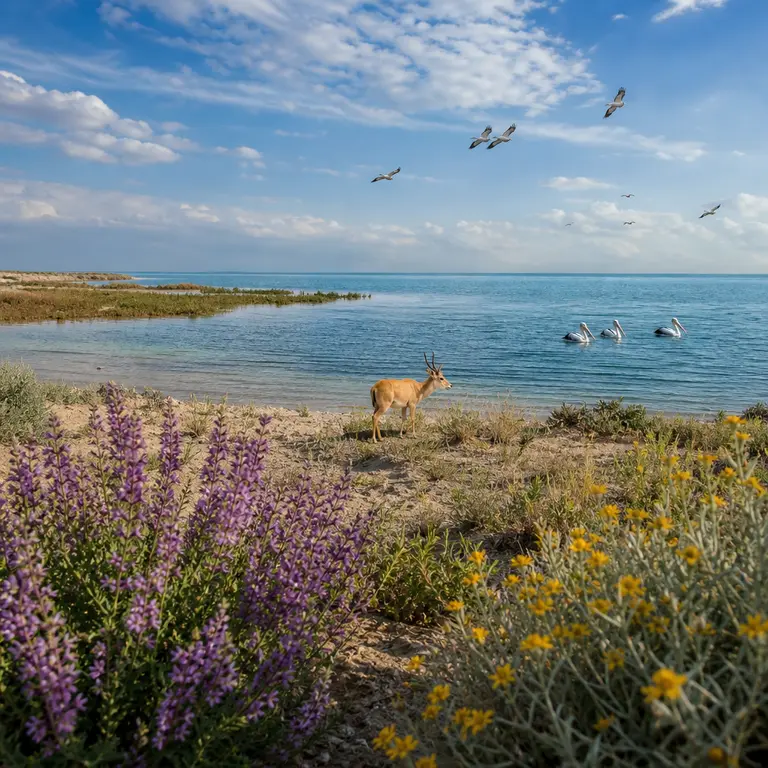
In the remote borderlands between Kazakhstan and Uzbekistan, one of the world’s most profound ecological disasters is experiencing an unexpected twist. The Aral Sea—once the world’s fourth-largest inland water body—has been the textbook example of human-caused environmental catastrophe since the 1960s. Yet in its northern section, something remarkable is happening that few environmental scientists predicted: a genuine ecological resurrection. This transformation challenges our understanding of environmental recovery and offers hope that even severely damaged ecosystems might possess unexpected resilience when given the right conditions and interventions.
The Disaster That Became a Case Study
The Aral Sea’s demise began in the Soviet era when massive irrigation projects diverted the Amu Darya and Syr Darya rivers to transform Central Asian deserts into cotton fields. By the early 2000s, the sea had shrunk to less than 10% of its original size, splitting into several disconnected bodies of water. Fishing communities collapsed, regional climate patterns shifted, and toxic dust storms carrying pesticides from the exposed seabed became commonplace.
“It was considered environmental vandalism on an unprecedented scale,” explains Dr. Elena Kreitsberg, environmental historian at the University of Almaty. “The Aral Sea became the cautionary tale taught in every environmental science program globally.”
The Soviet planners who initiated the massive irrigation projects in the 1950s were aware of the potential consequences but prioritized cotton production—often referred to as “white gold”—over environmental concerns. The region became one of the world’s largest cotton exporters, providing approximately 90% of the Soviet Union’s cotton needs. This agricultural transformation came at an extraordinary ecological cost, with the Aral Sea losing more than 60,000 square kilometers of water surface—an area roughly the size of Belgium and the Netherlands combined.
The human toll matched the environmental devastation. Communities that had relied on the sea for centuries saw their way of life vanish. The fishing industry, which once harvested 40,000 tons of fish annually and employed tens of thousands, collapsed entirely by the 1980s. Karakalpakstan, the autonomous republic in Uzbekistan bordering the southern Aral, experienced some of the worst health outcomes in the former Soviet space, with residents suffering elevated rates of anemia, cancers, and respiratory diseases linked to toxic dust and contaminated water.
The Unexpected Recovery
What makes this story remarkable is the partial but significant recovery occurring in the North Aral Sea (sometimes called the “Small Aral”) within Kazakhstan’s borders. In 2005, Kazakh authorities and the World Bank completed the Kokaral Dam—an $86 million project that prevented Syr Darya River water from flowing into the southern basin.
The results have defied expectations. Water levels in the northern section have risen by over 3.3 meters, with the sea’s surface area expanding by 18%. Salinity levels have dropped from over 30 grams per liter to under 10 grams per liter—a critical threshold for freshwater fish species.
“What’s happening contradicts the fatalistic narrative that some environmental damage is irreversible,” says Philip Micklin, a geography professor emeritus at Western Michigan University who has studied the Aral Sea for decades. “Nature has proven more resilient than we anticipated, given the right conditions.”
The Kokaral Dam itself represents an engineering approach notable for its relative simplicity. Rather than attempting a grandiose solution, engineers designed an 8-mile earthen dike with concrete spillways to regulate water flow. This modest intervention worked with the region's natural hydrology rather than against it. Construction faced significant challenges, including harsh weather conditions and remote-location logistics, yet the project was completed in less than two years—remarkably fast for infrastructure of this magnitude.
Ecological Cascades and Economic Revival
Perhaps most surprising is the rapid biological response. Twenty-four native fish species have returned to the northern Aral, including commercially valuable pike, perch, and carp. Annual commercial fish catches have increased from virtually zero in the 1990s to over 7,000 tons today.
The town of Aralsk, once 100 kilometers from the shoreline, now sits just 25 kilometers from the water. Small-scale commercial fishing has resumed, and the local economy shows signs of revival. Local fisherman Nurlan Temirbayev notes: “My grandfather told me stories of the sea’s abundance. I never thought I would witness its return in my lifetime.”
The ecological recovery extends beyond fish. Migratory birds have returned to the region, and vegetation patterns are shifting as the local microclimate stabilizes. Dust storms have decreased in frequency and intensity.
The speed of recovery has surprised even optimistic scientists. Within just three years of the dam’s completion, the water level had already exceeded projections for 2010. Fish species reintroduction programs accelerated naturally as improving conditions allowed populations to establish breeding cycles. Local fisheries now support over 1,000 jobs in a region previously facing economic collapse. The Aral Sea’s partial resurrection has become a source of national pride for Kazakhstan, featured prominently in the country’s environmental policies and international commitments.
Cross-Disciplinary Lessons
The Aral Sea’s partial recovery offers insights that transcend environmental science, touching fields from economics to psychology.
Behavioral economists point to the Aral Sea recovery as an example of the “shifting baseline syndrome”—how each generation accepts the environmental conditions they first observe as normal, making it difficult to recognize both degradation and improvement. “Many younger residents of Aralsk had no memory of the sea at its original size, making the current recovery seem almost miraculous rather than a partial restoration,” notes Dr. Saule Nurzhanova of Kazakhstan’s Institute of Psychology.
Hydrological engineers are studying the Kokaral Dam as a model for targeted intervention in other degraded water systems. Unlike massive geoengineering proposals, this modest structure worked with existing natural processes rather than attempting to completely redesign the ecosystem.
The recovery also illustrates principles from resilience theory—the study of how complex systems absorb disturbances while maintaining essential functions. The northern Aral retained enough fundamental ecological components—including viable seed populations of native species and basic hydrological patterns—that once conditions improved, recovery mechanisms activated relatively quickly. This contradicts the common assumption that ecological collapse follows a simple linear trajectory.
Political scientists have noted that the Aral’s bifurcated fate reflects differences in governance between Kazakhstan and Uzbekistan. Kazakhstan’s relatively stronger economic position and more diversified economy allowed it to prioritize environmental recovery, while Uzbekistan continued to depend heavily on water-intensive cotton production. This case demonstrates how environmental outcomes often reflect political and economic realities as much as technical or scientific factors.
The Southern Contrast
The recovery story has a stark counterpoint. While Kazakhstan’s portion recovers, the much larger southern section in Uzbekistan continues to deteriorate. This southern remnant has split into several hypersaline bodies of water with salinity exceeding 100 grams per liter—nearly three times saltier than ocean water. The exposed seabed continues to generate dust storms carrying agricultural chemicals.
This dichotomy has created a natural experiment in ecological management approaches, with profound implications for other threatened water bodies worldwide, from Lake Chad in Africa to the Salton Sea in California.
Uzbekistan has only recently begun shifting its approach. Under new leadership since 2016, the country has started reducing cotton cultivation and implementing water-saving technologies. International organizations have established several projects to stabilize portions of the exposed seabed by planting vegetation, which has shown promise in reducing dust storms. However, full restoration of the southern basin remains technically and economically unfeasible given current water demands and climate realities.
Future Trajectories
Climate change introduces new uncertainties. Central Asia is experiencing rising temperatures and altered precipitation patterns, which could affect the rivers feeding the northern Aral. Additionally, upstream water management in Kyrgyzstan and Tajikistan—where the rivers originate—will play a crucial role.
Kazakhstan has proposed a second phase of restoration, including improvements to irrigation infrastructure and additional water control structures. The goal is to raise the North Aral’s level by another 4 meters, potentially bringing water back to Aralsk’s former port.
“What we’re witnessing is not just ecological recovery but the creation of a new, hybrid ecosystem,” explains ecologist Dr. Viktor Lagutov. “It will never be identical to the original Aral Sea, but it demonstrates how strategic interventions can trigger positive feedback loops in seemingly collapsed systems.”
The Aral Sea’s partial resurrection offers a nuanced lesson for global environmental management: while some damage may indeed be permanent, ecological systems often harbor unexpected resilience. The key appears to be identifying and supporting these natural recovery mechanisms rather than assuming that human-caused damage is irreversible.
As Dr. Kreitsberg concludes: “Perhaps the most valuable lesson is that environmental narratives are rarely finished stories. Even our most profound disasters may contain chapters of recovery we haven’t yet imagined.”