
Converting Cow Manure into Sustainable, Ready-To-Use Paper
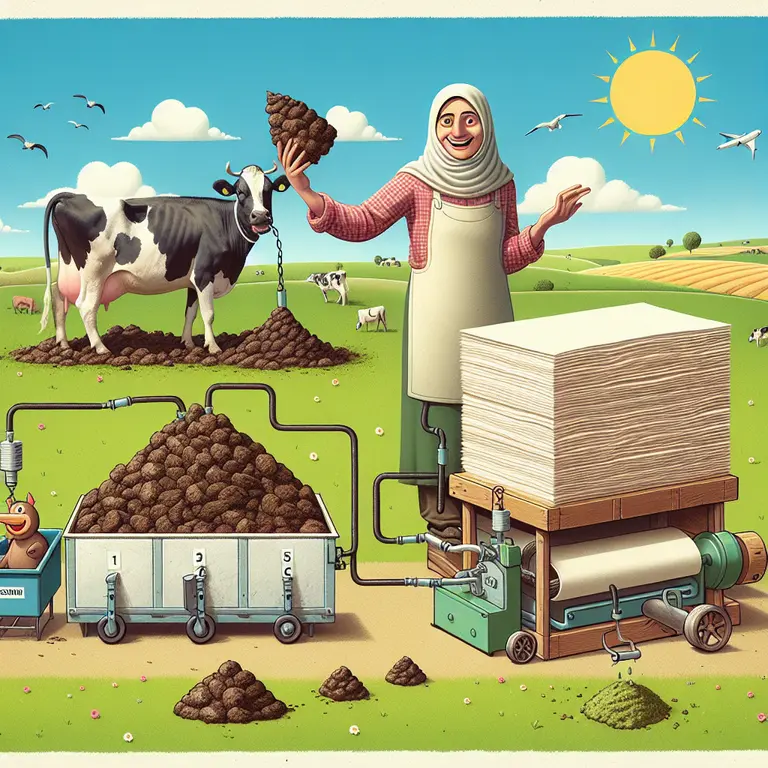
Cow manure can surprisingly be turned into sustainable paper products.
 Watch on YouTube
 Watch on Rumble
Introduction
Farmers worldwide face the challenge of managing substantial amounts of cow manure. On a single large dairy farm, hundreds of cows can collectively produce tens of thousands of gallons of manure every day, creating a logistical and environmental burden that demands creative solutions. Traditionally, this waste has been utilized as fertilizer or converted into biogas through anaerobic digestion. However, its potential in creating sustainable paper is lesser known but equally fascinating and environmentally beneficial. What sounds like an unlikely pairing of agriculture and stationery turns out to be a scientifically grounded, historically informed, and ecologically promising frontier in materials science. The paper in your notebook or printer may one day have passed through a very different kind of processing plant than you might imagine.
Historical Context and Modern Advancements
The technology of transforming animal dung into paper is not entirely new. It draws from ancient techniques used by various civilizations that employed natural fibers to create writing materials. Elephants in Thailand and Nepal have long been associated with dung-based paper production, where local artisans recognized that the fibrous remains of partially digested plant matter in animal waste could be repurposed into usable sheets. The logic is straightforward: herbivores consume enormous quantities of plant material, and their digestive systems, efficient as they are, cannot break down every strand of cellulose they ingest. What exists in the animal is still rich in the very fibers that papermakers have always depended upon.
Modern advancements have significantly refined these practices, making them more efficient and scalable. Companies like Eco-Poo Paper, based in the Netherlands, are at the forefront of transforming cow manure into high-quality paper products that are commercially viable and aesthetically indistinguishable from conventional paper. Their processes incorporate industrial-grade filtration, sterilization, and pulp processing, bringing the output up to modern standards of hygiene and usability. What was once a cottage industry in parts of Asia and Africa has begun attracting serious investment and scientific attention as the global paper industry searches for alternatives to wood pulp. Research institutions in Europe and North America have begun examining the structural properties of manure-derived cellulose, comparing fiber length and tensile strength with those of traditional wood-based pulp, with results that are often surprisingly competitive.
The Process of Creating Paper from Cow Manure
The transformation of raw cow manure into a finished paper product involves several carefully managed stages, each designed to isolate the useful fibrous content while eliminating biological hazards and impurities.
The process begins with initial cleaning. Fresh manure undergoes a thorough cleaning process that involves meticulous filtration to separate it from grass, undigested food, and other contaminants. This step is critical not only for producing a workable raw material but also for ensuring that the final product is sanitary. The filtration systems used in modern facilities can remove pathogens and excess moisture, leaving a concentrated mass of organic fiber that is safe to handle and process further.
Following filtration, the next stage involves cellulose extraction. The cleaned organic matter primarily comprises cellulose, the same structural polymer found in wood pulp that has been the backbone of papermaking for centuries. Because cows are herbivores consuming grasses, hay, and other cellulose-rich plant matter, their manure retains a surprisingly high proportion of this useful compound. Depending on the diet of the cattle and the efficiency of their digestion, the dry fiber content of cow manure can range from thirty to forty percent cellulose, which is a workable figure for paper production.
Once the cellulose is isolated, the material moves into pulp formation. The remaining fibrous material is mixed with water and heated to break down residual impurities and soften the fibers. This results in a slurry that closely resembles the wood-based paper pulp used in conventional mills. Some producers add small amounts of recycled paper fiber at this stage to improve the consistency and strength of the final product, though many are working toward entirely manure-derived outputs.
The final stage is sheet formation. The slurry is spread onto screens, allowed to drain, and then pressed and dried into sheets following traditional papermaking methods that have remained largely unchanged for hundreds of years. The result is a paper that can be used for writing, printing, packaging, and a range of other applications. Some producers offer unbleached varieties that retain a slightly warm, natural tone, while others process the sheets further to achieve a brighter, whiter finish more familiar to mainstream consumers.
Environmental Benefits
The conversion of cow manure into paper offers a range of environmental benefits that extend well beyond the novelty of the concept. Understanding these benefits requires looking at several interconnected problems that conventional paper production and modern livestock farming each generate independently.
One of the most immediate advantages is improved waste management. Large-scale livestock operations generate manure in quantities that can overwhelm local ecosystems. When manure runoff enters waterways, it introduces excess nitrogen and phosphorus, triggering algal blooms that deplete oxygen and devastate aquatic life. By diverting a portion of this waste into paper production, farms can reduce their environmental footprint while simultaneously generating a new revenue stream. The manure becomes a resource rather than a liability.
The deforestation implications are equally significant. According to data from the World Wildlife Fund, approximately 15 billion trees are cut down annually worldwide, with the paper and pulp industry accounting for a significant share of that total. Forests are not simply collections of trees but complex ecosystems that regulate climate, filter water, and support biodiversity. Every ton of paper produced from agricultural waste rather than virgin timber represents a direct reduction in pressure on these systems. Even if manure-derived paper were to supply a modest fraction of global demand, the cumulative effect on forest preservation could be substantial.
Reducing methane emissions represents another compelling environmental argument. Cows produce considerable amounts of methane during digestion, a potent greenhouse gas with a warming potential roughly eighty times greater than carbon dioxide over a twenty-year period. Stored manure continues to release methane as it decomposes in lagoons and pits commonly used on large farms. Redirecting that manure into a processing pipeline reduces the volume sitting in open storage, thereby cutting the duration and intensity of methane release. While biogas systems capture this methane for energy use, paper production offers an alternative pathway that reduces emissions and produces a tangible, marketable product.
Conclusion
Transforming cow manure into sustainable paper is an innovative solution that simultaneously addresses environmental degradation, farm waste management, and the overconsumption of forest resources. It is a rare example of a circular economy principle that works across multiple industries at once, connecting agriculture and manufacturing in a way that benefits both. By adopting such eco-friendly practices at scale, producers and consumers alike can contribute to meaningful reductions in deforestation and greenhouse gas emissions while promoting a more sustainable relationship between human industry and the natural world. The next time you pick up a sheet of paper, it may be worth considering just how many forms a blade of grass can take before it reaches your hand.