
Exploring the Invisible Aerial Rivers of the Amazon Basin
How the Amazon rainforest generates its own weather system through atmospheric rivers of water vapor, and why its destruction could trigger droughts thousands of miles away.
Introduction
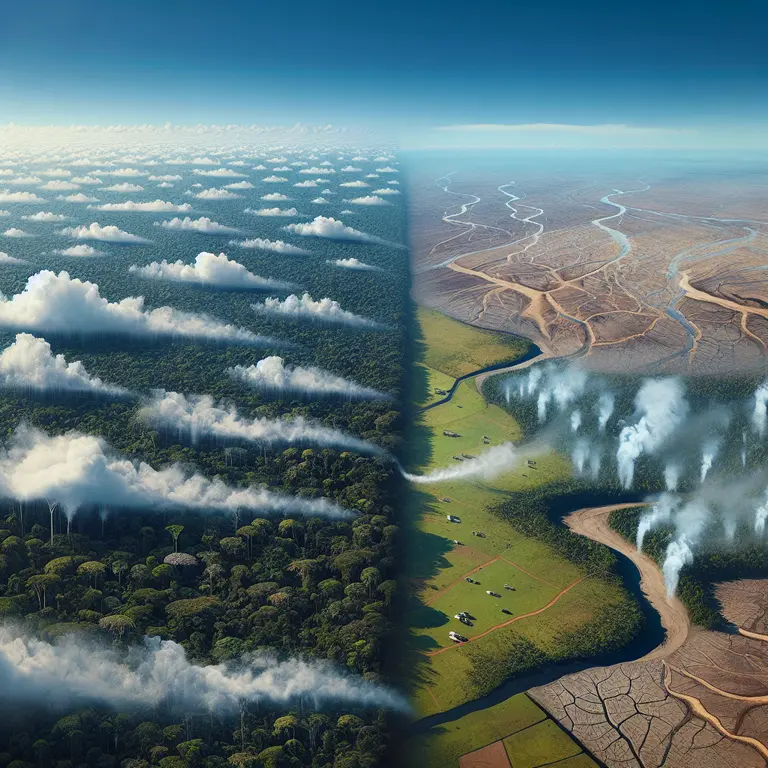
Most people learn about the Amazon River as one of the great wonders of hydrology — a sprawling, continent-draining system that carries roughly 20 percent of all freshwater discharged into Earth’s oceans. It is a river so vast that it defies ordinary comprehension, one that has shaped the ecology and culture of an entire continent for millions of years. But there is a second Amazon that receives far less attention, one that flows not through soil and sediment but through the atmosphere itself. Scientists call it the “flying rivers,” and by some estimates, this aerial waterway transports more water each day than the physical river below it.
The Amazon basin releases approximately 20 billion tons of water vapor into the atmosphere every day through a process called evapotranspiration, in which trees essentially exhale moisture through their leaves. This is not passive evaporation from open water. It is an active, biologically driven pumping mechanism. A single large Amazonian tree can release hundreds of liters of water per day, and when you scale that across 390 billion trees spread over 5.5 million square kilometers, the result is an atmospheric river system of staggering volume that shapes rainfall patterns across all of South America. Understanding this system — and what happens when it is disrupted — may be one of the most consequential scientific challenges of the twenty-first century.
The Biotic Pump Hypothesis
In 2006, two Russian physicists, Anastassia Makarieva and Victor Gorshkov, proposed what became one of the more controversial ideas in atmospheric science: the biotic pump hypothesis. Their model suggested that forests do not merely respond to rainfall — they actively generate and direct it. The condensation of water vapor released by trees creates localized low-pressure zones that draw moist air inland from the ocean, essentially functioning as a biological engine driving continental weather patterns over thousands of kilometers.
The idea was met with considerable skepticism when it was first published, largely because it inverted the conventional understanding of the relationship between forests and rainfall. Traditional climatology treated forests as passive beneficiaries of precipitation, not as active agents shaping atmospheric circulation. Makarieva and Gorshkov were arguing something far more radical: that the forest itself is the pump, and that without it, the moisture-laden winds from the Atlantic would stall near the coast rather than penetrating deep into the continental interior.
If the hypothesis holds, it means that deforestation does not simply reduce local rainfall. It could collapse the pressure gradient that pulls Atlantic moisture thousands of kilometers inland, turning the interior of continents into arid zones regardless of ocean conditions. The hypothesis remains debated among atmospheric scientists, and some critics have challenged the mathematical framework underlying the pressure differential calculations. However, a growing body of observational data from the Amazon has given it increasing credibility. Studies published in journals including Nature Climate Change have documented measurable correlations between deforestation rates in the eastern Amazon and reduced rainfall in Brazil’s agricultural heartland — the Cerrado — as well as in cities like São Paulo, which experienced catastrophic water shortages in 2014 and 2015 that many researchers linked partly to Amazon degradation.
The São Paulo crisis is worth dwelling on. A metropolitan area of more than 21 million people came within weeks of running out of water, not because of an unusual drought in isolation, but because the atmospheric systems that had historically delivered reliable rainfall to the region had been progressively weakened. The reservoirs serving the city dropped to single-digit percentage capacity. Emergency rationing was imposed. The event was treated in the media primarily as a water management failure, but the underlying science pointed to something more systemic and harder to solve with infrastructure alone.
Teleconnections and the Reach of Amazonian Moisture
The consequences of disrupting the flying rivers extend well beyond Brazil’s borders. Atmospheric scientists use the term “teleconnection” to describe how weather patterns in one part of the world influence conditions in distant regions through linked atmospheric circulation. These are not metaphorical connections but measurable physical relationships encoded in pressure systems, jet streams, and moisture transport corridors. The Amazon’s moisture export feeds teleconnections that reach into Central America, the Caribbean, and parts of the western United States.
A 2019 study modeled what would happen if the Amazon were entirely deforested. The results projected significant rainfall reductions not just in South America but across portions of North America, particularly during summer monsoon seasons. The study estimated agricultural losses in the American Midwest could reach into the billions of dollars annually — an economic consequence originating in a forest that most American policymakers never consider when discussing domestic food security. The Amazon is, in this sense, a piece of invisible infrastructure supporting agricultural systems it has never been credited with sustaining. It occupies no line in any national budget, generates no quarterly report, and appears in no supply chain analysis, yet its hydrological services underpin food production across an entire hemisphere.
The flying rivers also interact with the Andes Mountains in a particularly elegant way. As moisture-laden air travels westward across the continent, it collides with the Andean cordillera and is deflected southward, channeling enormous quantities of rainfall into the La Plata basin, which includes the agricultural regions of Paraguay, Uruguay, and northern Argentina. The Pantanal, the world’s largest tropical wetland and a system of extraordinary biological richness, depends substantially on this redirected aerial moisture. Deforestation in the eastern Amazon therefore threatens ecosystems and food systems in countries that share no border with the forest itself, creating a category of environmental harm that existing international frameworks are almost entirely unprepared to address.
This spatial disconnect between cause and consequence is one of the most politically inconvenient features of the flying rivers. A cattle rancher clearing forest in Para state, Brazil, is not merely making a local land-use decision. Through the mechanisms of atmospheric teleconnection, that decision propagates outward through the climate system in ways that are real, measurable, and diffuse enough to evade any straightforward legal or diplomatic accountability.
A Tipping Point With No Clear Threshold
What makes this system particularly alarming to climate scientists is the concept of a tipping point — a threshold beyond which the system shifts irreversibly into a new state. Tipping points are dangerous precisely because they are difficult to identify in advance and because they transform gradual, manageable change into sudden, unmanageable transformation. The Amazon is currently losing forest at a rate that has, according to several research groups, left it somewhere between 17 and 25 percent deforested since the 1970s. Some models suggest that once deforestation crosses roughly 20 to 25 percent of the basin’s total area, the reduction in evapotranspiration becomes self-reinforcing.
The logic of this feedback loop is straightforward and grim. Less forest means less moisture recycled into the atmosphere. Less moisture means less rainfall reaching the remaining forest. Reduced rainfall stresses trees, making them more vulnerable to fire and die-off. Dead and dying forest releases stored carbon into the atmosphere, accelerating warming. Warming intensifies drought conditions, further stressing the forest. Each stage of the cycle amplifies the next, and the system can cross from a stable forested state to a stable savanna state without any additional external pressure once the initial threshold is breached. This transition is sometimes called “dieback,” and the disturbing reality is that researchers are not certain exactly where the threshold sits, or whether parts of the Amazon may have already crossed it.
The carbon implications alone are staggering. The Amazon stores an estimated 150 to 200 billion tons of carbon in its biomass and soils. A large-scale dieback event would release a pulse of carbon dioxide and methane into the atmosphere that would dwarf decades of industrial emissions reductions elsewhere on the planet. To put this in context, the United States' annual greenhouse gas emissions are approximately 6 billion tons of carbon dioxide equivalent. A significant Amazon dieback could release quantities of carbon that would effectively cancel out generations of climate mitigation efforts in other sectors, rendering net-zero commitments across the developed world arithmetically meaningless.
Conclusion
The flying rivers of the Amazon represent something that human civilization has rarely been forced to reckon with: a piece of critical global infrastructure that is invisible, unowned, unpriced, and currently being dismantled at industrial speed. The physical Amazon River is protected by its sheer size and the political boundaries it crosses. The atmospheric Amazon has no such protection. It moves through jurisdictions without passports, delivers rainfall to nations that have contributed nothing to its destruction, and fails those same nations without warning or recourse when it is gone.
The science here is not settled in every detail, and researchers continue to debate the precise mechanisms and thresholds involved. But the broad picture that has emerged over the past two decades is clear enough to demand serious attention. A forest exhaling 20 billion tons of water vapor per day is not a passive backdrop to human civilization. It is an active participant in the climate system, performing hydrological services that no engineering project could replicate and no insurance policy could compensate for. The question of what happens to the flying rivers is, in the end, a question about what kind of planet remains viable for complex agricultural societies — and the answer depends heavily on decisions being made right now, in a forest most of the world’s decision-makers have never visited and can barely locate on a map.