
Discover the Enigmatic Beauty of Australia's Pink Lake
Lake Hillier in Australia is a bright pink color and scientists aren't sure why
Introduction
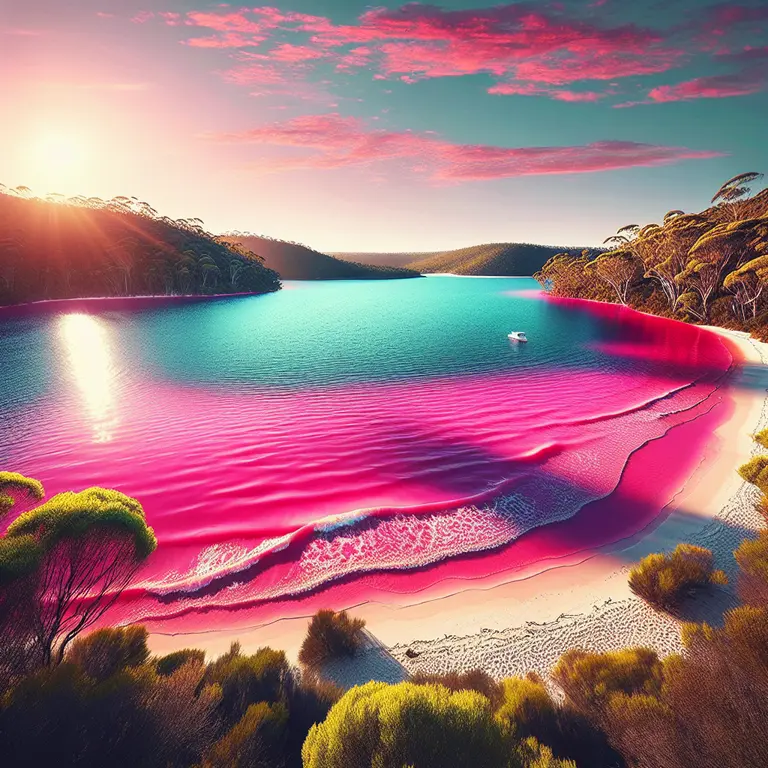
Among the many natural wonders scattered across the Australian continent, few are as immediately arresting as Lake Hillier. Situated on the edge of Middle Island, the largest island in the Recherche Archipelago off the southern coast of Western Australia, this extraordinary saltwater lake stretches approximately 600 meters in width and is separated from the Southern Ocean by nothing more than a narrow strip of dense woodland and sand dunes. What makes Lake Hillier instantly unforgettable is not its size or its remote location, but its color. The water is a vivid, almost artificial-looking shade of pink that closely resembles bubble gum or a glass of strawberry milk. Unlike some other pink lakes around the world, which shift in color depending on the time of day, the season, or atmospheric conditions, Lake Hillier maintains its remarkable hue with remarkable consistency. The color does not fade, dilute, or transform even when the water is removed from the lake and placed in a container. A bottle of Lake Hillier water remains unmistakably, stubbornly pink. This permanence is part of what has elevated the lake from a regional curiosity to an internationally recognized natural phenomenon, drawing scientists, photographers, and adventurous travelers from across the globe.
Scientific Explanations for the Color
Despite decades of observation and scientific inquiry, the precise combination of factors responsible for Lake Hillier’s coloration has not been definitively resolved. The lake has proven to be a surprisingly complex biological and chemical system, and researchers continue to refine their understanding of what is happening beneath its bubblegum surface. The most widely accepted explanation involves an interplay between extreme salinity and the metabolic activity of specific salt-tolerant microorganisms, but the full picture is more layered than any single cause can account for.
High salinity alone does not produce pink water. The salt concentration in Lake Hillier is roughly ten times that of ordinary seawater, placing it in the same category as other hypersaline bodies of water found around the world. However, it is what thrives within that extreme saltiness that appears to generate the color. Scientists have identified at least two major biological contributors, each producing its own set of pigments that together create the lake’s signature appearance. What remains genuinely uncertain is the precise proportion each contributor plays, and whether additional chemical or geological factors are also involved. A 2015 study by the Extreme Microbiome Project, which conducted a comprehensive metagenomic analysis of the lake, identified a far richer diversity of microorganisms than previously known, suggesting that the color may result from a more complex ecological community than the two dominant species alone can account for.
The Role of Dunaliella Salina and Halobacteria
Two microorganisms stand out as the primary suspects in the ongoing scientific investigation of Lake Hillier’s color. The first is Dunaliella salina, a single-celled green microalga that has evolved to survive and even flourish in environments with salt concentrations that would destroy virtually any other photosynthetic organism. When exposed to high salinity and intense sunlight, Dunaliella salina responds by producing large quantities of carotenoid pigments, particularly beta-carotene, as a protective mechanism against oxidative stress. These carotenoids are the same class of compounds responsible for the orange color of carrots and the red of tomatoes, and in sufficient concentrations, they shift the color of the water toward shades of orange, red, and pink. Dunaliella salina is already commercially cultivated in other parts of Australia and around the world for use in dietary supplements and natural food colorings, underscoring just how prolific its pigment production can be.
The second major contributor is a group of microorganisms known as halobacteria, or haloarchaea. Despite the name, these are not technically bacteria in the modern classification of life; rather, they belong to the domain Archaea, representing one of the most ancient lineages of life on Earth. Halobacteria produce a red pigment called bacteriorhodopsin, which they use to harvest light energy in a process chemically distinct from conventional photosynthesis. Bacteriorhodopsin is what gives halobacteria their characteristic reddish hue, and in a body of water as densely populated with these microorganisms as Lake Hillier, the cumulative effect on water color is significant. The 2015 metagenomic study also identified Salinibacter ruber and various Halorubrum species, each contributing additional pigmentation to the overall visual effect.
Environmental Conditions and Human Safety
The environmental conditions of Lake Hillier are as extreme as they are unusual, yet they support an ecosystem that, in its own way, thrives. The lake is fed by groundwater and rainwater but loses moisture rapidly through evaporation in the hot Western Australian climate, which is what drives and sustains its extraordinary salt concentration. The surrounding landscape of dense paperbark tea trees and eucalyptus forest creates a microenvironment that further influences the lake’s temperature and humidity, helping to maintain the stable conditions that the lake’s microbial inhabitants depend upon.
One of the more counterintuitive facts about Lake Hillier is that, despite its alien chemistry, it poses no danger to human swimmers. The high salinity makes swimming a peculiar experience, akin to floating in the Dead Sea, but the water is neither corrosive nor toxic to human skin. Visitors who have had the rare opportunity to swim in the lake report that the water feels slightly oily and leaves a salty residue on the skin, but causes no irritation or harm. This is a remarkable contrast to some other extreme chemical environments on Earth, which can be genuinely dangerous to biological tissue. The microorganisms living in the lake pose no pathogenic risk to humans, and the salt itself, while extreme, is the same sodium chloride found in ordinary seawater, just in far greater quantities.
Access to Middle Island is restricted and regulated, primarily to protect the fragile ecosystem from human disturbance. The island is part of the Recherche Archipelago Nature Reserve, and visitors cannot simply arrive and wade in at will. Most people who see Lake Hillier do so from the air, during scenic flights that offer a breathtaking aerial view of the pink oval nestled between the dark green of the forest and the deep blue of the Southern Ocean.
Historical Significance and Discovery
Lake Hillier has a history that stretches back to the early days of European exploration of the Australian coastline. The credit for its European discovery is generally attributed to the British navigator and hydrographer Matthew Flinders, who encountered the lake in January 1802 during his ambitious circumnavigation of the Australian continent. While anchored near Middle Island, Flinders ascended the island’s highest point, which he named Flinders Peak, in order to gain a better vantage point for surveying the surrounding waters and coastline. It was from this elevated position that he first observed the startling pink lake below. Flinders recorded his observations in his journal, noting the unusual color of the water and expressing curiosity about its cause, though he was unable to offer a scientific explanation.
The lake is believed to have been named after William Hillier, a surgeon and naturalist who was part of a subsequent expedition to the island in the same year. Hillier died on the island, reportedly from dysentery, and the lake was named in his memory. In the early twentieth century, the island was briefly used as a base for whaling and fishing operations, and workers at the time are reported to have occasionally swum in the lake without ill effect, adding early anecdotal evidence to what science has since confirmed about its safety.
Conclusion
Lake Hillier stands as one of nature’s most quietly astonishing achievements, a body of water that defies easy explanation and rewards curiosity with layers of biological, chemical, and historical complexity. Its consistent pink color, born from the collective metabolic activity of ancient microorganisms thriving in conditions hostile to almost all other life, serves as a vivid reminder that the natural world still holds genuine surprises. As scientific methods become more sophisticated, researchers are likely to continue uncovering new details about the lake’s microbial community and the precise mechanisms behind its color. Yet even as understanding grows, Lake Hillier retains something irreducibly wonderful, a quality that no amount of scientific explanation can fully dissolve. It is a place that makes the world feel larger, stranger, and more interesting than we sometimes allow ourselves to remember.