
Surprising Origins: The Invention Journey of Inkjet Printers
The creation of Inkjet printers was an accidental discovery by a Canon engineer, Ichiro Endo in 1951.
Introduction
During the mid-twentieth century, marked by rapid technological advancements and groundbreaking inventions, an unintentional journey began that eventually led to the creation of a device now considered indispensable in offices and homes worldwide: the inkjet printer. It is one of those rare stories in the history of technology where the destination had almost nothing to do with the starting point. A young engineer was not trying to reinvent communication or transform the publishing industry. He was simply trying to build a better stopwatch. Yet the observation he made almost by accident one afternoon would ripple outward across decades, reshaping how human beings record, share, and reproduce information. This is the story of Ichiro Endo, a Canon engineer born in 1951, whose curiosity in the face of an unexpected phenomenon set in motion one of the most consequential technological developments of the modern era.
The Accidental Discovery That Started Everything
Endo’s initial project was far removed from printing technology. He had been tasked with developing a reliable automatic stopwatch for the Tokyo Olympics, a project that demanded precision engineering and a thorough understanding of electronic timing mechanisms. It was painstaking, detail-oriented work, the kind that requires an engineer to remain completely focused on a narrow set of technical problems. Endo was doing exactly that when something entirely unplanned caught his attention.
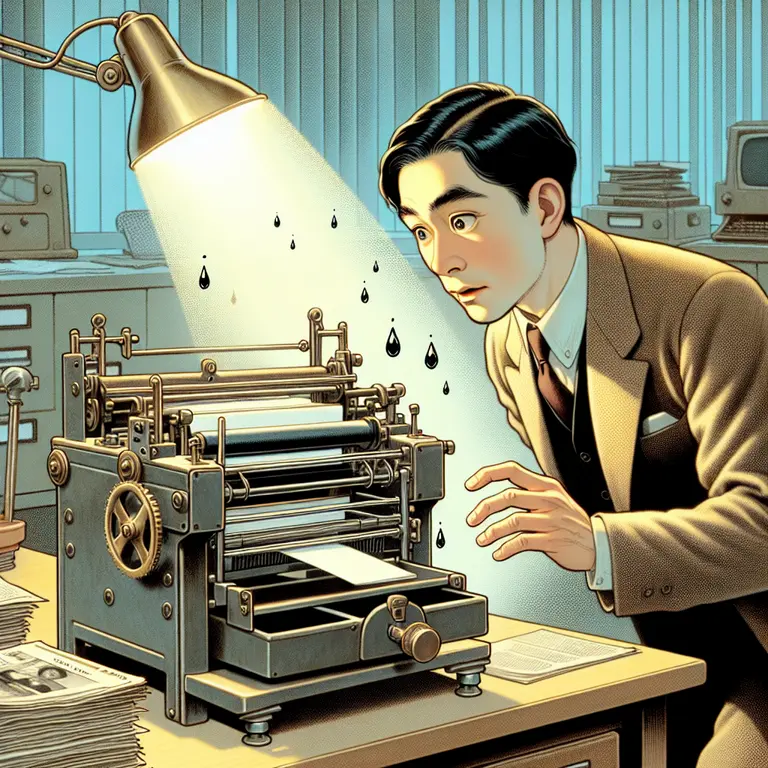
While working at his bench, the heat radiating from his soldering iron caused ink droplets to shoot out from the reservoir of a nearby fountain pen. The effect was sudden, almost violent in its unexpectedness. A tiny jet of ink propelled itself outward, leaving a mark where none had been intended. For many engineers, this would have been a minor annoyance, a mess to clean up before returning to the task at hand. For Endo, it was a question demanding an answer.
What he had witnessed was a thermodynamic event. The heat from the soldering iron had rapidly vaporized a small amount of ink inside the pen’s reservoir, creating a bubble that expanded and then collapsed, forcing the surrounding liquid outward through the pen’s tip. It was a fleeting, almost invisible process, but Endo recognized that it contained within it the seed of something potentially far more significant. He set aside his stopwatch project and began to investigate.
Experimentation, Precision, and the Physics of Ink
Intrigued by what he had observed, Endo began a systematic series of experiments designed to understand and replicate the phenomenon under controlled conditions. The central question he was pursuing was deceptively simple: at what temperature does ink vaporize to produce a consistent, controllable droplet? The answer, it turned out, was far more nuanced than that question implied.
Through extensive experimentation, Endo discovered that the relationship between heat and ink behavior was highly sensitive. With too little energy, the bubble would not form with sufficient force to eject a droplet. With too much energy, the process became chaotic, producing irregular spray patterns that would be useless for any practical application. The key, he found, was to achieve a precise, repeatable energy input that could generate bubbles of consistent size. Because the bubble's size directly determined the volume of ink displaced, controlling the bubble meant controlling the droplet. And controlling the droplet meant controlling the mark left on a surface.
This insight was not merely interesting from a scientific standpoint. It suggested a practical mechanism for producing fine, accurate marks on paper at high speed without any mechanical contact between the printing element and the surface being printed on. Traditional printing technologies of the era relied on physical impact, whether through typewriter ribbons, stamp-based mechanisms, or inked rollers pressed against paper. Endo’s approach pointed toward something fundamentally different: printing through the precise application of thermal energy, with no moving parts touching the page at all. The implications for speed, reliability, and print quality were enormous.
The Invention of Bubble Jet Printing and Its Relationship to Inkjet Technology
Endo’s eureka moment not only contributed to the development of inkjet printing as a broad technology category but also paved the way for a closely related, distinctly Canon-branded process known as bubble jet printing. While the two terms are often used interchangeably in everyday conversation, they refer to processes with meaningful operational differences that reflect their separate developmental histories.
Inkjet printing, in its broader sense, encompasses any printing method that propels droplets of ink onto a surface without contact. Within that category, there are two dominant approaches. The first, piezoelectric inkjet printing, was developed primarily by Epson and uses electrical charges to deform a piezoelectric crystal inside the print head, creating pressure that forces ink through a nozzle. This method does not rely on heat at all. The second approach, thermal inkjet printing, is the technology Endo’s discovery pointed toward, and it is this method that Canon branded as bubble jet printing.
In Canon’s bubble jet system, tiny resistors within the print head are heated almost instantaneously to temperatures exceeding 300 degrees Celsius. This causes a microscopic portion of the ink to vaporize, forming a bubble that expands rapidly and forces a droplet of ink out through the nozzle. The bubble then collapses as the resistor cools, creating a slight vacuum that draws fresh ink into the chamber in preparation for the next firing cycle. This process occurs thousands of times per second across hundreds of individual nozzles, producing the smooth gradients and fine text that users have come to associate with high-quality printed output.
The distinction between Canon’s bubble jet approach and Hewlett-Packard’s version of thermal inkjet printing, which was developed independently and in parallel during roughly the same period, lies primarily in the geometry of the heating element and nozzle arrangement. Both companies arrived at similar solutions through different engineering paths, a coincidence that led to a period of competitive tension and patent negotiations in the early 1980s.
Commercial Viability and the Drop-on-Demand Revolution
The theoretical breakthroughs achieved through Endo’s experimentation became commercially meaningful in the period between 1978 and 1979, when Canon introduced what it called Drop-on-Demand technology. This designation captured something essential about why the new printing approach was so revolutionary compared to what had come before.
Earlier continuous inkjet systems, which had existed in industrial settings since the 1950s and 1960s, worked by generating a constant stream of ink droplets and then deflecting unwanted droplets away from the page using electrostatic fields. These systems were fast and capable, but they were also expensive, mechanically complex, and difficult to miniaturize. They were suited to industrial marking applications, not to the kind of compact, affordable desktop device that a business office or household might realistically purchase and maintain.
Drop-on-Demand technology changed that equation entirely. By firing individual droplets only when and where they were needed, the system eliminated the waste and complexity of continuous stream deflection. The print head became simpler, smaller, and cheaper to manufacture. Ink consumption dropped dramatically. The entire mechanism could be scaled down to fit inside a device small enough to sit on a desk. Canon’s first commercial bubble jet printer, the BJ-80, released in 1981, demonstrated that these advantages were not merely theoretical. It was quieter than dot-matrix printers, faster than many daisy-wheel machines, and capable of producing output that looked closer to typeset text than anything a personal printer had previously achieved at a comparable price point.
Hewlett-Packard followed with its own thermal inkjet products, and the resulting competition between the two companies drove rapid improvements in resolution, speed, and cost throughout the 1980s and into the 1990s. By the time color inkjet printing became widely available in the early 1990s, the technology had become a genuine mass-market product, accessible to ordinary consumers and small businesses in a way that laser printing, with its higher upfront costs, was not.
Global Impact and the Legacy of an Unexpected Observation
Today, inkjet and bubble jet printing methods are ubiquitous worldwide. They are found in hospital laboratories printing patient labels, in photographic studios producing gallery-quality prints, in manufacturing facilities marking serial numbers on components, and in countless kitchens and home offices printing recipes, school assignments, and boarding passes. The global inkjet printing market is valued in the tens of billions of dollars annually, encompassing not just document printers but also large-format printers used in advertising, textile printers used in fashion, and bioprinters used in medical research to deposit living cells in precise patterns.
That last application is perhaps the most striking illustration of how far the principles Endo stumbled upon have traveled. The same fundamental logic that governs the ejection of an ink droplet from a thermal print head, the controlled application of energy to produce a precisely sized and directed burst of liquid, is now being explored as a method for building human tissue layer by layer. The journey from a soldering iron accidentally heating a fountain pen to the frontier of regenerative medicine is not a straight line, but the thread connecting those two points is real.
Conclusion
The story of Ichiro Endo and the invention of bubble jet printing is a reminder that the history of technology is rarely as tidy as textbook accounts suggest. Innovation does not always emerge from deliberate research programs aimed at a predefined goal. Sometimes it arrives in a moment of attentiveness, in the willingness to ask why something unexpected just happened rather than simply move on. Endo was not looking for a new way to print. He was looking at a fountain pen that had just behaved strangely, and he was curious enough to follow that strangeness wherever it led.
The device that curiosity eventually produced has touched virtually every corner of modern life. It has made high-quality printing accessible to people who could never have afforded earlier alternatives. It has enabled new forms of manufacturing, art, and medicine. And it began, as so many transformative things do, with someone pausing to notice something small that everyone else might have ignored.