
Ingenious Tricks to Use Lightbulbs in Creative Ways
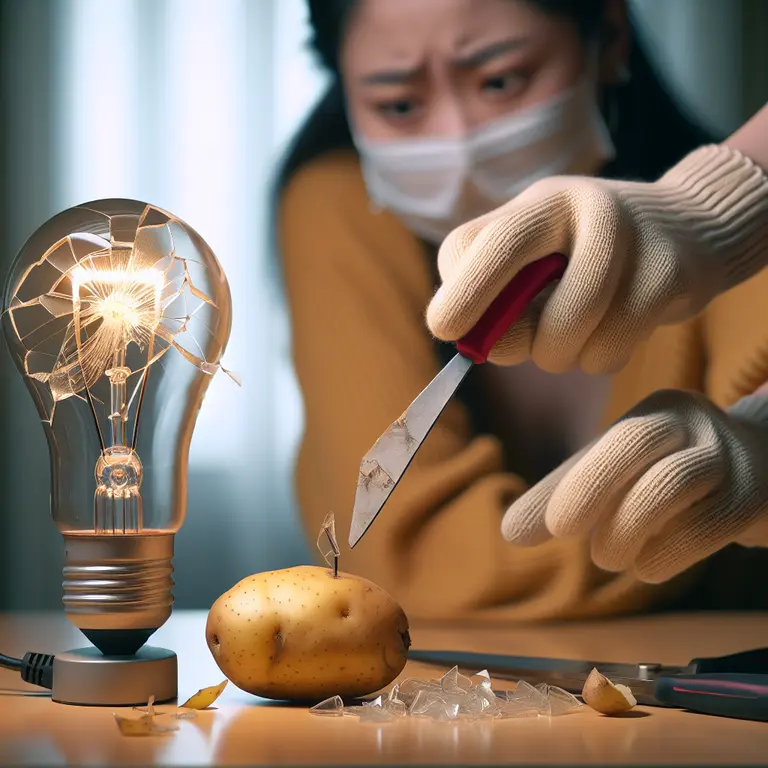
Use a potato to remove a broken lightbulb without getting hurt.
Introduction
If a lightbulb in your home has broken and you are unsure how to safely remove it without risking injury, you can use a simple and surprisingly effective trick: a raw potato. This method allows you to extract the broken bulb from its socket without risking cuts from sharp glass edges. It is a quick, practical solution that requires minimal tools and preparation, making it a reliable go-to for many households.
Broken lightbulbs are one of those small household mishaps that can seem more dangerous than they actually are, provided you know how to handle them correctly. The jagged edges left behind after a bulb shatters can cause serious cuts if handled carelessly, and the confined space of a light socket makes it difficult to get a safe grip. That is precisely where the potato trick earns its reputation. It sounds unusual at first, but the science behind it is straightforward, and the results are consistently effective. Whether the bulb broke during removal, shattered from heat stress, or simply snapped off at the base, this method can help you resolve the problem calmly and without specialized equipment.
How to Remove a Broken Lightbulb Using a Potato
The first and most important step before doing anything else is to turn off the power. Safety must be the first priority when dealing with any electrical fixture. Switch off the light at the wall and, if possible, go one step further and turn off the circuit breaker that controls the lighting in that area of your home. Working with live electricity is genuinely dangerous, and this precaution takes only a moment but eliminates a significant risk entirely. If you are uncertain which breaker controls the relevant circuit, use a non-contact voltage tester to confirm the power is off before proceeding.
Once the power is turned off, locate a raw potato from your kitchen. Any variety will work, whether it is a russet, a Yukon gold, or a simple white potato. The only requirement is that it is large enough to cover the base of the broken bulb. You do not need any specialized equipment or materials beyond this.
Take a knife and cut the potato cleanly in half. You will be using the flat, freshly cut surface to grip the broken bulb. This interior face is soft, moist, and starchy, which is exactly what makes it useful for this task. Press the flat side of the potato firmly into the broken socket, pushing it against the jagged edges of the remaining glass. Apply enough pressure for the potato to grip the broken rim, but avoid forcing it so hard that you drive glass fragments deeper into the socket or cause further breakage.
With the potato seated against the broken bulb, begin turning it slowly and steadily counterclockwise. Standard lightbulbs use a right-hand thread, meaning counterclockwise rotation will unscrew them from the socket. The starchy, moist interior of the potato creates enough friction against the broken glass to allow it to turn without slipping. Continue rotating gently and consistently until the bulb base is entirely free from the socket.
Once the broken bulb is loose, carefully remove the potato and the attached glass. Wrap the broken pieces in several layers of newspaper or place them in a rigid container such as a cardboard box before disposing of them in the trash. This prevents the shards from tearing through a garbage bag and injuring someone who later handles the waste. After disposal, inspect the socket briefly to ensure no glass fragments remain before fitting a new bulb.
Why the Potato Trick Actually Works
The effectiveness of this method depends on the potato's physical properties. The moist, starchy interior of a freshly cut potato behaves somewhat like a soft, natural adhesive. When pressed against the irregular, jagged edge of a broken bulb, it conforms to the uneven surface, creating suction and friction that a harder material simply could not. A dry cloth might slip, and a rubber grip might not press securely into the socket, but the potato's yielding texture adapts to whatever shape it encounters.
There is also a structural advantage to this approach. Because the potato is soft, it absorbs and distributes pressure across a wider area rather than concentrating force on a single sharp point. This reduces the likelihood that the remaining glass will shatter further during removal. The result is a grip that is firm enough to unscrew the base but gentle enough to avoid worsening the situation.
This method is particularly useful when the glass portion of the bulb has broken off entirely, leaving only the metal base lodged in the socket. In this scenario, the potato can press against the inner rim of the metal collar, providing enough rotational force to dislodge it. It is a versatile solution that handles several variations of the same problem.
Additional Safety Precautions Worth Knowing
While the potato trick is simple and low-risk, a few additional precautions are worth keeping in mind to ensure the process goes smoothly. Even after switching off the wall light, always verify that the breaker is completely off before touching anything inside the socket. This is especially important in older homes where wiring may not behave predictably.
If you are concerned about handling broken glass at any point during the process, consider wearing work gloves or rubber gloves before you begin. Gloves provide an extra layer of protection in case the potato slips or a fragment of glass breaks free unexpectedly. They are not strictly necessary if you follow the steps carefully, but they add a meaningful margin of safety for those who prefer it.
Pay attention to the disposal step as well. Broken glass is one of those hazards that causes injuries long after the original incident, often when someone else is handling the trash. Wrapping the broken bulb in newspaper and placing it inside a small box or rigid container before putting it in the bin is a simple habit that protects everyone in the household and anyone who handles the waste afterward.
Other Methods for Removing a Broken Lightbulb
The potato method works well for most situations, but there are alternative approaches worth knowing in case a potato is not available or the bulb has broken in an unusual way.
Needle-nose pliers are a practical option when the glass has broken away entirely, and only the metal base remains in the socket. The narrow tips of the pliers can grip the inside edge of the metal collar and apply enough rotational force to unscrew it. This method requires a careful hand and should only be attempted with the power fully off, but it is effective and precise.
Duct tape is another improvised solution. By folding a length of duct tape into a loop or pressing it firmly against the remaining bulb base, you can create a makeshift handle with enough grip to turn the socket. This works best when some glass remains to adhere to, and it is less effective against very sharp or irregular edges.
For those who encounter broken bulbs regularly, such as in a rental property or workshop setting, purpose-built bulb-removal tools are available at most hardware stores. These tools are designed specifically for this problem and can handle a range of bulb sizes and socket types. They are a worthwhile investment if the issue arises often enough to justify the cost.
Conclusion
The raw potato trick is a clever, efficient, and genuinely safe method for removing a broken lightbulb from its socket. By using a common kitchen item, you can avoid direct contact with sharp glass, maintain a reliable grip throughout the removal process, and get the job done without purchasing any specialized equipment. It is the kind of resourceful, low-tech solution that proves household problems rarely require expensive fixes.
This technique also speaks to a broader principle worth keeping in mind around the home: the best tool for a job is sometimes the one already sitting in your kitchen. Understanding why the method works, not just that it works, gives you the confidence to apply it correctly and to adapt it when circumstances vary slightly. Next time you find yourself facing a broken bulb, reach for a potato, turn off the power, and follow these steps to resolve the situation quickly and safely.