
Gps and Relativity: How Einstein's Theories Shape Our World
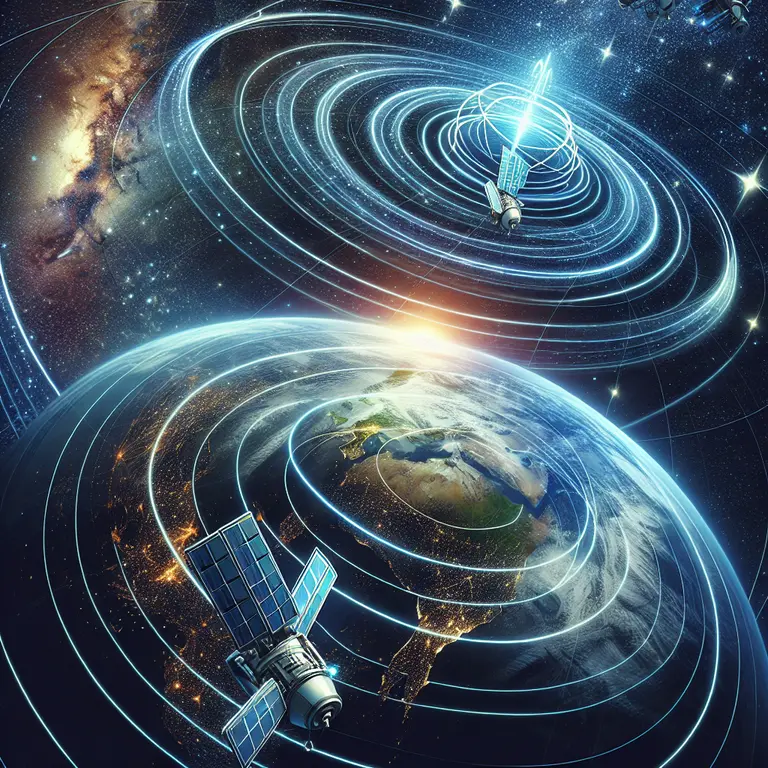
Modern GPS satellites experience time differently than clocks on Earth due to relativity, and without constant corrections, our navigation systems would drift miles off course within a single day.
 Watch on YouTube
 Watch on Rumble
When Einstein Runs Your Smartphone
Every time a rideshare app pins your location to within a few meters, it is quietly relying on one of the most counterintuitive predictions in the history of physics. The Global Positioning System, operated by the United States Space Force and used by billions of devices worldwide, only works because engineers deliberately built Albert Einstein’s theories of relativity into the firmware of every satellite orbiting Earth. Without those corrections, GPS would accumulate positional errors of roughly 11 kilometers per day, rendering it useless for navigation within hours of launch.
The satellites in the GPS constellation orbit at approximately 20,200 kilometers, completing two full orbits per sidereal day. At that altitude and velocity, two separate relativistic effects pull time in opposite directions simultaneously, and the engineers who designed the system in the 1970s had to account for both. What makes this engineering achievement so remarkable is not merely its technical precision but the conceptual leap it required. The designers of GPS were not building a physics experiment. They were building a navigation tool, and yet they found themselves forced to treat the fabric of spacetime as a variable in their calculations. For most of human history, time was assumed to be a fixed and universal backdrop against which events occurred. GPS demolished that assumption and embedded its demolition in a consumer product used by billions of people every single day.
It is worth pausing on that strangeness. The average person checking a map application on a phone has no idea that the coordinates appearing on the screen are only accurate because a team of engineers in the 1970s took seriously a set of equations that most people at the time considered the exclusive domain of theoretical physics. The gap between abstract science and lived experience has rarely been bridged so invisibly or so completely.
Two Forces Pulling Time Apart
The first effect comes from special relativity. Because GPS satellites travel at roughly 14,000 kilometers per hour relative to an observer on the ground, their onboard atomic clocks tick more slowly than Earth-based clocks by about 7 microseconds per day. This is time dilation caused by velocity, the same phenomenon that would make an astronaut age more slowly than a twin left on Earth. Einstein first described this effect in 1905, and while it was accepted theoretically within the physics community relatively quickly, its practical consequences seemed remote for decades. No one anticipated that time dilation would one day need to be patched into satellite software as a routine engineering correction.
The second effect runs in the opposite direction and comes from general relativity. Gravity warps spacetime, and the stronger the gravitational field, the slower time passes. On the surface of Earth, clocks sit deep inside a gravitational well. The satellites, orbiting far above most of Earth’s mass, experience weaker gravity and therefore their clocks tick faster than ground-based clocks by approximately 45 microseconds per day. This gravitational time dilation is perhaps the more philosophically disorienting of the two effects, because it means that time itself passes at different rates depending on where you are in a gravitational field. A clock at sea level and a clock at the top of a mountain are not merely measuring time differently due to instrument error. They are genuinely experiencing different amounts of time.
When you subtract the 7-microsecond slowdown from the 45-microsecond speedup, the net result is that GPS satellite clocks gain roughly 38 microseconds per day relative to ground clocks. Since GPS positioning works by measuring the travel time of light-speed radio signals, and since light travels about 30 centimeters per nanosecond, an uncorrected 38-microsecond daily drift would translate to an error of more than 11 kilometers. The satellites are pre-programmed to run their clocks slightly slow before launch to compensate, and ground stations provide ongoing relativistic corrections throughout their operational lives.
What this means in practical terms is that every GPS satellite launched into orbit carries a deliberate, calculated distortion: a clock set to run at the wrong rate on purpose, so that the warping of spacetime by gravity and velocity will bring it back into alignment with clocks on the ground. The correction is not approximate. It is derived directly from Einstein’s field equations and applied with extraordinary precision. Engineers who once might have spent their careers thinking about antenna design or orbital mechanics found themselves needing to become conversant in the geometry of curved spacetime.
The Atomic Clocks Doing the Heavy Lifting
Each GPS satellite carries between one and four atomic clocks, typically rubidium or cesium standards, accurate to within a few nanoseconds. The entire constellation currently consists of 31 operational satellites, and the system as a whole maintains timing accuracy to better than 100 nanoseconds across the network. That precision is not merely a navigation luxury. Financial trading systems, power grid synchronization, cellular network handoffs, and internet packet routing all depend on GPS timing signals rather than positional data. Estimates suggest that a GPS outage lasting several days would cost the United States economy tens of billions of dollars, a figure that has grown substantially as infrastructure dependence has deepened since the system became fully operational in 1995.
The degree to which modern civilization has quietly reorganized itself around GPS timing is difficult to overstate. High-frequency trading firms use GPS timestamps to sequence transactions that occur milliseconds apart. Power utilities use GPS to synchronize the phase of alternating current across grids that span entire continents. Mobile phone networks use GPS timing to coordinate handoffs between towers so seamlessly that a caller moving at highway speed never notices the transition. None of these applications requires knowing your location. They require knowing exactly when you are, and they require that knowledge to be consistent across thousands of physically separate locations simultaneously. GPS provides a solution, in real time and at a continental scale, to a problem in relativistic physics.
The successor system, GPS III, began launching in 2018 and carries more stable atomic clocks with three times the accuracy of earlier generations. The newest satellites also broadcast on additional frequency bands, which allow receivers to correct for ionospheric delays that introduce timing errors independent of relativity. The ionosphere, the layer of charged particles in the upper atmosphere, slows radio signals by a small but measurable amount that varies with solar activity, time of day, and geographic location. Correcting for this effect requires a separate layer of modeling and measurement, adding yet another physical phenomenon to the list of variables that must be accounted for before a phone can tell you to turn left in 200 meters.
The Geopolitical Dimension of Timekeeping
The United States is not alone in operating a global navigation satellite system. Russia maintains GLONASS, the European Union operates Galileo, and China has completed its BeiDou constellation, which became fully global in 2020 with 35 satellites. Each of these systems independently implements relativistic corrections, making the practical application of Einstein’s century-old equations a matter of active international competition for infrastructure. The fact that four separate geopolitical entities have each invested billions of dollars and decades of engineering effort into building systems that all depend on the same underlying physics is a testament to how thoroughly relativity has moved from the blackboard to the backbone of modern infrastructure.
The existence of multiple competing constellations has an underappreciated strategic dimension. In 2000, the United States government disabled a feature called Selective Availability, which had deliberately degraded GPS signal quality for civilian users by introducing artificial timing errors. The capability to reactivate that degradation, or to apply it selectively in specific geographic regions, remains technically available. Nations that depend exclusively on American GPS for critical infrastructure are therefore exposed to a form of geopolitical leverage that has no real historical precedent. A country whose power grid, financial system, and telecommunications network all synchronize to a signal controlled by a foreign government is vulnerable in ways that traditional concepts of sovereignty do not easily capture.
This concern has driven European investment in Galileo and accelerated China’s BeiDou deployment far beyond what civilian navigation needs alone would justify. BeiDou, in particular, has been integrated into Chinese military communications, infrastructure monitoring, and maritime operations, making it a strategic asset as much as a civilian service. The competition to control the timing signals that underpin modern civilization is, in a very real sense, a contest over a layer of reality most people do not even know exists.
A Universe That Does Not Sit Still
There is a deeper strangeness lurking beneath all of this engineering. The relativistic corrections built into GPS are not approximations or engineering workarounds. They are exact applications of equations derived from pure theoretical physics, written decades before satellite navigation existed. Einstein developed general relativity between 1907 and 1915 without any practical application in mind, working from thought experiments about elevators and light beams. The fact that those equations now silently govern the timing systems that tell a delivery driver where to turn represents one of the more remarkable arcs in the history of applied science.
The history of physics is full of discoveries that seemed purely abstract at the time of their creation and later turned out to be foundational to technologies their discoverers could not have imagined. Maxwell’s equations for electromagnetism, derived in the 1860s, underpin every wireless communication system ever built. Quantum mechanics, developed in the 1920s to explain the behavior of electrons in atoms, is the theoretical foundation of the transistor and, by extension, of every digital device on Earth. General relativity now joins that list, not as a curiosity or a correction to Newtonian physics that matters only in extreme conditions, but as a working component of the infrastructure of daily life.
As quantum positioning systems begin moving from laboratory demonstrations toward practical deployment, using the quantum properties of atoms rather than radio signals to determine location, researchers are already calculating which new physical corrections will be required. Quantum inertial navigation systems, which track position by measuring the quantum interference patterns of ultracold atoms, are sensitive to gravitational gradients at a level that may require corrections derived from theories not yet fully developed. The universe, it turns out, keeps offering new layers of complexity to anyone willing to measure it carefully enough. Every time humanity builds an instrument precise enough to probe a new regime of nature, nature reveals another set of rules that must be accounted for. GPS is not the end of that story. It is one chapter in a much longer account of what happens when the tools of measurement finally catch up to the depth of the world they are trying to describe.