
The Wooden Satellite That Could Change Space Debris
Japan's LignoSat, the world's first wooden satellite, launched in 2024 and is now being studied for its potential to reduce space debris by burning up completely on reentry — a radical rethinking of spacecraft materials.
 Watch on YouTube
 Watch on Rumble
A Timber Spacecraft in Low Earth Orbit
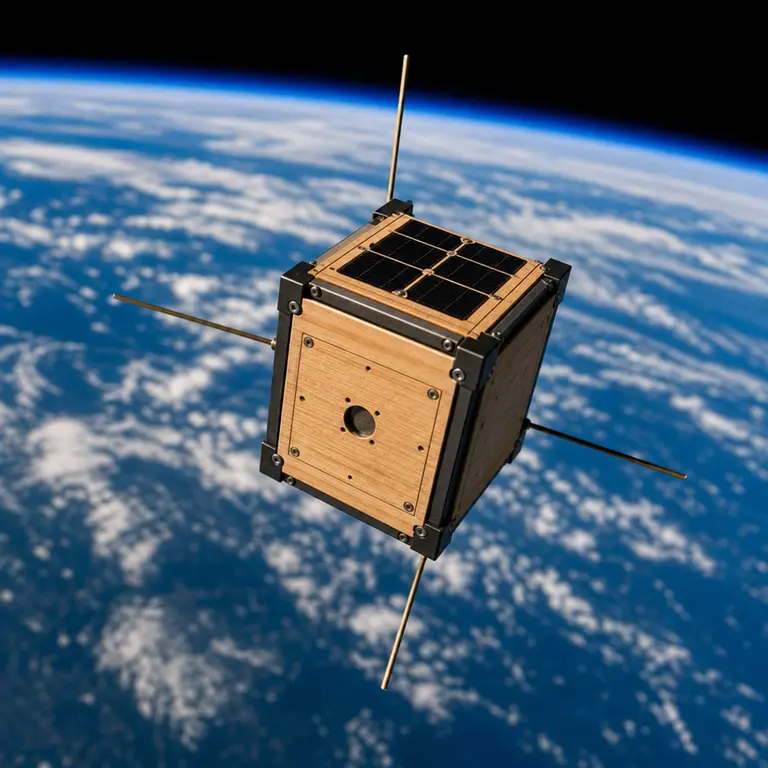
In November 2024, a small cube roughly the size of a coffee mug was delivered to the International Space Station and subsequently deployed into low Earth orbit. It was not made of aluminum, titanium, or carbon fiber. It was made of wood. Specifically, it was constructed from honoki, a Japanese magnolia species, chosen after researchers tested multiple wood types in the vacuum and radiation conditions of space. LignoSat, developed jointly by Kyoto University and Sumitomo Forestry, became the world’s first wooden satellite — and its implications for the growing crisis of orbital debris are far more serious than the novelty of its material might suggest.
The satellite is a 1U CubeSat, meaning it occupies a standardized 10x10x10 centimeter form factor. Despite its modest dimensions, the engineering questions it poses are enormous. Wood is hygroscopic, meaning it absorbs and releases moisture, and it expands and contracts with temperature. In the thermal extremes of orbit — swinging between roughly -120 and +150 degrees Celsius across each 90-minute day-night cycle — these properties were considered potentially catastrophic for a structural material. Yet early telemetry from LignoSat has reportedly shown the wooden structure performing within acceptable parameters, a result that surprised even members of the development team. That surprise is itself significant. It suggests that the intuitive dismissal of wood as a serious aerospace material may reflect cultural assumptions about what space hardware is supposed to look like rather than rigorous engineering analysis.
To understand why this experiment matters, it helps to step back and consider the broader environment in which LignoSat is operating. Low Earth orbit is not the pristine frontier it once was. It is a crowded, increasingly contested shell of altitude ranging from roughly 200 to 2,000 kilometers above the surface, and it is filling rapidly with commercial and governmental satellites, spent rocket stages, and the fragmented wreckage of collisions and explosions that have accumulated since the dawn of the space age. The question of what satellites are made of, and what they leave behind when their operational lives end, has shifted from a minor footnote in aerospace engineering to a matter of genuine planetary concern.
Why Wood Solves a Problem Aluminum Cannot
The conventional materials used in satellite construction — primarily aluminum alloys — create a specific and underappreciated environmental problem that has only recently begun to receive serious scientific attention. When satellites reenter Earth’s atmosphere at the end of life, they do not simply vaporize cleanly and disappear. Aluminum combustion at reentry temperatures produces aluminum oxide nanoparticles, which accumulate in the upper stratosphere at altitudes between 35 and 80 kilometers. A 2023 study published in the Proceedings of the National Academy of Sciences found measurable concentrations of vaporized spacecraft metals in stratospheric aerosol particles, with aluminum and other elements present at levels suggesting that roughly 10 percent of stratospheric aerosol particles now contain satellite-derived metals. The long-term effects of this accumulation on ozone chemistry and atmospheric albedo remain under active investigation, but the trend line is alarming given that tens of thousands of additional satellites are planned for launch over the coming decade.
The scale of the problem becomes clearer when viewed against current launch projections. SpaceX alone has regulatory approval to launch tens of thousands of Starlink satellites, and competing constellations from Amazon, OneWeb, and various national programs will add thousands more. Each of these satellites, at the end of its life, will reenter and burn up. If each burning satellite deposits a measurable quantity of metallic nanoparticles into the stratosphere, the cumulative effect over decades of this launch cadence could represent a novel and largely uncontrolled form of atmospheric modification. Researchers studying this question are careful to note that the science is not yet settled, but the precautionary argument is difficult to dismiss.
Wood burns completely and produces only carbon dioxide and water vapor upon reentry — compounds already present in the atmosphere in vast quantities and chemically benign in this context. No metallic nanoparticle residue, no stratospheric contamination, no novel chemistry introduced into an atmospheric layer that plays a critical role in protecting life on the surface from ultraviolet radiation. This is the core argument for wooden satellites, and it is one that atmospheric scientists have begun to take seriously as launch cadences accelerate. The LignoSat mission is in part a proof-of-concept designed to demonstrate that this material substitution is not merely theoretical but practically achievable with existing woodworking and aerospace engineering knowledge.
The Unexpected Engineering Properties of Timber in Space
Beyond the reentry argument, wood offers some genuinely counterintuitive advantages as a spacecraft material that have little to do with what happens at the end of its life and everything to do with how it performs during its operational mission. It does not interfere with radio signals the way metals do, meaning antennas and communication systems can be embedded within the wooden structure rather than mounted externally on the hull. This simplifies satellite design considerably and opens up new geometric possibilities for antenna placement that are simply unavailable when the chassis itself acts as a Faraday cage. Wood also does not generate the electromagnetic interference problems that can affect sensitive onboard instruments in metal-hulled satellites, a practical advantage that becomes more significant as satellite payloads grow more sophisticated.
The specific choice of honoki wood was not arbitrary or driven by sentiment. Researchers from the Kyoto University Wood Graduate School conducted a systematic and rigorous comparison of wood species under simulated space conditions, exposing samples to ultraviolet radiation, electron bombardment, and thermal cycling in vacuum chambers over extended periods. Several common timber species were evaluated before honoki demonstrated the best dimensional stability under these stresses, showing minimal warping, cracking, or delamination. The wood used in LignoSat was not treated with any preservatives, resins, or coatings that might compromise its clean-burn properties or introduce contaminants during reentry. It was essentially raw structural timber, machined to tolerances measured in fractions of a millimeter, a requirement that demanded considerable precision from the craftspeople who prepared it.
That precision woodworking requirement connects LignoSat to a much older tradition that is worth pausing to appreciate. The Sumitomo Forestry company, one of the mission’s corporate partners, was founded in 1691 and has been working with timber continuously for over three centuries. The company began as a copper mining enterprise that relied on vast quantities of timber for mine supports and smelting fuel, and over generations, it developed deep institutional knowledge of how wood behaves under stress, how different species respond to environmental variation, and how timber can be worked to exacting specifications. The company’s involvement in LignoSat represents one of the more unusual intersections of ancient craft knowledge and cutting-edge aerospace engineering in recent memory, and it raises an interesting question about which kinds of expertise become relevant again as engineering problems evolve in unexpected directions.
The Kessler Context and What Comes Next for Orbital Timber
LignoSat’s mission duration is approximately six months, after which it will naturally decay from orbit due to atmospheric drag at its relatively low altitude and reenter the atmosphere. Researchers are collecting data throughout this period on structural integrity under radiation exposure, the behavior of wood grain under repeated thermal cycling in vacuum, and the performance of onboard sensors embedded in a non-metallic chassis. The findings will directly inform whether wooden construction can be scaled to larger satellite formats and whether the material properties observed in ground testing hold up across a full operational mission in the actual space environment.
The broader context for this work is the Kessler Syndrome concern—a theoretical cascade scenario first described by NASA scientist Donald Kessler in 1978, in which collisions between orbital debris generate additional debris in a self-reinforcing cycle that could render certain orbital shells unusable for generations. The mathematics of the scenario are straightforward and sobering. Each collision produces fragments, each fragment increases the probability of further collisions, and beyond a certain debris density, the process becomes self-sustaining regardless of whether any new objects are launched. With the current count of tracked orbital objects exceeding 35,000 and an estimated one million objects too small to track but large enough to damage or destroy an operational spacecraft, the debris environment is already a significant operational concern for satellite operators. Any material innovation that reduces the long-term debris footprint of satellites or ensures more complete and cleaner disposal at the end of life deserves serious attention from the engineering community and policymakers.
Several European aerospace startups have begun exploring bio-derived and organic materials for small satellite construction in the wake of LignoSat’s launch, and the industry conversation has shifted perceptibly. What was dismissed as a curiosity when Kyoto University first announced the project has become a reference point in discussions about sustainable space operations. The concept of a satellite that disappears cleanly upon reentry — leaving nothing behind in either orbit or the atmosphere — represents a fundamental philosophical shift in how humanity thinks about its relationship with the space environment, moving from treating orbit as an infinite resource to treating it as a commons that requires stewardship.
Whether wood becomes a mainstream aerospace material or remains a niche solution for small satellites in low orbits, the experiment currently circling Earth at approximately 28,000 kilometers per hour is asking a question the industry can no longer afford to ignore. The materials we choose for the objects we send into space are not merely engineering decisions. They are choices about what we leave behind, and the accumulated weight of those choices is becoming visible in the stratosphere above our heads.
Sources & Further Reading
- Kyoto University / Sumitomo Forestry. LignoSat Project Overview. Kyoto University Research News, 2024. https://www.kyoto-u.ac.jp/en
- Murphy, D.M. et al. Radiative and chemical implications of the growth of stratospheric aerosol from satellite reentry metals. Proceedings of the National Academy of Sciences, 2023. https://doi.org/10.1073/pnas.2306738120
- Kessler, D.J. and Cour-Palais, B.G. Collision Frequency of Artificial Satellites: The Creation of a Debris Belt. Journal of Geophysical Research, 1978.
- ESA Space Debris Office. ESA's Annual Space Environment Report. European Space Agency, 2024. https://www.esa.int/Space_Safety/Space_Debris