
The Quantum Battery Revolution Arriving Sooner Than Expected
Quantum batteries, once purely theoretical, are edging toward real-world viability — and they could charge exponentially faster than anything lithium-ion technology can offer.
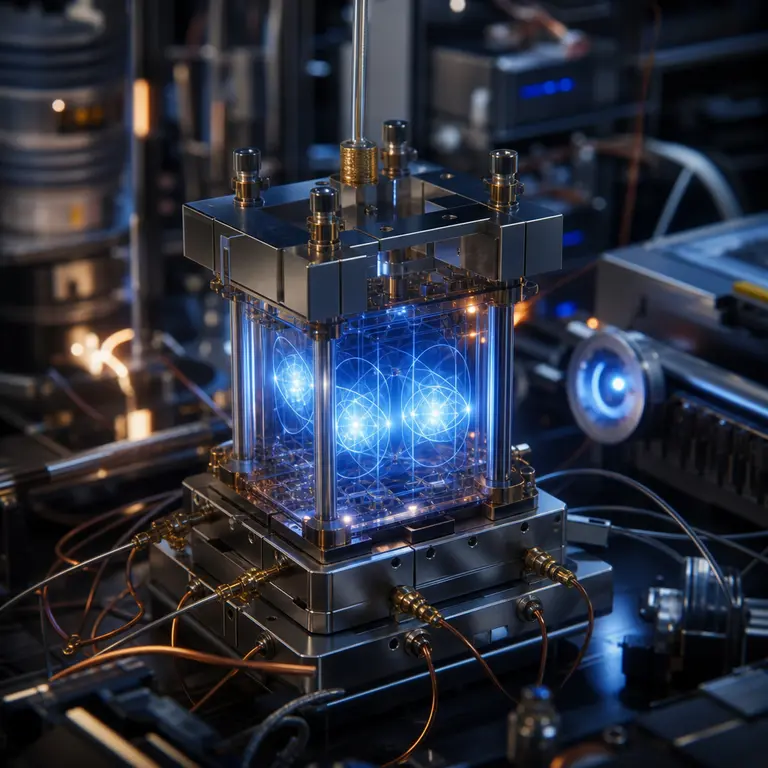
 Watch on YouTube
 Watch on Rumble
When Physics Promises to Reinvent the Power Cell
In mid-2025, researchers at institutions across South Korea, Italy, and Australia published a series of papers that accelerated the timeline for what physicists call quantum batteries — energy storage devices that exploit quantum-mechanical phenomena such as entanglement and superposition to charge and discharge at speeds that classical thermodynamics would consider impossible. Unlike a lithium-ion cell, which stores energy through fundamentally sequential electrochemical reactions, a quantum battery can theoretically charge all its cells simultaneously through a phenomenon called collective charging. The more units you add, the faster the entire system charges — a relationship that scales with the square of the number of cells, not linearly as in conventional batteries.
This counterintuitive property was first formally proposed in a 2013 paper by physicist Robert Alicki and Mark Fannes, who demonstrated mathematically that quantum coherence could be harnessed to extract work from a battery more efficiently than any classical analog. For years, the concept sat in the realm of theoretical elegance, admired by physicists and largely ignored by engineers who had no practical pathway to test it. That is rapidly changing, and the pace of change has accelerated in ways that have surprised even the researchers driving it.
What Quantum Coherence Actually Does Inside a Battery
To understand why quantum batteries behave so differently from anything on the market today, it helps to understand what coherence means in this context and why it matters so much to the energy equation. In a classical system, particles storing energy do so independently — each molecule or ion is unaware of its neighbors, processing and releasing energy in isolation according to the rules of classical thermodynamics. In a quantum-coherent system, particles exist in overlapping states and can be manipulated as a unified whole, responding to external inputs as though they share a single identity rather than operating as a crowd of individuals.
When you charge a quantum battery using coherent light or microwave pulses, you are not charging one unit at a time in the way a conventional charger deposits energy sequentially into a cell. You are applying a transformation to the entire ensemble simultaneously, which is why the charging speed advantage scales so dramatically with the number of particles involved. This is not merely a faster version of what already exists — it is a structurally different relationship between energy, time, and matter.
A 2022 experimental demonstration at the University of Queensland used an organic semiconductor microcavity — essentially a thin film sandwiched between two mirrors — to show that quantum coherence genuinely enhanced charging power in a physical system rather than just a mathematical model. The researchers measured a charging advantage that grew with the number of molecules involved, directly confirming Alicki and Fannes’s predictions at a tangible physical scale. The experiment did not produce a consumer product, but it proved that the underlying mechanism is not merely mathematical fiction, which was the critical threshold the field needed to cross.
There is also a related concept called the quantum advantage in ergotropy — the maximum extractable work from a quantum state — that adds another dimension to why these devices are so theoretically appealing. Classical batteries lose some stored energy to entropy during discharge, a loss that is not an engineering flaw but a fundamental consequence of the irreversible chemical reactions involved. Quantum batteries, under certain conditions, can theoretically recover energy that a classical device would irreversibly waste, because quantum operations can be unitary and therefore reversible in ways that chemical reactions are not. This means the efficiency ceiling of a quantum battery is set by different physics than that of anything we currently plug into a wall.
The 2025 Landscape: From Lab Curiosity to Engineering Problem
By early 2025, the field had shifted from asking whether quantum batteries work to asking how to make them work at room temperature and at scales useful to engineers rather than just to physicists with access to specialized laboratory equipment. This is not a trivial transition, and the history of quantum technology is littered with phenomena that proved theoretically sound but practically unreachable for decades. The challenge with quantum batteries follows a familiar pattern, but the solutions being proposed are increasingly creative and grounded in adjacent fields that have already made progress on similar problems.
Quantum coherence is notoriously fragile. It collapses when a system interacts with its environment — a process called decoherence — and most early quantum battery experiments required cryogenic temperatures or near-perfect isolation to maintain coherence long enough to measure anything meaningful. These conditions are achievable in a research setting but represent an obvious barrier to any technology intended to power a vehicle, a building, or a portable device operating in the ordinary world.
Researchers at the Korea Advanced Institute of Science and Technology and collaborators in Milan published work in 2024 and early 2025 exploring open quantum systems — batteries deliberately designed to interact with their environment in controlled ways rather than be shielded from it. The surprising finding is that certain types of environmental noise, rather than destroying coherence, can actually stabilize it through a mechanism called environment-assisted quantum transport. This is the same phenomenon that may explain the extraordinary efficiency of energy transfer in photosynthesis, where plants appear to exploit quantum effects in warm, wet, noisy biological environments that, by naive expectation, should destroy any quantum advantage immediately. If this approach scales into engineered devices, it removes one of the field's most daunting barriers and reframes the engineering challenge entirely — instead of fighting the environment, designers may be able to enlist it.
Separately, a group at the University of Adelaide demonstrated in 2025 that a quantum battery architecture based on two-level quantum systems — essentially artificial atoms that can exist in a ground state, an excited state, or a superposition of both — could maintain a charging advantage even under realistic levels of decoherence, provided the charging protocol was carefully optimized. Their simulations suggest that near-term quantum hardware, including the superconducting qubits already used in existing quantum computers, could serve as a testbed for functional quantum battery prototypes within this decade. The overlap with quantum computing infrastructure is significant because it means the investment and manufacturing knowledge accumulated in that industry could accelerate quantum battery development without requiring an entirely separate technological ecosystem to be built from scratch.
Why This Matters Beyond the Laboratory
The practical implications of quantum batteries, if the remaining engineering challenges are overcome, extend well beyond faster smartphone charging or more convenient consumer electronics. The technology is particularly relevant to two areas where energy density and charging speed are not merely desirable features but existential constraints on what is physically possible: electric aviation and grid-scale energy storage.
Electric aircraft require batteries that can deliver enormous bursts of power during takeoff and then recharge rapidly during short ground turnarounds, often measured in minutes rather than hours. Current lithium-ion chemistry degrades rapidly under the fast-charging cycles aviation demands, and the thermal management required to prevent dangerous overheating during rapid charging adds weight, further undermining the energy equation. A quantum battery that charges in seconds rather than hours, without the thermal degradation that plagues lithium cells, would represent a categorical shift in what electric aviation can achieve and would likely alter the economics of short-haul air travel in ways that are difficult to fully anticipate from the current vantage point.
For grid storage, the ability to absorb and release energy at quantum speeds could enable power grids to respond to fluctuations in renewable generation — from solar panels that go dark under clouds and wind turbines that slow during calm periods — with a responsiveness that no current storage technology can match. The challenge of integrating intermittent renewables into stable grids is one of the central engineering problems of the energy transition, and the solutions currently available, including pumped hydro, large-scale lithium storage, and flow batteries, each carry significant limitations in either cost, geography, or response time. Quantum storage would not replace all of these approaches, but inserting it at critical nodes where speed and efficiency matter most could change the overall architecture of how grids manage uncertainty.
There are also implications for medical technology, where implantable devices currently limited by battery life and the invasiveness of replacement surgeries could benefit from storage systems that charge wirelessly and efficiently from the body’s own thermal or electromagnetic environment. The same physics that makes quantum batteries attractive for aviation applies at the microscale, and the convergence of quantum biology research with quantum energy research suggests that some of the most interesting applications may emerge in domains that current researchers have not yet fully mapped.
A Thought Experiment Becoming an Engineering Discipline
The field is still years from commercial deployment, and intellectual honesty requires acknowledging that the distance between a promising laboratory result and a manufacturable product has humbled many technologies that once seemed inevitable. Decoherence, materials engineering, cryogenic requirements, and the challenge of interfacing quantum systems with classical electrical infrastructure remain formidable obstacles that will require sustained investment and interdisciplinary collaboration to overcome.
But the trajectory in 2025 is unmistakably toward practical realization rather than perpetual theorizing. The questions being asked have changed in character — they are engineering questions now, questions of how rather than whether, and that shift in framing carries its own significance. For a technology that began as a thought experiment about the thermodynamics of quantum mechanics, proposed by two physicists exploring abstract mathematical limits, the journey to becoming a recognized engineering discipline is already a remarkable story. What happens in the decade ahead may determine whether it also becomes a consequential one.
Sources & Further Reading
- Alicki, R. and Fannes, M. Entanglement Boost for Extractable Work from Ensembles of Quantum Batteries. Physical Review E, 2013. https://journals.aps.org/pre/abstract/10.1103/PhysRevE.87.042123
- Huang, J. et al. Quantum Battery Based on Hybrid Field Charging. Physical Review Letters, University of Queensland, 2022. https://link.aps.org/doi/10.1103/PhysRevLett.128.140501
- Campaioli, F. et al. Quantum Batteries: A Review of Theory and Experiments. Reports on Progress in Physics, IOP Publishing, 2024. https://iopscience.iop.org/article/10.1088/1361-6633/ad3812
- Vinjanampathy, S. and Anders, J. Quantum Thermodynamics. Contemporary Physics, Taylor & Francis, 2016. https://www.tandfonline.com/doi/full/10.1080/00107514.2016.1201896