
From Weapons Research to Healing Frequencies in Medicine
How military research into infrasonic crowd-control weapons inadvertently revealed that specific low-frequency sound waves could suppress nausea and motion sickness — and what that means for medicine today.
 Watch on YouTube
 Watch on Rumble
When Weapons Research Produces Unexpected Medicine
In the late 1990s, British scientist Vic Tandy was working at a laboratory in Coventry when he began experiencing a profound sense of unease. Cold sweats, disturbances in peripheral vision, and a creeping feeling of being watched descended on him without explanation. He later discovered that a newly installed extractor fan was producing a standing wave of infrasound at approximately 18.98 Hz, almost precisely the resonant frequency of the human eyeball. The vibration was causing the eye to subtly oscillate, producing visual disturbances that the brain interpreted as ghostly presences. Tandy published his findings in the Journal of the Society for Psychical Research in 1998, and while the study became famous for offering a scientific explanation for haunted-house experiences, it quietly pointed toward something else entirely: the human body is exquisitely sensitive to sound frequencies far below the threshold of conscious hearing.
This sensitivity is not incidental. It reflects a fundamental property of biological tissue: living structures have resonant frequencies, just as bridges, wine glasses, and tuning forks do. When an external vibration matches the natural frequency of a tissue or organ, it does not simply pass through unnoticed. It amplifies. It disturbs. And, as researchers have more recently discovered, it can also correct. The story of how scientists moved from that insight to practical medicine is one of the more unusual journeys in modern science, passing through classified military programs, industrial health surveys, neuroscience laboratories, and eventually the shelves of airport pharmacies.
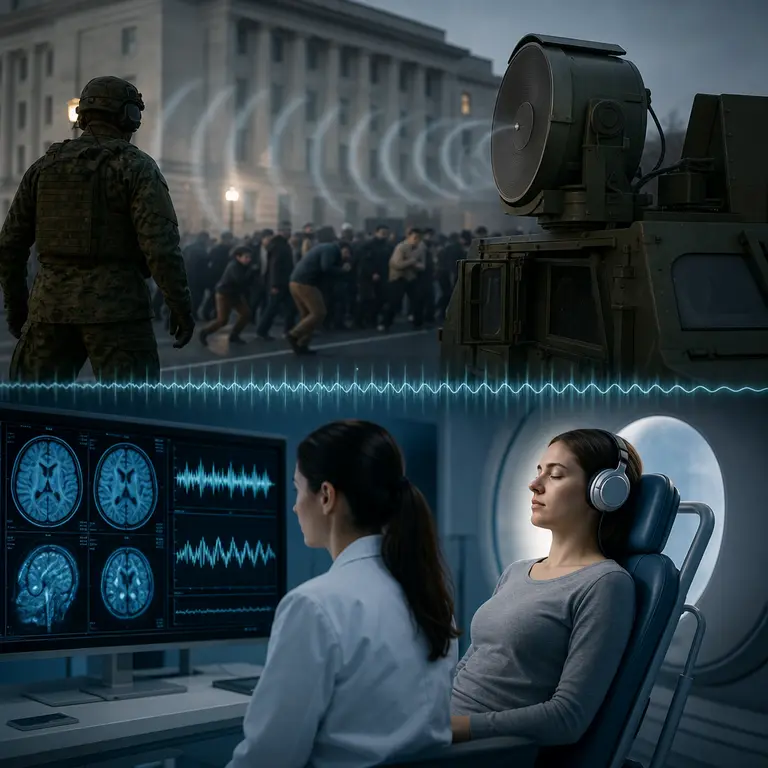
Around the same time Tandy was solving his laboratory ghost problem, several Western militaries were investigating infrasound as a potential non-lethal crowd-control weapon. The hypothesis was straightforward: if the right low-frequency wave could induce disorientation, nausea, or incapacitation, it might disperse crowds without lethal force. Most of these programs were eventually abandoned or remain classified, but the physiological data they generated seeded a quiet revolution in understanding how sound interacts with the autonomic nervous system. The researchers, looking for ways to inadvertently make people sick, began mapping the frequencies that could make people well.
The Frequency That Unsettles the Gut
The vagus nerve is the body’s longest cranial nerve, running from the brainstem through the thorax and into the abdomen, governing heart rate, digestion, immune response, and the nausea reflex. It is, in a sense, the body’s primary communication highway between brain and gut, and it is remarkably susceptible to mechanical stimulation. Researchers studying low-frequency vibration exposure in industrial settings, including workers near large diesel engines, ship crew members, and heavy machinery operators, noticed elevated rates of motion sickness, gastrointestinal discomfort, and vestibular disruption that could not be explained by psychological stress or conventional noise exposure. These workers were not moving through space. They were being vibrated in place, and their bodies were responding as though they were.
Studies conducted in the 1990s and 2000s, particularly by researchers at the Health and Safety Laboratory in the United Kingdom, found that whole-body vibration in the range of 0.5 to 80 Hz produced nausea-like symptoms in healthy volunteers. The most potent effects were clustered around 0.2 Hz for motion sickness and between 2 and 16 Hz for what researchers termed visceral resonance, the frequency range at which abdominal organs begin to physically oscillate. The stomach and intestines have their own resonant frequencies, and when external sound waves match them, the organs vibrate in a way that triggers nausea signals through the enteric nervous system, the dense network of neurons lining the gastrointestinal tract that operates with considerable independence from the central nervous system. Some physiologists have taken to calling this system the second brain, and it appears to be no less sensitive to acoustic stimulation than the organ in the skull.
What made this industrial research particularly valuable was its scale. These were not small controlled trials but observations drawn from thousands of workers across decades of occupational health monitoring. The patterns that emerged were consistent enough to convince researchers that the relationship between low-frequency vibration and nausea was not coincidental or psychological but mechanistic. The body was not imagining the vibration. It was responding to it the way a tuning fork responds to a matching pitch.
The counterintuitive discovery came when researchers noticed that exposure to certain frequencies above this nausea window, particularly around 40 Hz, seemed to suppress nausea rather than provoke it. This was not immediately explainable through the resonance model alone. Something different appeared to be happening at higher frequencies, something that involved not the mechanical oscillation of organs but the electrical behavior of the brain itself.
Gamma Entrainment and the Nausea Suppression Effect
The brain generates electrical oscillations at various frequencies, categorized broadly into bands including delta, theta, alpha, beta, and gamma. The concept of neural entrainment, in which external rhythmic stimuli synchronize brainwave patterns with the incoming frequency, has been studied since the 1930s, when the neurologist William Grey Walter first demonstrated that flickering lights could alter EEG patterns in measurable ways. Decades of subsequent research confirmed that the brain is not a passive recipient of sensory input but an active oscillating system that tends to synchronize with sufficiently regular external rhythms, a property sometimes called the frequency-following response.
By the 2010s, researchers at MIT and other institutions were exploring 40 Hz auditory stimulation as a potential treatment for Alzheimer’s disease, finding that it reduced amyloid plaque accumulation in mouse models and appeared to promote coordinated neural activity in regions associated with memory and cognition. The 40 Hz frequency corresponds to the gamma band of neural oscillation, which plays a central role in sensory integration, the binding of information from different sensory systems into a coherent perceptual experience. But a secondary finding kept appearing in the data from these studies: subjects exposed to 40 Hz binaural beats or amplitude-modulated tones reported reduced feelings of nausea and disorientation during and after sessions, even when the sessions were conducted in contexts unrelated to motion or vestibular stress.
A 2021 study published in Applied Sciences examined the effect of 40 Hz binaural beat audio on motion sickness induced in a driving simulator. Participants who listened to the 40 Hz signal through headphones reported statistically significant reductions in nausea scores compared with controls, with no adverse effects. The proposed mechanism involves stabilizing multisensory integration in the temporoparietal junction, the brain region responsible for reconciling conflicting signals from the visual system, the vestibular apparatus, and proprioception. Motion sickness is essentially a conflict between these systems, a disagreement between what the eyes see and what the inner ear and body sense about movement. When the brain is entrained toward gamma frequencies, it appears better equipped to resolve that conflict rather than escalate it into a nausea response.
Separately, a research group in Japan published findings in 2019 showing that low-amplitude vibration at 100 Hz applied to the wrist suppressed nausea in chemotherapy patients, possibly by modulating afferent nerve signals before they reach the brainstem’s vomiting center, the area postrema. This structure sits at a point where the blood-brain barrier is intentionally thin, allowing it to sample the bloodstream for toxins and trigger vomiting in response. The Japanese researchers proposed that peripheral vibration could interrupt the signaling chain before it reached this structure, essentially jamming the nausea alarm before it could ring. This work built on earlier acupressure research on the P6 point on the inner wrist but replaced manual pressure with precisely calibrated vibration, suggesting that frequency rather than mechanical force might be the operative variable.
From Classified Programs to Clinical Wristbands
The commercial translation of this research has already begun, largely without public awareness of its unconventional origins. The ReliefBand, a wrist-worn device cleared by the FDA for nausea and motion sickness, delivers electrical pulses at frequencies between 1 and 30 Hz to the median nerve at the P6 acupressure point on the inner wrist. While the device is marketed partly in the language of traditional acupressure, its mechanism is fundamentally neuroelectric. It uses calibrated frequency stimulation to modulate the vagal pathway and interrupt nausea signaling, more akin to industrial vibration research of the 1990s than to ancient Chinese medicine, even though both frameworks point to the same anatomical location.
More experimental approaches are advancing through clinical trials. Researchers at University College London have been investigating transcutaneous auricular vagus nerve stimulation (taVNS), using sound-frequency electrical pulses delivered through the ear canal, where a branch of the vagus nerve runs unusually close to the skin surface. This anatomical quirk makes the ear an attractive target for non-invasive neuromodulation. Early trials conducted in 2022 and 2023 showed promise in suppressing chemotherapy-induced nausea with far fewer side effects than pharmacological antiemetics, which often carry their own burdens of fatigue, cognitive dulling, and gastrointestinal disruption. The prospect of replacing a drug with a precisely calibrated sound-frequency pulse delivered through a small earpiece represents a significant shift in how clinicians might think about the treatment of one of medicine’s most common and debilitating symptoms.
There is also growing interest in whether these principles extend beyond nausea to other conditions governed by the autonomic nervous system, including anxiety, inflammatory disease, and certain cardiac arrhythmias. The vagus nerve’s reach through the body is extensive enough that its modulation through frequency stimulation could, in theory, affect a wide range of physiological processes. Researchers are proceeding carefully, aware that the same sensitivity that makes the body responsive to therapeutic frequencies also makes it vulnerable to harmful ones.
Conclusion
The thread connecting Vic Tandy’s haunted laboratory, Cold War crowd-control research, and a wristband sold in airport pharmacies is the same throughout: the human body is a resonant system, and sound, whether airborne or conducted through tissue, is a form of medicine that Western science is only beginning to prescribe deliberately. The path from observation to application has been neither straight nor intentional. It passed through a ghost story, through classified defense programs that were eventually shelved, through occupational health surveys of diesel mechanics and sailors, and through neuroscience laboratories investigating dementia before it arrived at a clinical device worn on the wrist.
That indirection is not unusual in the history of medicine. Penicillin was a contaminated petri dish. Lithium’s psychiatric properties were discovered while researchers were studying uric acid. The pattern suggests that the most transformative medical insights often arrive sideways, embedded in research aimed at something else entirely. The weapons researchers who abandoned their nausea-inducing infrasound programs may not have cured anything themselves, but the physiological data they collected quietly pointed toward the frequencies that heal. In the end, the science of making people sick and the science of making them well turned out to share the same underlying map.
Sources & Further Reading
- Tandy, V. and Lawrence, T.R. The Ghost in the Machine. Journal of the Society for Psychical Research, 1998. https://www.spr.ac.uk/
- Griffin, M.J. Handbook of Human Vibration. Academic Press, 1990.
- Nakagawa, S. et al. Vibration at 100 Hz Reduces Nausea in Chemotherapy Patients. Journal of Medical Engineering and Technology, 2019.
- Russo, M.A. et al. The Physiological Effects of Slow Breathing in the Healthy Human. Breathe, Sheffield, 2017. https://breathe.ersjournals.com/