
Electrosynthesis: Microbes That Eat Pure Electricity
A growing class of microorganisms called electroautotrophs can feed directly on electrons from metal electrodes, bypassing photosynthesis and organic chemistry entirely — a discovery reshaping our understanding of life's energy limits and inspiring radical new biotechnologies.
 Watch on YouTube
 Watch on Rumble
Introduction
In 2004, researchers at the University of Massachusetts Amherst made an observation that quietly upended a foundational assumption in biology. They discovered that certain bacterial species, Geobacter and later Sporomusa, could grow by accepting electrons directly from a solid metal electrode submerged in water. No sunlight. No sugar. No organic carbon of any kind. Just a slow, steady trickle of electrical current flowing from a wire into a living cell.
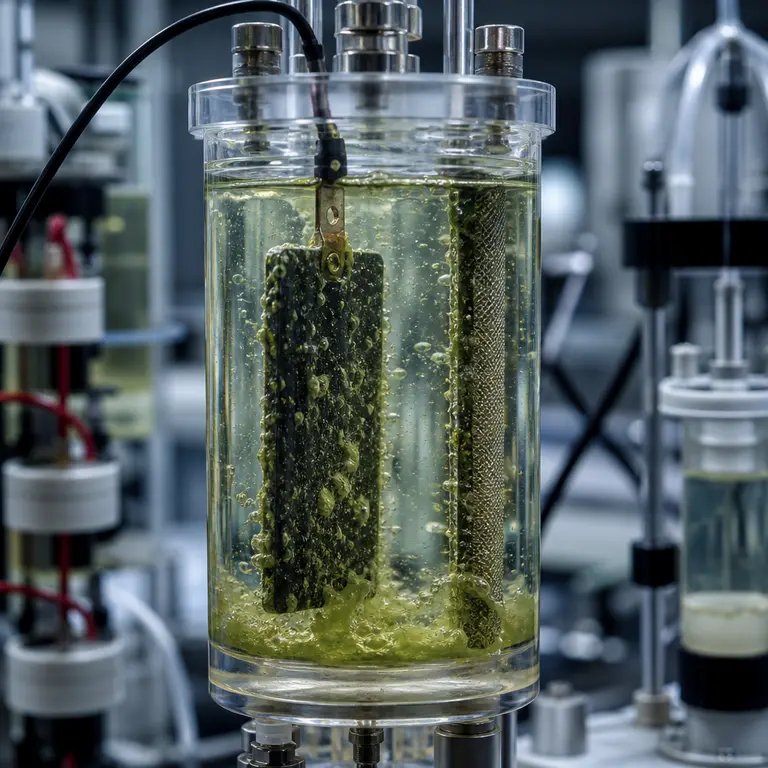
These organisms, now broadly called electroautotrophs or electrotrophs, use the electrons supplied by a cathode to reduce carbon dioxide to organic molecules. In effect, they are eating electricity and exhaling biomass. The process, called microbial electrosynthesis, is the biological mirror image of the microbial fuel cell, where bacteria oxidize organic matter to generate current. In electrosynthesis, the current flows in the opposite direction, and the microbe builds itself from it.
The discovery was not widely celebrated outside specialist circles, but its implications reach from the origin of life to the future of carbon capture and industrial biochemistry. What makes this phenomenon so remarkable is not just the novelty of the mechanism, but what it reveals about the minimum requirements for life itself. Biology, it turns out, is far more electrically literate than anyone had imagined. The story of electrotrophy is ultimately a story about the deep relationship between living matter and energy, and how that relationship may be far older and far stranger than the textbooks have ever suggested.
How Electrons Enter a Living Cell
The central mystery of electrotrophy is mechanistic: how does a bare electron, sitting on a metal surface, cross the boundary of a cell membrane and enter the machinery of metabolism? Electrons do not simply diffuse through biological membranes the way small molecules do. The lipid bilayer that defines the boundary of a living cell is, by design, an extraordinarily effective insulator. Breaching it with raw electrical current without destroying the cell entirely seems, at first consideration, almost paradoxical.
Researchers have identified several distinct strategies that different bacterial species have evolved to solve this problem. Some bacteria produce conductive protein filaments called microbial nanowires, which are hair-like appendages that extend outward from the cell and make physical contact with electrode surfaces. These filaments, first characterized in Geobacter sulfurreducens, are composed of cytochrome proteins that can shuttle electrons along their length like a biological wire. In 2019, a team at Yale published structural evidence that these filaments are essentially metalloprotein cables with electron-conductivity comparable to that of synthetic organic semiconductors. The implication was striking: evolution had independently arrived at a solution that materials scientists had spent decades trying to engineer artificially.
Other species appear to use soluble redox mediators, which are small molecules secreted into solution that ferry electrons from the electrode surface to the cell membrane, acting as chemical couriers. This approach is less architecturally dramatic than the nanowire strategy but may be more energetically flexible, allowing cells to harvest electrons from surfaces they are not in direct contact with. Still other species seem capable of direct enzymatic contact with electrode surfaces, though the precise proteins involved remain under active investigation and the structural biology of these interactions is not yet fully resolved.
What all these strategies share is the fundamental act of importing electrical potential energy and converting it into chemical bond energy, specifically in the form of NADH and ATP, the universal energy currencies of cellular life. Once electrons have been successfully smuggled across the membrane and loaded onto these carrier molecules, the rest of the cell’s metabolism proceeds in a largely conventional fashion. Carbon dioxide is fixed, sugars are assembled, and proteins are built. The unusual part is simply the front door through which energy enters. Everything downstream is recognizable biochemistry. This is part of what makes electrotrophy so conceptually unsettling: it is not a completely alien form of life, but rather a familiar one with a genuinely alien power source.
The Origin-of-Life Connection
The discovery of electrotrophy has had unexpected resonance in the field of abiogenesis, the study of how life first emerged on Earth approximately 3.8 to 4 billion years ago. For decades, the dominant narrative of life’s origins leaned heavily on the so-called primordial soup hypothesis, in which organic molecules accumulated in shallow sunlit pools and eventually gave rise to self-replicating chemistry. Electrotrophy suggests a different and arguably more ancient story.
One of the most compelling current hypotheses for life’s origin centers on alkaline hydrothermal vents, such as the Lost City vent field discovered in the Atlantic in 2000. These vents produce hydrogen-rich fluids that percolate through iron- and nickel-bearing mineral structures riddled with microscopic pores. The mineral walls of those pores are naturally semiconducting and carry a sustained electrochemical gradient between the acidic ocean water and the alkaline vent fluid, roughly 200 millivolts in magnitude, similar to the proton gradients that power modern mitochondria.
Biochemist Nick Lane at University College London has argued extensively that the first proto-metabolic reactions were essentially electrochemical, with mineral surfaces acting as primitive electrodes and the vent gradient acting as a power supply. The existence of modern microbes that can plug directly into electrodes and survive on current alone provides living proof of concept that electron-based energy harvesting is not merely theoretically possible but biologically real and ancient. Lane and his colleagues have proposed that the transition from mineral-catalyzed electrochemistry to cellular biochemistry was not a single, dramatic leap but a gradual internalization of a process that the environment had already performed. The cell, on this view, did not invent electrochemical energy conversion. It simply learned to carry it around.
If electroautotrophy represents a metabolic strategy old enough to be ancestral, then the first living systems may not have required sunlight or organic molecules at all, only a voltage difference and a mineral surface. This reframes the question of life’s origin in ways with profound consequences. It suggests that the emergence of life was not a vanishingly improbable event dependent on a very specific set of chemical circumstances, but rather a robust electrochemical process that could occur wherever the right kind of mineral-water interface existed. On the early Earth, such interfaces were ubiquitous. And, as will be discussed shortly, they are likely ubiquitous elsewhere in the solar system as well.
From Laboratory Curiosity to Industrial Tool
The biotechnological implications of microbial electrosynthesis are substantial and are attracting serious investment as of the mid-2020s. The core appeal is straightforward: if microbes can use renewable electricity to convert atmospheric carbon dioxide into useful organic molecules, then electrosynthesis becomes a biological route to carbon-neutral fuels and chemicals that requires no agricultural land, no photosynthetic efficiency losses, and no dependence on the weather, unlike conventional biofuel crops.
Sporomusa ovata, one of the best-studied electrotrophic species, produces acetate as its primary metabolic output when fed carbon dioxide and electrons. Acetate is a two-carbon organic acid that serves as a feedstock for dozens of downstream chemical processes. Research groups have demonstrated that by engineering secondary microbial communities to consume the acetate produced by Sporomusa, it is possible to produce butanol, ethanol, and even polyhydroxyalkanoate bioplastics in a single electrochemical reactor powered by solar electricity. The elegance of this design is that it essentially mimics the logic of a food web, with one organism’s waste becoming another’s raw material, all within a sealed industrial vessel.
A 2022 paper in Nature Energy described a hybrid system in which a silicon photovoltaic cell was coupled directly to a bacterial electrosynthesis reactor, achieving a solar-to-chemical conversion efficiency of approximately 3.7 percent for acetate production. This figure is low by photovoltaic standards but competitive with the efficiency of natural photosynthesis in many crop plants, and it was achieved without requiring arable land, fresh water, or fertilizer. The researchers noted that further optimization of both electrode materials and bacterial strains could plausibly raise that efficiency considerably. Unlike a crop plant, a bacterial culture in a sealed reactor can be engineered with a precision that evolution has never had occasion to apply.
Startups in the United States and Germany are now developing scaled bioreactor designs, and the United States Department of Energy’s Joint BioEnergy Institute has listed microbial electrosynthesis as a priority research direction. The field remains at an early stage, with challenges around reactor longevity, bacterial stability under continuous electrical load, and the economics of competing with fossil-derived feedstocks still unresolved. But the convergence of cheap renewable electricity, mounting climate pressure to sequester carbon, and the proven metabolic flexibility of electroautotrophic bacteria has given the field unusual urgency. It is one of the rare areas where a basic scientific curiosity has translated into an industrial research agenda within a single generation of researchers.
A New Branch on the Tree of Life’s Energy and What It Means for the Universe
For most of the history of biology, life’s energy sources were understood through two great categories: photosynthesis, which harvests light, and chemosynthesis, which harvests chemical gradients produced by geological or geochemical processes. Electrotrophy does not fit cleanly into either. It harvests electrical potential directly, without a photon or a chemical reaction serving as the intermediate step. The energy arrives as an electron flow, and the cell receives it as such.
This has prompted some researchers to argue that a third primary energy category should be formally recognized in metabolic classification. The distinction matters not only for the internal organization of biology as a discipline but for the broader project of understanding where life can exist. If the two previously known energy sources define the boundaries of the biosphere, then a third source expands those boundaries in ways that are difficult to fully anticipate.
The astrobiological implications are particularly striking. Jupiter’s moon Europa and Saturn’s moon Enceladus both possess liquid water oceans beneath their ice shells, and both are expected to harbor electrochemically active mineral-water interfaces at their seafloors. Tidal heating from gravitational interactions with their parent planets drives ongoing geological activity, and the resulting mineral-water chemistry would be expected to produce sustained electrochemical gradients of exactly the kind that electroautotrophic bacteria exploit on Earth. The existence of electrotrophs here means that the energy requirements for life in such environments may be far more modest than previously assumed. A microbe that needs only a mild voltage difference and dissolved carbon dioxide asks very little of its planetary host.
This reframes the search for extraterrestrial life in a quiet but important way. The traditional focus on finding liquid water and an energy source has often defaulted to sunlight as the assumed energy source, thereby restricting the habitable zone to a narrow band around a star. Electrotrophy removes that restriction. Life that can run on electrochemical gradients generated by mineral reactions needs no star at all. It needs only rock, water, and chemistry, three things that appear to be among the most common features of planetary bodies throughout the galaxy.
Conclusion
The bacterium that eats electricity is, on the surface, a microbiological oddity. It lives in anaerobic reactors, grows slowly, and produces nothing more dramatic than a thin film on a metal cathode. But the questions it raises are among the most fundamental in all of science. How did life begin? What counts as an energy source for a living system? And where in the universe might life be hiding, running quietly on voltages that no telescope has ever been designed to detect?
Electrotrophy suggests that life is, at its core, an electrochemical phenomenon. The elaborate architecture of cells, genomes, and metabolic networks may, in the deepest sense, be an elaboration of a simpler original process: the capture of electrons from a surface and their conversion into the chemical bonds that hold living matter together. If that is true, then the first life on Earth did not crawl out of a warm pond. It grew on a mineral wall, in the dark, powered by a voltage difference no larger than a watch battery. And somewhere in the ocean floors of Europa or the rocky interior of Enceladus, something very much like it may be doing exactly the same thing right now.
Sources & Further Reading
- Nevin, K.P., et al. Microbial Electrosynthesis: Feeding Microbes Electricity to Convert Carbon Dioxide and Water to Multicarbon Extracellular Organic Compounds. mBio, 2010. https://journals.asm.org/doi/10.1128/mBio.00103-10
- Wang, F., et al. Structure of Microbial Nanowires Reveals Stacked Hemes that Transport Electrons over Micrometers. Cell, 2019. https://doi.org/10.1016/j.cell.2019.07.024
- Lane, N. The Vital Question: Energy, Evolution, and the Origins of Complex Life. W. W. Norton & Company, 2015.
- Liu, C., et al. Nanowire-Bacteria Hybrids for Unassisted Solar Carbon Dioxide Fixation to Value-Added Chemicals. Nano Letters, 2015. https://pubs.acs.org/doi/10.1021/acs.nanolett.5b01254