
The Deadly Collision of Military Sonar and Marine Life
How military sonar causes mass cetacean strandings, and the surprising acoustic biology that explains why whales cannot escape it.
 Watch on YouTube
 Watch on Rumble
Introduction
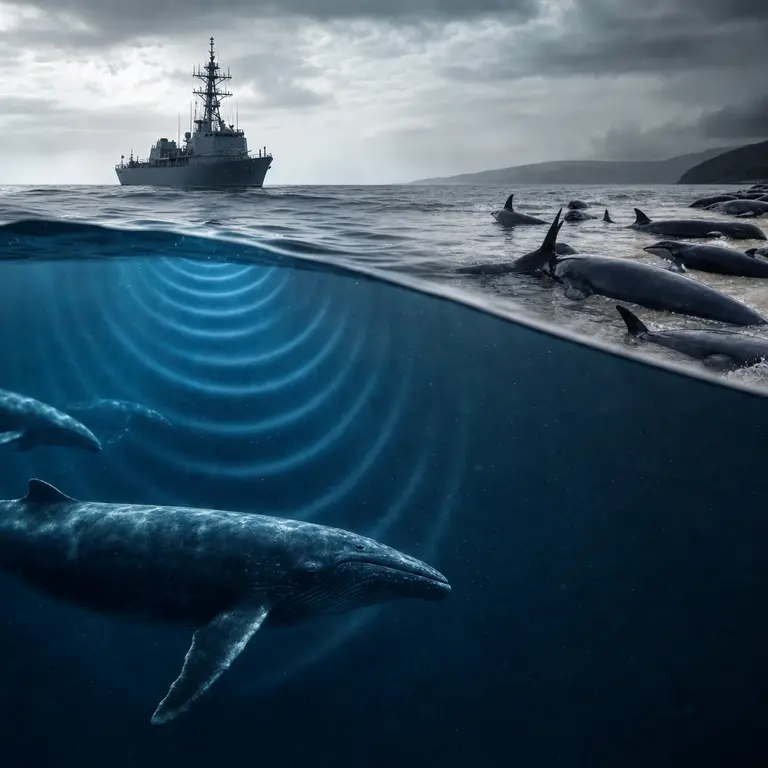
In March 2000, fifteen beaked whales stranded themselves along the shores of the Bahamas within hours of a US Navy sonar exercise in the area. Most were dead before rescuers arrived. Necropsies revealed hemorrhaging around the ears, brain, and eyes — injuries consistent with severe acoustic trauma. It was one of the first events to force a reckoning between military operations and marine biology, and it opened a disturbing window into how sound, the very medium through which cetaceans experience the world, can become a lethal weapon.
Military mid-frequency active sonar, known as MFAS, operates between 1,000 and 10,000 Hz and emits pulses that can exceed 235 decibels at the source — louder than a Saturn V rocket launch at close range. These pulses are designed to detect quiet diesel submarines by bouncing sound off their hulls across ranges of hundreds of kilometers. The ocean, being far more acoustically conductive than air, carries these signals with extraordinary efficiency. Sound travels roughly four to five times faster in seawater than in air, and it loses far less energy over distance, meaning a single sonar transmission from a naval vessel can saturate an enormous volume of ocean in seconds. What the engineers optimizing submarine detection did not fully anticipate was that the ocean was already saturated with biological acoustics, and that some of its most sophisticated listeners would respond to sonar with fatal panic. The consequences of that oversight are still being counted, decades later, in strandings on beaches from the Canary Islands to the coast of Greece.
Why Beaked Whales Are Uniquely Vulnerable
Among all cetaceans, beaked whales — particularly Cuvier’s and Blainville’s species — are disproportionately represented in sonar-related strandings. The reason lies in their extraordinary diving physiology. Beaked whales are the deepest-diving mammals on Earth. Cuvier’s beaked whales have been recorded diving to 2,992 meters and holding their breath for over three hours. To survive these dives, they have evolved a suite of adaptations: collapsible lungs, blood that stores oxygen at remarkable density, and a tolerance for nitrogen saturation that would kill a human diver within minutes of surfacing.
When sonar pulses reach these animals during or after a deep dive, researchers now believe the whales respond with a fear reflex that overrides their decompression physiology. Instead of ascending slowly to allow nitrogen to safely off-gas from their tissues, they surface rapidly. The result is a condition functionally identical to decompression sickness — nitrogen bubbles forming in the blood and tissues, causing emboli in organs and fat. Post-mortem studies by researchers, including Paul Jepson of the Zoological Society of London, published in Nature in 2003, found gas-bubble lesions in stranded beaked whales consistent with this mechanism, a finding that was initially controversial but has since gained broad scientific acceptance. The lesions were found not only in soft tissue but also in bone, suggesting that repeated exposure events may cause cumulative skeletal damage in animals that survive initial encounters with sonar.
The irony is profound: the very adaptations that allow beaked whales to dive deeper than almost any creature alive also make them uniquely susceptible to acoustic disturbance. Their survival toolkit, refined over millions of years, contains no defense against a technology that has existed for less than a century. Beaked whales are also among the least studied of all cetacean groups, owing to their preference for deep offshore waters and their elusive behavior at the surface. This means that the full scope of sonar-related mortality is almost certainly underestimated, since animals that die at depth or strand in remote locations are rarely recovered or examined.
The Acoustic Landscape Cetaceans Depend On
To understand why sonar is so disruptive, it helps to appreciate how completely sound structures cetacean existence. Toothed whales, including dolphins, sperm whales, and beaked whales, use biosonar — echolocation — to navigate, hunt, and maintain social bonds in an environment where vision is often useless beyond a few meters. The clicks they produce can reach 230 decibels, making them the loudest biological sounds on Earth, yet they are exquisitely targeted and coded in ways that allow individuals to distinguish their own signals from others in a crowded acoustic environment. Sperm whales produce a distinct pattern of clicks known as a coda, which functions like a signature, allowing them to identify one another over long distances and maintain cohesion within matrilineal social groups that can span decades.
Baleen whales, including blue, fin, and humpback whales, communicate across ocean basins using low-frequency vocalizations. The songs of blue whales, at frequencies around 10 to 40 Hz, can theoretically propagate thousands of kilometers through the deep sound channel—a natural acoustic waveguide that exists at depths of 600 to 900 meters, where sound velocity is minimum. This channel, known formally as the SOFAR channel, was discovered by military researchers during World War II as a means of transmitting signals across oceans without surface relay stations. The fact that whales had been exploiting the same physical phenomenon for millions of years was not appreciated until much later. Before industrial shipping noise began saturating the ocean in the twentieth century, researchers estimate that blue whales may have been able to communicate across entire ocean basins. Acoustic modeling by Roger Payne and Scott McVay in the 1970s first revealed the complexity of humpback whale song, but it was later work by Christopher Clark at Cornell University that quantified just how severely ocean noise had compressed these communication ranges — in some cases reducing them by 90 percent over the course of the industrial era.
Military sonar adds an acute, intense layer to this chronic anthropogenic noise background. For an animal whose survival depends on precise acoustic information, a sonar pulse is not merely loud — it is cognitively catastrophic, potentially masking the echolocation returns and social calls that the animal relies on to function. There is also growing evidence that cetaceans experience something analogous to acoustic startle responses, and that repeated exposure to intense sound events can alter behavior in ways that reduce foraging efficiency and reproductive success even in animals that survive direct acoustic injury. A blue whale that abandons a feeding ground due to noise disturbance does not simply relocate; it expends energy reserves that may determine whether a calf survives its first winter.
Legal Battles, Fleet Exercises, and Uneasy Compromises
The 2000 Bahamas stranding triggered years of litigation between conservation organizations and the US Navy. The Natural Resources Defense Council repeatedly sued over sonar use in training exercises, and in 2008, the case reached the US Supreme Court in Winter v. Natural Resources Defense Council. The court ruled 5-4 in favor of the Navy, holding that national security interests could override environmental review requirements under certain conditions. The decision was legally significant but scientifically unsatisfying — it resolved the legal question of who could authorize sonar exercises without resolving the biological question of how harmful those exercises actually were.
NATO allies have navigated this tension differently. Spain, where beaked whale strandings near the Canary Islands have been documented in correlation with naval exercises since the 1980s, eventually agreed to suspend sonar exercises in certain sensitive areas. The International Whaling Commission has called for precautionary exclusion zones around known beaked whale habitat during sonar operations. The US Navy itself has funded substantial cetacean monitoring research and now deploys marine mammal observers on vessels during exercises — though critics note that visual observation cannot detect animals that are underwater and out of sight during the critical moments of sonar transmission. The fundamental limitation of surface observation is that it addresses the problem only at the interface between two worlds, while the harm occurs entirely within one of them.
The most recent development in this ongoing tension is the deployment of passive acoustic monitoring networks — essentially listening arrays that can detect whale vocalizations in real time and alert commanders to cetacean presence before sonar is activated. Whether these systems are sensitive enough and whether operational pressures allow commanders to act on the data they provide remain open and contested questions in both naval policy and marine conservation science. Some researchers have proposed that beaked whales, because of their own sophisticated biosonar, might be detectable through their echolocation clicks before they are visually observable, offering a window of warning that current monitoring systems do not yet fully exploit. The technology exists; the institutional will to prioritize it over operational tempo is less certain.
Conclusion
The story of military sonar and cetacean mortality is, at its core, a story about the collision of two kinds of sophistication. On one side is the engineering achievement of active sonar — a technology that helped win the Cold War by turning the ocean into a transparent medium for military intelligence. On the other hand is the biological achievement of cetacean acoustics — a sensory and communicative system of extraordinary complexity that evolved over tens of millions of years to exploit the same physical properties of seawater that naval engineers later discovered and weaponized. When these two systems occupy the same water column, the consequences are asymmetric in the most brutal way possible. The sonar pulse continues to its target; the whale does not.
What makes this problem particularly resistant to resolution is that neither side of the conflict is trivial. Submarine detection is a genuine national security concern, and the oceans remain contested spaces in ways that make sonar capability operationally significant. Cetacean populations, meanwhile, are not abstract conservation symbols — they are keystone components of ocean ecosystems whose decline cascades through food webs, affecting fisheries, carbon cycling, and ocean health at a planetary scale. The nitrogen that whale carcasses carry to the seafloor, the iron that their feces recycle to surface waters, the acoustic complexity that their vocalizations contribute to marine environments — all of these are real and measurable contributions that disappear when populations collapse. The challenge for the coming decades is whether the institutions that manage both military operations and marine conservation can develop frameworks sophisticated enough to honor both imperatives, or whether the ocean will continue to absorb the costs of their failure to do so.
Sources & Further Reading
- Jepson, P.D. et al. Gas-bubble lesions in stranded cetaceans. Nature, 2003. https://www.nature.com/articles/425575a
- D'Amico, A. et al. SOCAL-BRS: A Coordinated Pacific Behavioral Response Study to Assess the Effects of Anthropogenic Sound on Marine Mammals. Aquatic Mammals, 2009.
- Clark, C.W. et al. Acoustic masking in marine ecosystems: intuitions, analysis, and implication. Marine Ecology Progress Series, 2009. https://www.int-res.com/abstracts/meps/v395/p201-222/
- Natural Resources Defense Council. Sounding the Depths II: The Rising Toll of Sonar, Shipping and Industrial Ocean Noise on Marine Life. NRDC, 2005. https://www.nrdc.org/resources/sounding-depths-ii