
The Poison That Became the World's Most Useful Gas
Carbon monoxide is one of history's most feared silent killers — yet it is also an endogenous signaling molecule produced by the human body, with emerging medical applications in surgery, organ preservation, and inflammation control.
 Watch on YouTube
 Watch on Rumble
The Gas That Kills and the Gas That Heals
Carbon monoxide occupies a peculiar dual identity in science and medicine. To most people, it is simply the invisible, odorless killer lurking in faulty furnaces and poorly ventilated garages — responsible for roughly 50,000 emergency room visits and over 400 accidental deaths annually in the United States alone. Yet since the mid-1990s, a growing body of research has revealed something deeply counterintuitive: the human body produces carbon monoxide intentionally, in small but physiologically critical amounts, and uses it as a molecular messenger that helps regulate blood pressure, suppress inflammation, and prevent cell death.
This discovery has quietly repositioned one of chemistry’s most notorious toxins as a candidate therapeutic agent — one that researchers at institutions including Harvard Medical School, the University of Pittsburgh, and the Karolinska Institute have been cautiously testing in clinical settings for over two decades. The story of carbon monoxide’s scientific rehabilitation is not simply a tale of medical curiosity. It is a window into how profoundly human assumptions about danger and benefit can be shaped by context, concentration, and the slow accumulation of evidence that challenges what everyone already believes they know.
How the Body Makes Its Own Poison
The enzyme responsible for endogenous carbon monoxide production is heme oxygenase, specifically the inducible isoform known as HO-1. When cells encounter oxidative stress, inflammation, or physical injury, HO-1 is upregulated and begins breaking down heme — the iron-containing component of hemoglobin — into three byproducts: biliverdin, free iron, and carbon monoxide. Far from being metabolic waste, this locally produced CO acts as a gasotransmitter, a class of signaling gas that also includes nitric oxide and hydrogen sulfide.
At the concentrations generated by HO-1, carbon monoxide binds to soluble guanylyl cyclase, triggering the production of cyclic GMP, relaxing smooth muscle in blood vessel walls and reducing vascular resistance. It also modulates mitochondrial respiration at low doses without shutting it down — a delicate distinction from the lethal concentrations that cause poisoning by permanently occupying hemoglobin’s oxygen-binding sites. The difference between medicine and poison, in this case, is literally a matter of parts per million.
What makes this system particularly remarkable is how ancient and conserved it appears to be across species. HO-1 activity has been detected in organisms ranging from single-celled algae to mammals, suggesting that the use of carbon monoxide as a biological signal predates the evolution of complex nervous systems by hundreds of millions of years. The human body did not stumble accidentally into producing a toxic gas. It inherited a finely tuned signaling mechanism from deep evolutionary time, one that persisted because it conferred survival advantages at the cellular level. This evolutionary context helps explain why the system is so robust and why its disruption is associated with a wide range of inflammatory and cardiovascular diseases. Individuals with genetic variants that reduce HO-1 expression have been found to face elevated risks of arteriosclerosis, ischemic injury, and certain autoimmune conditions — a pattern consistent with the idea that endogenous CO production is not incidental but essential.
Organ Preservation and the Surgery of the Future
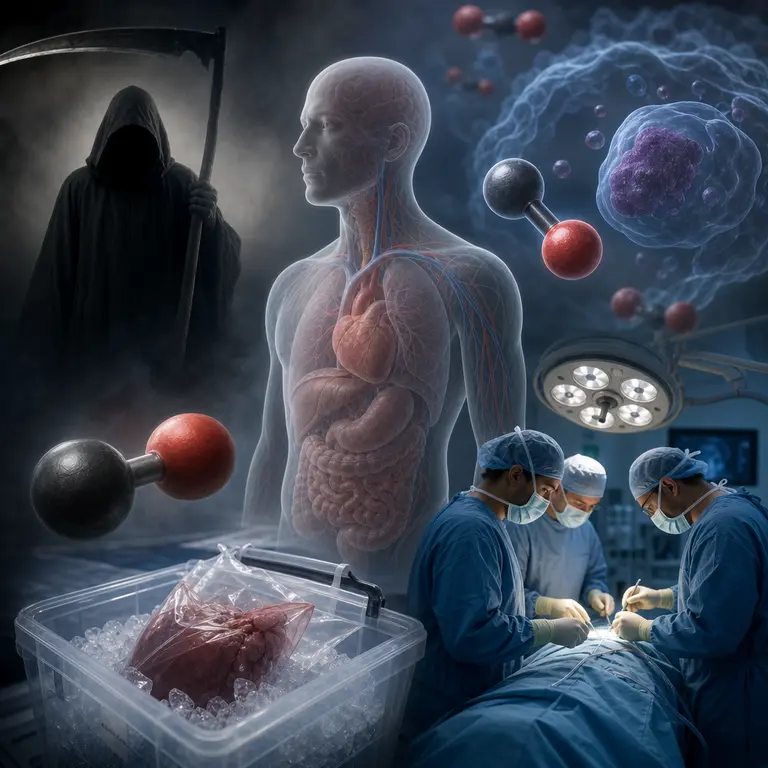
One of the most immediately practical applications under active investigation is the use of controlled carbon monoxide exposure to preserve donor organs before transplantation. Ischemia-reperfusion injury — the cellular damage that occurs when blood flow is restored to a tissue after a period of deprivation — is one of the leading causes of transplant failure. Animal studies have demonstrated that pre-treating donor organs with low-concentration CO gas significantly reduces this injury by suppressing the inflammatory cascade triggered at the moment of reperfusion.
In 2015, researchers reported that CO-treated rat hearts survived extended cold storage and demonstrated dramatically better functional recovery than untreated controls. More recently, trials involving human kidney and liver preservation have moved into early-phase human studies in Europe and the United States. The approach involves either flushing the organ with CO-saturated preservation solution or exposing the recipient patient to carefully titrated inhaled CO before surgery — concentrations of 50 to 250 parts per million, well below the threshold of toxicity but sufficient to prime cellular protective pathways.
A parallel technology, CO-releasing molecules (CORMs), has been developed to deliver the gas in a controlled, pharmacologically precise manner without requiring the patient to inhale a gas mixture. CORMs are organometallic compounds that slowly release CO upon contact with biological fluids and are currently being investigated for applications ranging from sepsis treatment to inflammatory bowel disease. The advantage of CORMs over inhaled CO is primarily one of precision and safety. Because they release the gas locally and gradually, they reduce the risk of systemic accumulation while still delivering therapeutic concentrations to targeted tissues. Several generations of CORM compounds have now been synthesized, each designed to refine the rate and location of CO release, and the chemistry involved has become a specialized subfield within medicinal chemistry in its own right.
The transplantation application carries particular urgency given the chronic shortage of viable donor organs worldwide. If CO-based preservation protocols can meaningfully extend the window during which a harvested organ remains viable for transplant, the downstream effect on patient survival could be substantial. Thousands of patients die each year while waiting for organs that never arrive in time or arrive too damaged to function. Even a modest improvement in preservation efficacy, achieved through a molecule that costs almost nothing to produce, would represent a significant advance in transplant medicine.
The Toxicology of Context
The story of carbon monoxide as medicine forces a confrontation with one of toxicology’s foundational principles, articulated by the 16th-century Swiss physician Paracelsus: the dose makes the poison. At concentrations above roughly 200 parts per million in ambient air, CO begins to outcompete oxygen for hemoglobin binding sites, forming carboxyhemoglobin and starving tissues of oxygen. Above 1,000 parts per million, unconsciousness and death can follow within an hour. The gas has no smell, no color, and no taste — it gives no warning.
Yet at 50 to 100 parts per million, administered in controlled clinical settings, the same molecule activates the Nrf2 pathway, one of the body’s master regulators of antioxidant defense. It suppresses the production of pro-inflammatory cytokines, including TNF-alpha and IL-1 beta, and has been shown in multiple animal models to extend survival in septic shock — a condition that kills approximately 270,000 Americans each year and for which effective new treatments remain desperately scarce.
The irony is not lost on researchers. The molecule that has killed people who slept too close to a campfire, or who left a car running in an enclosed garage, may one day be administered in hospitals as a precise anti-inflammatory agent. The challenge is developing delivery systems accurate enough to guarantee therapeutic rather than toxic concentrations — a problem of engineering as much as biology.
This challenge is compounded by the fact that individual sensitivity to carbon monoxide varies considerably across populations. Pregnant women, infants, the elderly, and individuals with pre-existing cardiovascular or pulmonary conditions are known to be more vulnerable to CO toxicity at any given ambient concentration. A therapeutic window that is safe for a healthy adult may be narrower or differently positioned in a patient who is already critically ill. Clinical trials must therefore grapple with questions of dosing precision that go beyond those typical of conventional pharmaceuticals. The gas cannot simply be prescribed in milligrams. It must be delivered through calibrated inhalation systems with continuous physiological monitoring, and the acceptable margin of error is vanishingly small. This is part of why the field has advanced more slowly than the underlying science might otherwise suggest.
What Comes Next
As of 2024, several pharmaceutical companies, including Hillhurst Biopharmaceuticals and Prolung, have active development programs centered on CO-based therapeutics. The FDA has granted orphan drug designation to certain CORM-based candidates for rare inflammatory conditions. Clinical trials are ongoing for CO inhalation therapy in acute respiratory distress syndrome, a condition that surged in prominence during the COVID-19 pandemic, and for which researchers noted that HO-1 upregulation appeared to correlate with better outcomes in some patient cohorts.
The COVID-19 connection is worth examining in some detail. During the pandemic, clinicians and researchers observed significant variability in patient outcomes that could not be fully explained by age, comorbidities, or viral load alone. Several research groups began investigating whether baseline HO-1 activity or genetic variants affecting the heme oxygenase pathway might account for some of this variability. Preliminary findings indicated that patients with higher HO-1 expression showed attenuated inflammatory responses to the virus, supporting the idea that endogenous CO signaling plays a protective role during acute respiratory infection. These observations accelerated interest in CO-based interventions as potential adjunct therapies for severe respiratory illness, and several pilot trials of inhaled CO in ventilated COVID-19 patients were initiated, with results that were cautiously encouraging if not yet definitive.
The broader implication is philosophical as much as medical. Carbon monoxide’s rehabilitation from pure toxin to endogenous signaling molecule is part of a larger pattern in biochemistry — the recognition that molecules the body produces, however dangerous in excess, are often dangerous precisely because they are so potent at the right concentration. Oxygen itself is toxic at high partial pressures. Nitric oxide, now recognized as a critical vasodilator and neurotransmitter, was for most of medical history simply the gas in smog. Hydrogen sulfide, which smells of rotten eggs and has caused industrial fatalities, is now understood to be a third gasotransmitter with roles in neuroprotection and cardiovascular regulation.
The history of medicine is, in part, a history of learning to listen to what the body already knows. Carbon monoxide’s journey from household hazard to prospective pharmaceutical is a reminder that the line between poison and medicine has always been drawn not by the molecule itself but by the conditions under which it acts. What the body produces deliberately, it produces for a reason — and understanding that reason, even when it contradicts everything a culture has been taught to fear, is precisely the work that science exists to do.
Sources & Further Reading
- Ryter, S.W. and Choi, A.M.K. Therapeutic Applications of Carbon Monoxide in Lung Disease. Current Opinion in Pharmacology, 2006. https://doi.org/10.1016/j.coph.2006.04.002
- Motterlini, R. and Otterbein, L.E. The Therapeutic Potential of Carbon Monoxide. Nature Reviews Drug Discovery, 2010. https://doi.org/10.1038/nrd3228
- Otterbein, L.E. et al. Carbon Monoxide Has Anti-Inflammatory Effects Involving the Mitogen-Activated Protein Kinase Pathway. Nature Medicine, 2000. https://doi.org/10.1038/75762
- Centers for Disease Control and Prevention. Carbon Monoxide Poisoning. CDC, 2023. https://www.cdc.gov/co-poisoning/