
Unraveling Khipus: The Inca Textiles Defying Conquest
For centuries, Andean khipus were dismissed as mere accounting tools. New computational analysis suggests they may encode a full writing system — one that could rewrite the history of literacy itself.
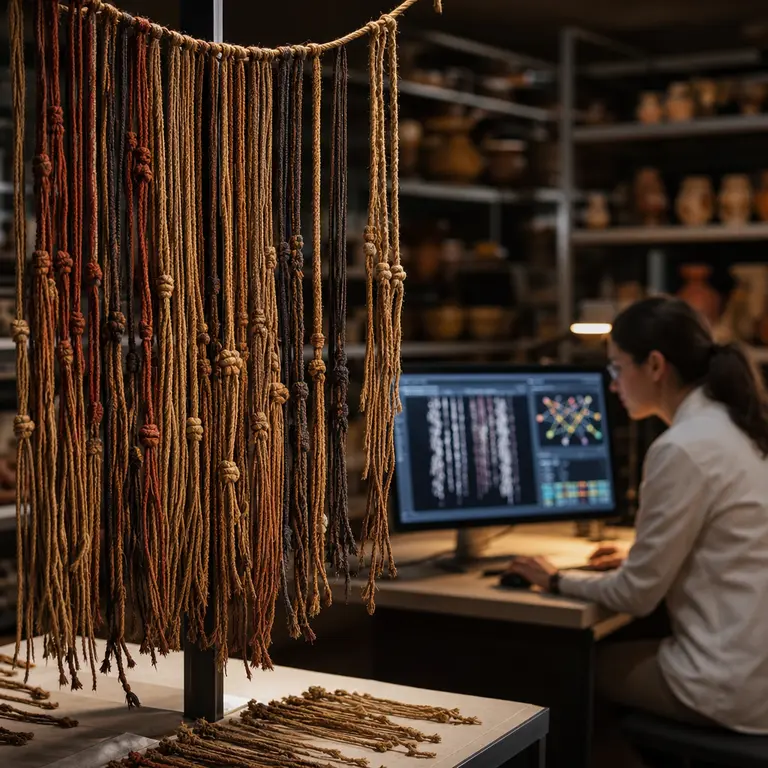
The Knots That Baffled Conquistadors
When Spanish colonizers arrived in the Andes in the sixteenth century, they encountered something that profoundly unsettled them: a civilization of extraordinary complexity that appeared to have no writing. No scrolls, no clay tablets, no inscribed monuments in any script they recognized. The Inca Empire, which at its height governed perhaps twelve million people across more than four thousand kilometers of coastline, highland, and jungle, had constructed roads, aqueducts, suspension bridges, and administrative hierarchies that rivaled anything in the contemporary Old World. And yet, as far as the Spanish could determine, it had done all of this without a written language.
What the Inca did possess were khipus — assemblages of colored, knotted cords hanging from a central spine — and administrators called quipucamayocs who could read them with apparent fluency. The Spanish burned thousands of khipus as suspected instruments of idolatry, treating them as objects of pagan ritual rather than repositories of knowledge. What survived, roughly 900 specimens now scattered across museums worldwide, has puzzled scholars for five centuries. That number represents only a fraction of what once existed. An entire archive of a civilization’s memory was reduced to ash, and what remains is fragmentary, contextless, and stubbornly resistant to interpretation.
For most of that time, the academic consensus held that khipus were sophisticated mnemonic and accounting devices: tools for recording census data, tribute tallies, and calendrical information. The knots encoded numbers using a positional decimal system, and this is firmly established. A single overhand knot in a particular position could represent a unit, a ten, or a hundred depending on its location along the cord. But a growing body of researchers now suspects the story is far more complicated — and far more significant — than a system of knotted arithmetic.
What the Computational Turn Revealed
In 2023, Harvard researcher Sabine Hyland and her collaborators published findings suggesting that certain khipus from the village of San Juan de Collata contain phonetic elements — that is, the cords may encode sounds rather than numbers. Hyland had earlier identified what she called binary coding in khipu construction: the direction of the ply, the attachment of pendant cords, the color sequences, and the type of knot each represent independent variables that can be combined and permuted. When she cataloged these variables combinatorially, she found a set of roughly 95 distinct signs — a number strikingly consistent with a syllabic writing system rather than a purely numerical one.
For context, the Cherokee syllabary contains 86 characters. Linear B, the ancient Mycenaean script used to record an early form of Greek, contains around 90 syllabic signs. The fact that khipu structural variables yield similar counts is not conclusive evidence of phonetic encoding, but it is the kind of convergence that makes serious researchers pause. A purely accounting-based system has no particular reason to settle on that range of combinatorial units. A syllabary does.
MIT’s Khipu Database Project, led by Marcia and Robert Ascher over several decades, has digitized the physical properties of over 650 khipus, creating a quantitative foundation that earlier generations of scholars simply lacked. In 2022, a team from MIT applied graph-theoretic and statistical models to this dataset and identified recurring structural patterns that resemble the syntax of a language — hierarchical clustering, positional dependencies, and frequency distributions mirroring those found in known scripts. The team was careful not to claim full decipherment, but the structural signatures were difficult to explain as mere accounting. Accounting systems do not typically exhibit the kind of long-range positional dependencies that linguists associate with grammar. Khipus, it appears, sometimes do.
The Narrative Khipus: A Separate Category
One of the most compelling pieces of evidence comes from a small subcategory of khipus that do not fit the numerical model at all. These so-called narrative khipus or anomalous khipus lack the standard decimal knot structures and instead feature unusual cord attachments, irregular color gradients, and what appear to be deliberate departures from accounting conventions. They do not tally anything researchers have identified. Colonial-era documents occasionally reference khipus being used to record histories, laws, and even poetry — accounts long dismissed by skeptics as exaggeration, misunderstanding, or the projection of European literary categories onto a foreign medium.
Those dismissals are becoming harder to sustain. The Spanish chronicler Felipe Guaman Poma de Ayala, writing in the early seventeenth century, described khipus that preserved the histories of Inca rulers and the records of military campaigns. Other colonial sources mention khipus being brought out during legal proceedings to settle disputes over land and inheritance. If these sources are accurate, then the Inca were not simply counting with their cords. They were arguing with them, commemorating with them, and possibly composing with them.
Hyland’s work on the Collata khipus is particularly striking because the community itself still retains oral traditions associated with specific khipus. When she cross-referenced the cord structures with the phonological patterns of the local Quechua dialect, she found tentative but reproducible correspondences between certain knot-and-color combinations and specific syllables. The sample size remains small, and independent replication is ongoing, but the implications are profound. If confirmed, it would mean the Inca possessed a writing system of a kind never before encountered — one encoded not in marks on a surface but in three-dimensional textile architecture. The medium itself would be unlike anything in the known history of human communication.
Why This Rewrites the History of Writing
The conventional history of writing recognizes a small number of independent inventions: Sumerian cuneiform emerging around 3200 BCE, Egyptian hieroglyphs appearing around the same period, Chinese logographs developing around 1200 BCE, and Mesoamerican scripts including Maya around 300 BCE. Each of these represents an independent cognitive achievement, a moment when a human community devised a system for externalizing language into a durable, transmissible form. The Inca, whose empire at its height in the early sixteenth century was among the largest political entities on earth, have never been included in that list. If khipus prove to encode language phonetically, that exclusion must be reconsidered, and the standard map of human intellectual history will require significant revision.
What makes the khipu case philosophically interesting beyond its historical stakes is that it challenges the very definition of writing. Most academic definitions require a system of graphic marks on a flat surface. The assumption is so deeply embedded that it rarely needs to be stated. Khipus are tactile and three-dimensional — they were designed to be read by touch as much as by sight. Blind administrators reportedly read them in complete darkness, running their fingers along the cords and interpreting the knots by feel alone. This is not a marginal or incidental feature of the medium. It is central to how khipus functioned, and it suggests that the cognitive category of text may be considerably broader than Western scholarship has assumed.
The absence of ink and parchment appears to have blinded researchers, quite literally, to a form of literacy that was hiding in plain sight — or rather, in plain touch — for centuries. The history of decipherment is full of moments when scholars failed to recognize a writing system because it did not look like the writing systems they already knew. Egyptian hieroglyphs were dismissed as decorative symbols for generations before Champollion. Linear B was assumed to be an administrative shorthand until Michael Ventris demonstrated it encoded Greek. Khipus may represent the latest, and perhaps the most structurally radical, entry in that long history of misrecognition.
A Living Act of Restitution
The implications of khipu decipherment extend well beyond academic classification and the reorganization of university syllabuses. Several Quechua communities in Peru are actively working with researchers to recover whatever meaning remains in surviving specimens, hoping to reconnect with administrative and historical records severed by colonial destruction. For these communities, the question of whether khipus encode language is not an abstract scholarly puzzle. It is a question about whether their ancestors left them messages they have not yet been able to read.
The destruction of khipus by Spanish authorities was not incidental to colonization. It was part of it. Eliminating the medium through which a civilization stored and transmitted knowledge was a way of making that civilization’s past inaccessible to its own descendants. The burning of khipus belongs to the same historical category as the burning of the Maya codices at the order of Bishop Diego de Landa in 1562 — acts of deliberate epistemic violence whose consequences are still being reckoned with today.
If a full decipherment eventually comes, it will arrive through a combination of computational analysis, linguistic fieldwork, and collaboration with communities whose oral traditions may preserve the last living keys to the system. It will not be purely an archaeological event, the kind of discovery that ends in a museum display and a journal article. It will be a restoration of voice to people whose ancestors were told, in the most literal possible way, that they had nothing worth saying. The knots that baffled the conquistadors may yet have the last word.
Sources & Further Reading
- Hyland, Sabine. How to Write in Inca: The Language of the Khipu. University of Texas Press, 2024.
- Urton, Gary. Signs of the Inka Khipu: Binary Coding in the Andean Knotted-String Records. University of Texas Press, 2003.
- Kim, Juliana et al. 'Decoding the Inca: New Statistical Approaches to Khipu Analysis.' MIT Media Lab, 2022. https://www.media.mit.edu/projects/khipu-analysis/overview/
- Ascher, Marcia and Robert Ascher. Code of the Quipu: A Study in Media, Mathematics, and Culture. University of Michigan Press, 1981.