
The Unseen Revolution: Quantum Dots in Everyday Devices
Quantum dots are revolutionizing display technology, offering unprecedented color accuracy and energy efficiency.
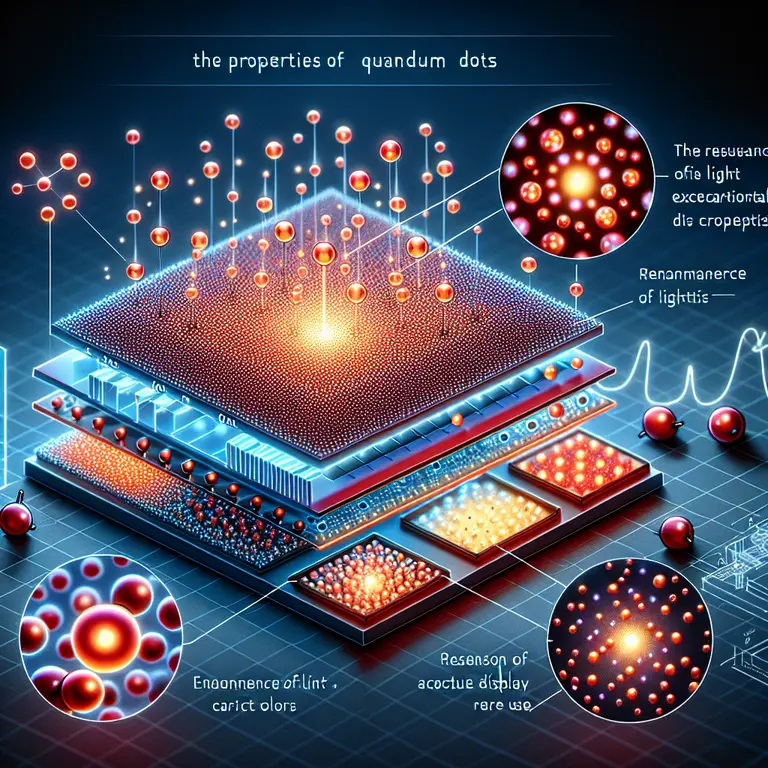
 Watch on YouTube
 Watch on Rumble
Introduction
In visual technology, a silent revolution has unfolded over the past decade. Quantum dots, nanoscale semiconductor particles, are fundamentally transforming how we experience digital imagery. These minuscule crystals, typically ranging from 2 to 10 nanometers in diameter, possess remarkable optical properties that are now being harnessed to create display technologies with unprecedented color accuracy and energy efficiency. To put their scale into perspective, a single human hair is roughly 80,000 nanometers wide, meaning you could line up thousands of quantum dots across its surface without crowding them. Yet despite their invisibility to the naked eye, the effects they produce are among the most vivid and precisely controlled ever achieved by any display technology.
As these quantum innovations transition from research laboratories to consumer electronics, they represent not merely an incremental improvement but a genuine paradigm shift in display capabilities. The implications stretch far beyond sharper televisions or brighter phone screens. They touch on how we interact with information, how artists and filmmakers communicate their intentions, and how scientists visualize data that was once too complex or too color-dependent to render accurately on a screen. Quantum dot technology promises to redefine our visual digital experiences for generations to come, and understanding the science behind it helps explain why that promise carries real weight.
The Science Behind Quantum Dots
At their core, quantum dots operate on principles derived from quantum mechanics, a branch of physics that governs the behavior of matter at subatomic and nanoscale levels. Unlike traditional display materials, quantum dots exhibit size-dependent optical properties, a phenomenon known as quantum confinement. When a semiconductor particle is reduced to a size smaller than its natural exciton Bohr radius, the electrons within it become spatially confined and begin to behave according to quantum mechanical rules rather than classical ones. This confinement changes the energy levels available to those electrons, which in turn determines the wavelength of light emitted when the particle is excited.
In practical display terms, this means that when quantum dots are excited by an energy source, typically blue LED backlighting in commercial applications, these nanocrystals emit light at specific wavelengths determined by their physical dimensions. Smaller quantum dots emit blue light, while progressively larger dots produce green and red wavelengths. The relationship between size and color is not approximate or statistical, as in traditional filter-based systems. It is governed by physics, making it extraordinarily precise and reproducible.
This precise size-wavelength relationship allows manufacturers to engineer quantum dots that emit light at exactly the desired frequencies, creating displays with exceptional color purity. The underlying semiconductor materials, most commonly cadmium selenide or indium phosphide, are carefully synthesized to ensure consistent size distribution and, therefore, consistent color output. This level of chromatic precision was previously unattainable with traditional display technologies, which relied on broad-spectrum light sources filtered through colored layers that absorbed a significant portion of the available energy. With quantum dots, the light produced is inherently narrow in its spectral bandwidth, meaning very little energy is wasted producing colors that are then blocked or discarded.
Advantages Over Conventional Display Technologies
Traditional LCD technology has dominated the consumer market for decades, and for good reason. It offered a reliable, scalable, and increasingly affordable path to flat-panel displays that replaced bulky cathode ray tube monitors. However, the fundamental limitations of LCD architecture have become increasingly apparent as consumer expectations evolve and content creation demands greater fidelity. Standard LCDs use white LED backlights whose light passes through color filters, an inherently inefficient process that wastes significant energy while producing colors that lack the vibrancy and accuracy of natural light. The white LED itself is typically a blue LED coated with a yellow phosphor, which produces a broad, somewhat uneven spectrum that color filters struggle to convert into clean primary colors.
Quantum dot displays address these shortcomings through several mechanisms that work in concert. First, they dramatically expand the color gamut, which is the range of colors a display can reproduce. A typical quantum dot display achieves over 90% of the DCI-P3 color space, the standard used in professional cinema production, compared to roughly 70% for conventional LCDs. Some advanced implementations push even further, approaching coverage of the Rec. 2020 standard, which was designed to encompass nearly the entire range of colors visible to the human eye. This translates to more vivid, lifelike images that better represent the full spectrum of human visual perception, making everything from nature documentaries to video games appear more convincingly real.
Energy efficiency represents another significant advantage that carries consequences beyond the individual device. Quantum dot displays waste substantially less energy on unwanted light frequencies because they produce precisely targeted wavelengths. Rather than generating a broad spectrum and then filtering out the unneeded portions, quantum dot systems convert energy almost directly into the specific colors required. Studies indicate that quantum dot displays can achieve up to 30% greater energy efficiency than traditional LCD panels of equivalent brightness. At the scale of millions of televisions, monitors, and mobile devices operating simultaneously around the world, that efficiency gain translates into a meaningful reduction in energy consumption and its associated environmental costs.
Implementation in Current Market Technologies
Integrating quantum dots into commercial display technologies has followed several distinct approaches, each representing a different point on the spectrum between incremental and fundamental redesign. The most widely adopted method is the quantum dot enhancement film, which involves placing a layer of quantum dots between the LED backlight and the LCD panel. This approach is attractive to manufacturers because it requires relatively modest changes to existing production lines while delivering a substantial improvement in color performance. Major manufacturers, including Samsung with its QLED product line, have embraced this technology to differentiate their premium television offerings from competitors' conventional backlighting.
An alternative approach gaining significant traction is electroluminescent quantum dot displays, which emit light directly when stimulated by an electric current, similar in concept to OLED technology but with the color-precision advantages of quantum materials. This architecture eliminates the need for a separate backlight, allowing each pixel to serve as its own light source. The potential benefits include thinner panel designs, improved contrast ratios, and even greater energy efficiency. Companies like Nanosys and Samsung Display are investing heavily in this next-generation implementation, which promises greater manufacturing flexibility and the ability to produce displays in form factors that would be impossible with backlight-dependent systems.
The computer monitor segment has also embraced quantum dot technology with considerable enthusiasm, particularly in markets where color accuracy is professionally consequential. Gaming displays benefit from the expanded color range and the improved refresh rates that become possible when the backlight system is more efficient and controllable. Professional-grade monitors for graphic design, video editing, color grading, and scientific visualization have likewise adopted quantum dot technology to achieve color accuracy previously the exclusive domain of expensive, calibrated reference monitors. This democratization of professional-grade color performance is itself a significant development, enabling a wider range of creators to work with confidence that what they see on screen reflects their true intentions.
Environmental and Manufacturing Considerations
Despite their considerable technological advantages, quantum dot implementation faces challenges that the industry has had to confront honestly. Early quantum dot formulations relied heavily on cadmium, a toxic heavy metal that raises serious environmental and regulatory concerns. Cadmium compounds are classified as carcinogens, and their presence in consumer electronics creates complications for disposal, recycling, and compliance with regulations such as the European Union’s Restriction of Hazardous Substances directive. The industry has responded by developing alternative cadmium-free quantum dots based on indium phosphide and other materials, though these formulations sometimes offer slightly reduced optical performance compared to their cadmium-based counterparts. Research into perovskite quantum dots and other novel semiconductor compositions continues, aiming to achieve cadmium-level performance without the associated toxicity.
The challenge of manufacturing at scale presents another significant hurdle. Producing quantum dots with consistent size distributions and optical properties in commercial quantities requires sophisticated, tightly controlled synthesis processes. Even small variations in particle size can shift the emitted wavelength enough to affect color accuracy, so maintaining quality across millions of units demands exceptional process engineering. Companies like Quantum Materials Corporation and Nanoco have developed continuous flow production methods that promise to increase yield while reducing costs, potentially accelerating widespread adoption. As these manufacturing processes mature and economies of scale take hold, the cost premium associated with quantum dot displays is expected to narrow considerably.
Future Directions and Emerging Applications
The evolution of quantum dot display technology continues at a pace that makes it difficult to predict where the ceiling lies. Researchers are actively exploring microLED and quantum dot hybrid architectures that combine microLED's perfect black levels and pixel-level control with quantum dot color precision. This combination could theoretically deliver the definitive display experience, with no compromises on contrast, color, brightness, or energy efficiency. Manufacturing challenges, particularly the difficulty of placing millions of microscopic LED chips with sufficient precision and yield, currently limit commercial viability, but progress is steady, and the industry consensus is that these obstacles are engineering problems rather than fundamental physical barriers.
Beyond conventional rectangular displays, quantum dots are finding applications in flexible screens, transparent displays, and augmented reality devices. Their ability to be dissolved into liquid suspensions and applied through printing or coating processes makes them uniquely suited to novel form factors and manufacturing techniques such as roll-to-roll processing, which could eventually enable display surfaces to be manufactured with the efficiency of printed paper. Augmented reality headsets, which must overlay digital imagery onto the real world with sufficient brightness and color accuracy to appear convincing under varied lighting conditions, stand to benefit enormously from quantum dot light sources that deliver intense, spectrally pure output from compact, power-efficient components.
Light-field displays, which provide three-dimensional images without requiring special glasses by controlling the direction, as well as the intensity and color of emitted light, represent another frontier where quantum dots may prove transformative. The precise wavelength control offered by these nanomaterials could help overcome current limitations in creating convincing holographic-like experiences, bringing technology once confined to science fiction within the reach of practical engineering.
Conclusion
Quantum dots represent a transformative force in display technology, offering unprecedented color accuracy and energy efficiency that is already reshaping consumer expectations and professional workflows. What began as a curiosity of quantum physics, the strange and counterintuitive behavior of matter at nanoscale dimensions, has matured into a commercially viable technology that touches the daily lives of millions of people who may never know the science behind the images they are watching.
As manufacturing processes mature and new implementations emerge, we stand at the threshold of a visual technology renaissance where digital displays can finally approach the richness and subtlety of the natural world. The challenges that remain, including scaling production, reducing costs, and addressing environmental concerns associated with certain materials, are real but not insurmountable. The trajectory of quantum dot technology appears firmly established, driven by the convergence of scientific understanding, engineering ingenuity, and genuine market demand for displays that do justice to the content they show. From next-generation televisions to revolutionary augmented reality experiences, these nanoscale semiconductors will continue to expand the boundaries of what is possible in visual technology, ensuring that our digital windows to the world grow ever more indistinguishable from the reality they represent.