
The Doorbell Invention Inspired by Inner Ear Anatomy
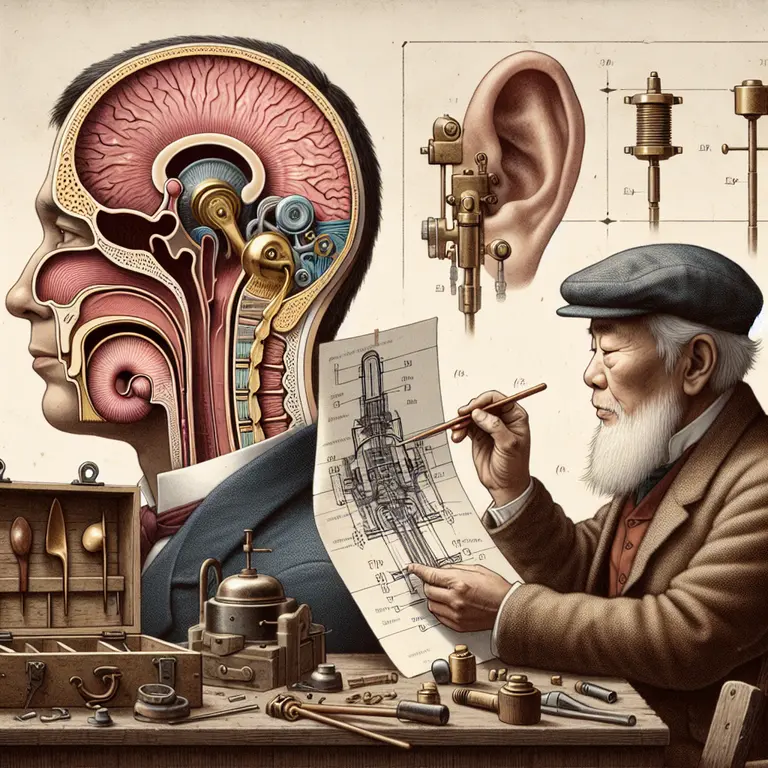
The invention of the electric doorbell was inspired by our body's inner ear anatomy, specifically the hammer and anvil mechanism.
Introduction
The history of science is filled with celebrated breakthroughs — the discovery of penicillin, the invention of the telephone, and the development of the steam engine. Yet some of the most fascinating stories in the history of innovation are the quieter ones, the discoveries that shaped everyday life in ways so ordinary that we rarely stop to question their origins. The electric doorbell is one such invention. A device so mundane that most people press it without a second thought, it owes its existence not to an engineer tinkering with circuits, but to a scientist captivated by the mechanics of the human body. Joseph Henry, one of America’s most consequential yet underappreciated scientific minds, drew a direct line between the anatomy of the inner ear and a piece of technology that now sits mounted beside billions of front doors around the world. That connection — between biological structure and electrical engineering — is a story worth telling in full.
Joseph Henry and the Science of Electromagnetism
Joseph Henry was born in Albany, New York, in 1797, and his path to scientific greatness was neither straightforward nor privileged. He grew up in poverty, worked as an apprentice to a watchmaker and silversmith in his youth, and only found his way into formal education through a combination of self-motivation and fortunate circumstance. By the time he joined the faculty of the Albany Academy in the 1820s, however, he had developed a ferocious intellectual appetite that would drive him toward some of the most significant discoveries of the nineteenth century.
In 1831, Henry discovered the fundamental principles of electromagnetic induction — the phenomenon by which a changing magnetic field produces an electric current. This discovery was made independently of and roughly simultaneously with Michael Faraday’s parallel work in England, though Faraday published first and has historically received the greater share of credit. Henry’s findings, however, were no less rigorous and in certain respects went further. He identified the concept of self-inductance, a property so central to electrical engineering that the international unit of inductance — the henry — was named in his honor. His work also directly influenced Alexander Graham Bell, who built upon Henry’s foundational research when developing the telephone decades later.
Henry was appointed the first Secretary of the Smithsonian Institution in 1846, a role he held until his death in 1878. Despite his enormous contributions to science, he was famously reluctant to patent his discoveries, believing that scientific knowledge should belong to humanity rather than to individuals. This generosity of spirit, while admirable, meant that others often received recognition and financial reward for innovations that grew directly from his work.
Joseph Henry’s Fascination with Human Anatomy
What made Henry unusual among the physicists and engineers of his era was his genuine interdisciplinary curiosity. He was not content to study electricity in isolation. He read widely across the natural sciences and was particularly drawn to the mechanics of biological systems, especially the structures of the human body that accomplish complex tasks with elegant simplicity.
The human ear captivated him most. The inner ear contains a chain of three tiny bones — the malleus, incus, and stapes, commonly known as the hammer, anvil, and stirrup — that together form one of the most efficient mechanical transmission systems in nature. When sound waves strike the eardrum, they cause it to vibrate. Those vibrations are then passed through the hammer-anvil-stirrup chain, which amplifies and transmits the signal into the fluid-filled cochlea, where it is ultimately converted into nerve impulses that the brain can interpret. The entire mechanism operates with extraordinary precision, converting pressure waves in air into meaningful neurological information within milliseconds.
Henry recognized in this system something that transcended biology. The ear was, in a fundamental sense, a signal transmission device. It received an input, transformed it through a mechanical relay, and delivered a converted output to a receiver. This was not merely a curiosity of anatomy — it was a working model of a principle that could be applied to the transmission of signals across distances using electricity. The insight was subtle but profound, and it planted a seed that would eventually grow into one of his most enduring practical contributions.
Early Innovations in Electromechanical Devices
Throughout the 1830s, Henry channeled his understanding of electromagnetism into a series of practical experiments that pushed the boundaries of what electrical devices could do. He built increasingly powerful electromagnets, demonstrating that coiled wire wrapped around iron cores could generate magnetic forces far stronger than anything previously achieved. He used these electromagnets to experiment with mechanical motion, exploring how electrical impulses could be converted into physical movement with reliable precision.
Around 1835, Henry constructed one of the earliest functional electromechanical relays. A relay is a device that uses a small electrical signal to control a larger one, allowing electricity to be switched or amplified across a circuit. This innovation was critical to the development of long-distance telegraphy, since telegraph signals weakened over distance and needed to be periodically boosted by relay stations. Henry’s relay solved this problem in principle, and later engineers — most famously Samuel Morse — incorporated relay technology into the commercial telegraph systems that would transform global communication in the mid-nineteenth century.
Henry received little public credit for the relay at the time, partly because of his reluctance to patent his inventions and partly because Morse was far more aggressive in promoting and commercializing his own system. Nevertheless, Henry’s contributions were acknowledged by those who understood the technical foundations of telegraphy, and his reputation among serious scientists remained formidable throughout his lifetime.
The Electric Doorbell: Anatomy Translated into Engineering
It is against this backdrop of anatomical curiosity and electromagnetic experimentation that Henry’s invention of the electric doorbell becomes fully comprehensible. The device he created was not a random product of tinkering — it was a deliberate application of principles he had observed in the human ear, translated into the language of electricity and mechanical engineering.
The operating principle of Henry’s electric doorbell is straightforward but ingenious. When a button is pressed, it completes an electrical circuit that sends current through a coiled wire wrapped around an iron core, creating an electromagnet. The electromagnet attracts a nearby iron armature — a small, movable metal piece — pulling it toward the coil. As the armature moves, it strikes a bell, producing the familiar ringing sound. In many designs, the armature's motion also breaks the circuit momentarily, causing the electromagnet to release the armature, which then springs back to its original position. The circuit closes again, the electromagnet reactivates, and the cycle repeats rapidly, producing a continuous ringing for as long as the button is held down.
This mechanism is a direct engineering echo of the hammer-anvil system in the human ear. Just as the malleus strikes the incus in response to vibration, the armature strikes the bell in response to electrical activation. Just as the ear converts one form of energy into another and transmits a signal to a receiver, the doorbell converts electrical energy into mechanical motion and then into sound. Henry had taken a biological blueprint and rebuilt it in copper, iron, and wire.
Impact on Modern Society and the Legacy of Cross-Disciplinary Thinking
Henry’s electric doorbell quietly transformed domestic life. Before its invention, alerting someone inside a home to a visitor’s presence required physical effort — knocking loudly, calling out, or operating a purely mechanical bell pull that required direct physical connection between the outside and the interior. The electric doorbell severed that physical dependency, allowing a signal to travel instantly through walls and across distances within a building. It made homes more accessible, more communicative, and subtly more modern.
The design principles Henry established proved remarkably durable. For well over a century, the fundamental mechanism of the electric doorbell remained essentially unchanged. Even as technology advanced through vacuum tubes, transistors, and integrated circuits, the basic electromagnet-armature-bell configuration continued to appear in homes, schools, factories, and public buildings worldwide. Contemporary smart doorbells, which incorporate cameras, wireless internet connectivity, and smartphone integration, represent the latest evolution of the technology, but they exist on a continuum that traces directly back to Henry’s nineteenth-century experiments.
Beyond the doorbell itself, Henry’s career offers a broader lesson about the value of cross-disciplinary thinking. His willingness to look at biological systems as sources of engineering inspiration anticipated a mode of innovation that has become increasingly recognized and formalized in modern science. Biomimicry — the practice of designing technologies and systems modeled on biological structures — is now an established field, producing innovations ranging from Velcro (inspired by burr hooks) to aerodynamic surfaces modeled on shark skin. Henry was practicing biomimicry before the term existed.
Conclusion
The electric doorbell is, on the surface, one of the most unremarkable objects in the modern home. It is pressed thousands of times over the course of a lifetime without prompting a single moment of reflection. Yet its origins reveal something genuinely remarkable about the nature of scientific discovery and the unexpected pathways through which knowledge travels between disciplines. Joseph Henry looked at the tiny bones of the human inner ear and saw not just anatomy, but architecture — a design principle waiting to be redeployed in a new context. That leap of imagination, from biology to engineering, from the microscopic structures of the body to the practical demands of domestic life, produced a device that has endured for nearly two centuries. It is a reminder that the boundaries between scientific disciplines are more permeable than they appear, and that some of the most consequential innovations in history began not with a problem to be solved, but with a curious mind paying close attention to the world as it already exists.