
The Eiffel Tower's Seasonal Height Changes Explained
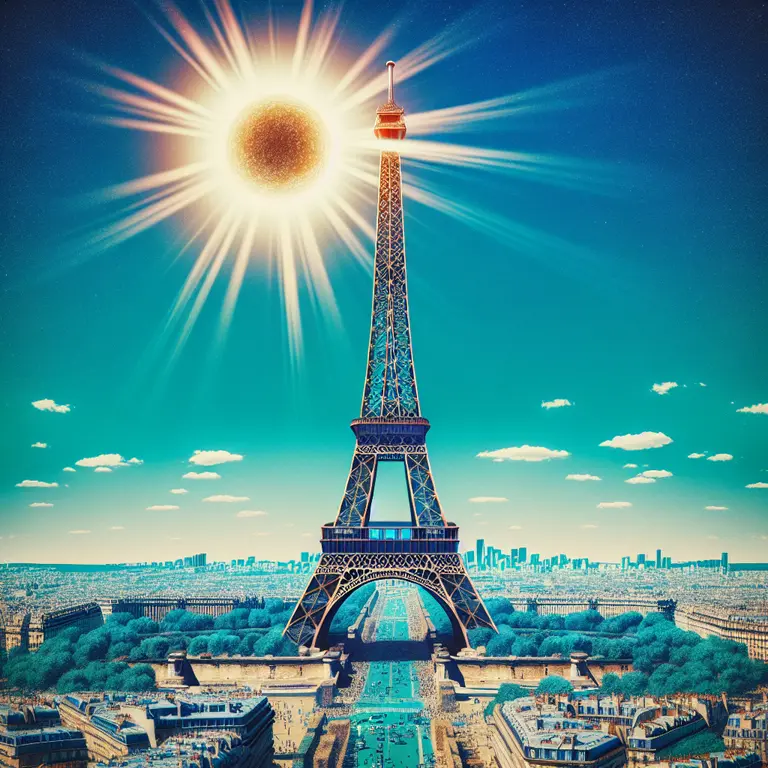
The Eiffel Tower, built in Paris (1887-1889), grows over six inches on hot days due to thermal expansion, showcasing its dynamic engineering and iconic stature.
 Watch on YouTube
 Watch on Rumble
The Eiffel Tower: Engineering Marvel, Scientific Wonder, and Enduring Icon
Few structures in human history have captured the collective imagination quite like the Eiffel Tower. Rising above the Parisian skyline on the Champ de Mars, it has become not only a symbol of France but a universal emblem of human ambition and creativity. Renowned for its impressive size, the tower stands 984 feet tall, a height that stunned the world upon its completion. Constructed between 1887 and 1889, it became the tallest man-made structure in the world, holding that record for 41 years until the Chrysler Building in New York City surpassed it in 1930. Yet the Eiffel Tower’s significance extends far beyond its height. It is a story of visionary engineering, physical science, cultural resilience, and the enduring human desire to build something that outlasts its creators.
Design and Construction
The Eiffel Tower was not born from a single stroke of genius but from a methodical, collaborative process rooted in rigorous engineering. Maurice Koechlin and Emile Nouguier, two senior engineers working under Gustave Eiffel’s construction company, conceived the original design in 1884. Their initial sketches depicted a tall pylon supported by four latticed girders, a concept that Eiffel refined and championed before submitting it as France’s centerpiece for the 1889 Exposition Universelle, a world’s fair celebrating the centennial of the French Revolution.
The construction process was as extraordinary as the structure itself. Over 18,000 individual iron parts were fabricated with extraordinary precision at Eiffel’s factory on the outskirts of Paris before being transported to the site for assembly. Workers used approximately 2.5 million rivets to join these components together, and at the height of construction, up to 300 workers labored on the tower simultaneously. Despite the scale of the project and the complexity of working at such heights, only one worker died during construction, a testament to the careful safety protocols Eiffel implemented, which were unusually rigorous for the era.
What made the engineering particularly groundbreaking was the use of puddled iron rather than steel, combined with advanced calculations to account for wind resistance. Eiffel and his team were deeply concerned with aerodynamics, and the tower’s distinctive curved legs were not merely aesthetic choices. They were mathematically derived to distribute wind load efficiently and prevent the structure from toppling under the powerful gusts that sweep across the Seine River valley. This integration of aesthetic form and structural function was ahead of its time and laid conceptual groundwork for modern architectural engineering.
The Thermal Expansion Phenomenon
Among the lesser-known but genuinely fascinating facts about the Eiffel Tower is its ability to grow measurably taller during hot summer days. Due to a physical process known as thermal expansion, the tower can increase in height by more than six inches when temperatures rise significantly. This is not a quirk or a flaw in the design. It is a direct consequence of fundamental physics, and it speaks to the sophistication with which Eiffel’s engineers approached their work.
Thermal expansion occurs because heat increases the kinetic energy of atoms within a material. As a solid object warms, its atoms vibrate more rapidly and push against one another with greater force, causing the distances between them to increase slightly. Across a structure made of thousands of tons of iron spanning nearly a thousand feet, even a small change at the atomic level accumulates into a measurable shift in overall dimensions. On a particularly hot summer day in Paris, the sun-facing side of the tower can expand more than the shaded side, causing the entire structure to lean slightly away from the sun by as much as seven inches at its peak.
This phenomenon is a critical consideration in the engineering of large structures worldwide. Bridges, railroad tracks, and pipelines are all designed with expansion joints or gaps that allow materials to grow and contract without buckling or cracking. In the case of the Eiffel Tower, the latticed iron framework itself provides the necessary flexibility. The open, grid-like design allows sections to shift slightly relative to one another, absorbing the dimensional changes without placing dangerous stress on individual components. It is a design solution that was intuitive for its time but is now recognized as an early example of what engineers call passive structural accommodation.
The thermal expansion of the Eiffel Tower also has a more subtle consequence that is rarely discussed. Because the top of the tower heats and cools at a different rate than its base, the structure is in a constant state of slow, imperceptible motion throughout the day. It breathes, in a sense, expanding as the sun climbs and contracting as temperatures drop after sunset. This dynamic quality is invisible to the naked eye but has been confirmed through precise measurements, adding an almost organic dimension to what might otherwise seem like a static monument.
Cultural Reception and Historical Resilience
When the Eiffel Tower was first unveiled, public reaction was far from universally admiring. A group of prominent French artists and intellectuals, including the writer Guy de Maupassant, signed a petition condemning it as an eyesore, calling it a blot on the Parisian landscape and comparing it unfavorably to a giant factory chimney. The criticism was fierce enough that Gustave Eiffel felt compelled to defend his creation publicly, arguing that there was beauty in the mathematical curves of its iron structure and that engineering itself was a form of art.
Time proved the critics wrong in the most decisive way possible. The tower was originally intended to stand for only 20 years before being dismantled. What saved it was its usefulness as a radio transmission tower. As wireless telegraphy emerged in the early twentieth century, the Eiffel Tower’s height made it an invaluable antenna, and French military authorities used it to intercept enemy communications during World War One. That practical function gave the structure a new purpose and effectively guaranteed its survival. What was once dismissed as a temporary curiosity became a permanent fixture of the Parisian skyline and, eventually, one of the most visited monuments on Earth.
During the German occupation of Paris in World War Two, the tower took on a different kind of symbolic weight. When Adolf Hitler visited Paris in 1940, French resistance workers cut the elevator cables so that the German leader would have to climb the stairs if he wished to reach the summit. He chose not to, and it was said that Hitler conquered France but never truly conquered the Eiffel Tower. Whether entirely accurate in every detail, the story reflects the degree to which the structure had become bound up with French national identity and the spirit of resistance.
The Visitor Experience and Living Science
When visitors arrive at the Eiffel Tower today, they typically come prepared to be impressed by its scale and history. What they may not anticipate is the degree to which the tower itself functions as a kind of living demonstration of physical principles. On a warm summer afternoon, the tower they are standing beneath is measurably taller than it was at dawn. If they visit in winter, they will find it slightly shorter. The monument is, in a very real sense, responsive to its environment in ways that most buildings are not perceptible enough to demonstrate.
This quality makes the Eiffel Tower an unusually effective subject for science education. The thermal expansion phenomenon, the aerodynamic design of its curved legs, the engineering of its riveted iron lattice, and the physics of its load distribution all offer accessible entry points into concepts that are otherwise abstract. Several educational programs in France use the tower as a real-world classroom, connecting students to physics, mathematics, and materials science through a structure they already find compelling.
Conclusion
The Eiffel Tower remains a testament to human ingenuity and engineering prowess, continuing to reveal new dimensions the longer it is studied. From its record-breaking height at completion to the collaborative genius behind its design, from its unexpected survival into the modern era to its daily performance of thermal expansion, it is a structure that rewards curiosity at every level. It breathes with the heat of the sun, leans gently away from its warmth, and stands a little taller on summer afternoons than it does on cold winter mornings. For a monument that was nearly torn down after two decades, it has proven to be among the most enduring and scientifically instructive structures ever built. Millions of visitors arrive each year to see an icon, and many leave having encountered something closer to a wonder.