
The Quantum Mirage: Atoms That Appear Where They Aren't
Inside ultracold quantum corrals, electrons project ghost images of atoms that don't physically exist — a phenomenon called the quantum mirage that may reshape future data storage and quantum computing.
 Watch on YouTube
 Watch on Rumble
The Experiment That Broke Intuition
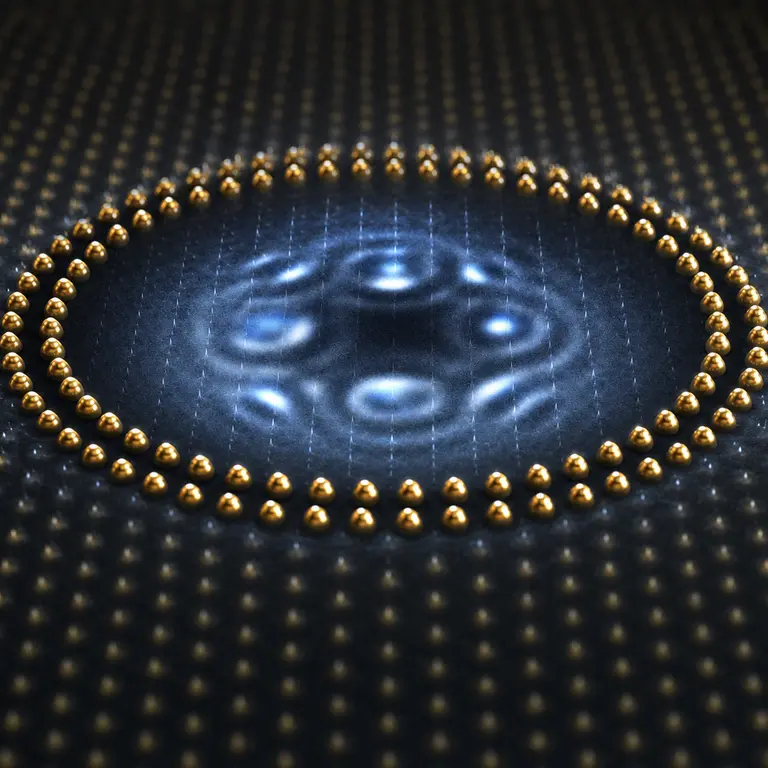
In 1993, researchers at IBM’s Almaden Research Center in San Jose did something that seemed almost absurd: they used a scanning tunneling microscope to arrange 48 iron atoms into a precise elliptical ring on a copper surface, cooled to a fraction of a degree above absolute zero. The result was not merely a feat of atomic manipulation. When a single cobalt atom was placed at one focal point of the ellipse, a ghost image of that atom — with nearly identical electronic properties — appeared spontaneously at the other focal point, where no atom existed at all.
This was the quantum mirage, and it remains one of the most visually and conceptually striking demonstrations of quantum mechanics ever produced in a laboratory. The phenomenon was formally published in Nature in 2000 by Hari Manoharan, Christopher Lutz, and Donald Eigler, and it has since challenged assumptions about locality, information, and the nature of matter itself. To understand why the experiment caused such a stir, it helps to appreciate just how far removed its implications are from everyday physical intuition. We are accustomed to thinking of information as something that must be carried by a signal, a particle, a wave traveling through a medium. The quantum mirage suggested that under the right geometric conditions, the universe has other arrangements in mind.
How a Mirage Forms at the Atomic Scale
The quantum mirage works because of the wave-like nature of electrons. At cryogenic temperatures, electrons near the surface of a copper crystal behave coherently — they do not scatter randomly but instead propagate as standing waves, much like sound in a concert hall. When iron atoms are arranged into an ellipse, they act as a quantum corral, confining and shaping those electron waves within the boundary.
An ellipse has a special geometric property: any wave emanating from one focus will converge precisely at the other focus. This is not a quantum mechanical novelty but a classical geometric truth, one that architects of whispering galleries have exploited for centuries. What makes the atomic-scale version extraordinary is that the waves being focused are quantum probability amplitudes, not sound or light, and that the information they carry is a detailed quantum-mechanical fingerprint of a real physical object.
When a cobalt atom sits at one focal point, it disturbs the local electron density in a characteristic way — creating a specific quantum mechanical signature called a Kondo resonance, named after Japanese physicist Jun Kondo, who described the effect in 1964. The Kondo effect arises when a magnetic impurity, such as a cobalt atom with an unpaired electron spin, becomes entangled with the surrounding sea of conduction electrons at low temperatures. The result is a many-body quantum state in which the impurity’s spin is screened by the electrons around it, producing a sharp and distinctive feature in the local electronic density of states. This resonance is not a simple spike in energy — it is a complex, temperature-sensitive phenomenon that encodes information about the magnetic and electronic character of the atom producing it.
Because the elliptical corral focuses electron waves so precisely, the Kondo resonance propagates across the enclosure and reconstitutes itself at the empty focal point. The scanning tunneling microscope detects an electronic signature at that second location that is nearly indistinguishable from the signature of a real cobalt atom — even though no atom is there. The mirage is not an optical illusion. It is a genuine quantum mechanical projection of electronic information across space, reconstructed in full by the geometry of the corral and the coherence of the electron waves it contains.
What the Mirage Tells Us About Information
The quantum mirage raises a profound question: if the electronic properties of an atom can be transmitted across a surface without any physical medium carrying them — no wire, no particle, no chemical bond — what does that imply about the nature of information itself?
Manoharan and his colleagues were careful to note that the mirage does not violate any physical laws. Information is not transmitted faster than light, and the phenomenon depends entirely on the coherent quantum mechanical environment of the corral. Destroy the ellipse, warm the sample above about 10 Kelvin, or introduce any disorder that scatters electrons, and the mirage vanishes instantly. The effect is fragile in precisely the way quantum coherence always is — exquisitely sensitive to environmental disturbance, requiring conditions that isolate the system from the thermal noise of the macroscopic world.
Nevertheless, the experiment demonstrated that quantum information can be projected spatially in a controlled way. The cobalt atom’s Kondo signature — a complex many-body quantum state — was effectively relocated across roughly 7 nanometers of copper surface without any conventional signal pathway. This is distinct from quantum teleportation in the photon sense, which requires an entangled pair of particles and a classical communication channel to complete the transfer. The quantum mirage, in contrast, relies on the wave mechanics of a many-electron system shaped by geometry. Yet it shares the same conceptual unsettlingness: the information about the atom appeared somewhere it should not have been, reconstructed from nothing more than the architecture of the space around it.
Subsequent theoretical work suggested that the fidelity of the mirage depends sensitively on the geometry of the corral. Ellipses work because of their dual-focus property, but researchers have explored whether other conic geometries, or three-dimensional analogs, could produce similar effects with greater stability or over larger distances. Some theoretical proposals have considered whether corrals shaped as parabolas could project a mirage to a point at infinity — effectively broadcasting a quantum signature in a directed beam rather than focusing it at a second point. These ideas remain largely theoretical, but they illustrate how the original experiment opened a conceptual space that physicists are still mapping.
Implications for Quantum Computing and Nanoscale Devices
The quantum mirage is not merely a curiosity. It points toward a class of possible nanoscale devices that could transmit or process information without conventional electrical interconnects. In a world where transistor miniaturization is approaching fundamental physical limits — with TSMC and Intel now manufacturing chips at 2-nanometer process nodes — the ability to move quantum information across a surface using only electron wave coherence could offer an entirely different architectural paradigm.
One proposed application involves using quantum corrals as logic elements, where the presence or absence of a mirage at a focal point encodes a binary state. Another direction involves exploiting the Kondo effect itself: because the Kondo resonance is exquisitely sensitive to the magnetic state of the atom producing it, a mirage-based sensor could detect single-atom magnetic changes with no physical contact required. This has potential implications for magnetic storage, where the ability to read a bit without touching the medium that encodes it would represent a fundamental departure from current technology.
There are formidable obstacles. Maintaining the quantum coherence required for a mirage demands temperatures close to absolute zero and atomically clean surfaces — conditions achievable in research laboratories but rare in commercial manufacturing environments. The scanning tunneling microscopes used to construct and observe quantum corrals are themselves large, expensive instruments that operate under ultra-high vacuum and require vibration isolation systems to function. Scaling any device based on these principles into something manufacturable at commercial volumes would require breakthroughs not just in materials science but in fabrication technology.
Room-temperature quantum coherence in condensed-matter systems is an active frontier, with materials such as topological insulators and certain two-dimensional crystals offering partial pathways forward. Graphene, for instance, supports long-range electron coherence at temperatures higher than conventional metals, and researchers have begun constructing corral-like structures on graphene surfaces to test whether mirage-like effects can be sustained under less extreme conditions. The results so far are preliminary, but they suggest that the physics demonstrated at Almaden in the 1990s may not be permanently confined to cryogenic laboratories.
The Broader Legacy of Atomic Manipulation
The quantum mirage experiment belongs to a lineage of landmark demonstrations at IBM Almaden that began in 1989, when Donald Eigler and Erhard Schweizer became the first humans to deliberately position individual atoms, spelling out the letters IBM using 35 xenon atoms on a nickel surface. That act, which took 22 hours of painstaking work, inaugurated the era of atomic-scale engineering and proved that the scanning tunneling microscope, invented by Gerd Binnig and Heinrich Rohrer at IBM Zurich in 1981, was not merely an imaging tool but an instrument of construction.
What the mirage added to this legacy was not just spectacle but a demonstration that the quantum world contains emergent phenomena with no classical analog — effects that arise not from the properties of individual atoms but from the collective quantum-mechanical environment they inhabit. The iron atoms forming the corral were not themselves doing anything exotic. They were simply walls. The physics happened in the space between them, in the invisible architecture of electron waves that those walls shaped and directed. This is a subtle but important point. The cobalt atom at the focus was real, but the mirage it cast was not a diminished or degraded copy — it was a faithful quantum mechanical reproduction, generated entirely by the geometry of the enclosure.
This insight — that geometry can be a quantum tool, that the shape of a boundary determines the behavior of the quantum world inside it — has quietly influenced fields from photonic crystal design to the engineering of topological quantum states. Photonic crystals, which confine and direct light using periodic structures rather than conventional mirrors or lenses, exploit an analogous principle: the material's geometry determines which wavelengths of light can propagate and which cannot. Topological quantum materials go further still, encoding quantum information in the global geometric properties of a system’s wave functions in a way that is inherently protected from local disturbances.
The quantum mirage was, in this sense, an early lesson in what physicists now call quantum geometry: the idea that the spatial arrangement of a system is not merely a container for physics but an active participant in it. A corral of 48 atoms on a copper surface, cooled to near absolute zero, demonstrated something that no equation alone could have made viscerally real — that space itself, structured correctly, can think. It can take the identity of an atom at one location and reproduce it somewhere else, without moving anything at all. That the effect disappears the moment the temperature rises or the geometry is disturbed does not diminish its significance. If anything, the fragility of the mirage is part of its message: the quantum world is capable of extraordinary things, but only when we are careful enough to let it be.
Sources & Further Reading
- Manoharan, H.C., Lutz, C.P., and Eigler, D.M. Quantum mirages formed by coherent projection of electronic structure. Nature, 2000. https://www.nature.com/articles/35000508
- Eigler, D.M. and Schweizer, E.K. Positioning single atoms with a scanning tunnelling microscope. Nature, 1990. https://www.nature.com/articles/344524a0
- Kondo, J. Resistance Minimum in Dilute Magnetic Alloys. Progress of Theoretical Physics, 1964.
- Crommie, M.F., Lutz, C.P., and Eigler, D.M. Confinement of Electrons to Quantum Corrals on a Metal Surface. Science, 1993.