
Glacioacoustics: The New Voice of Melting Glaciers
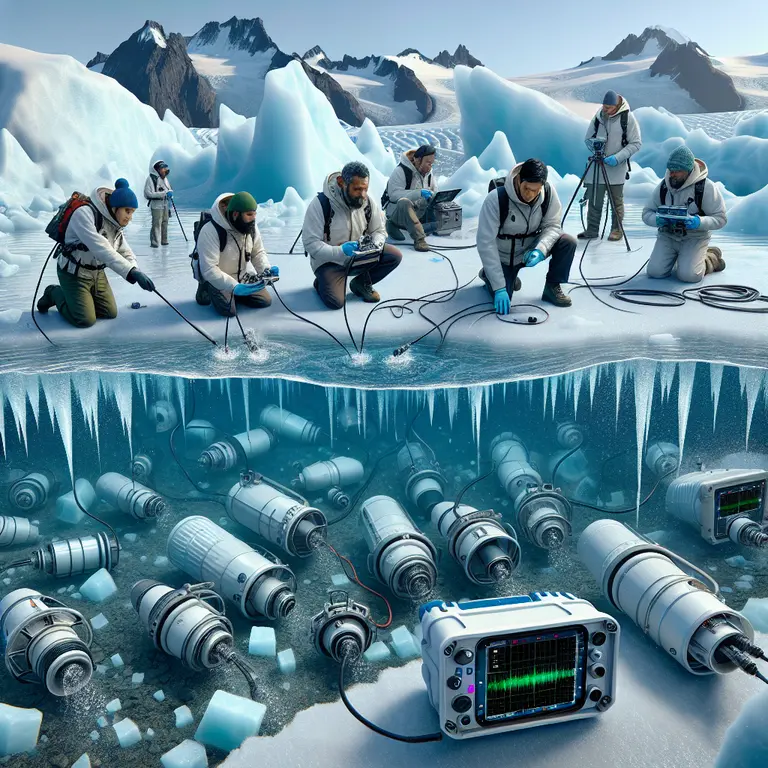
Researchers are now using hydroacoustic sensors and underwater microphones to record the sounds of melting glaciers, revealing a hidden acoustic world that may redefine how we monitor climate change in real time.
 Watch on YouTube
 Watch on Rumble
Introduction
For most of human history, glaciers have been understood as silent, geological monuments — slow, indifferent, and mute. They appear in photographs as vast blue-white expanses, timeless and impassive, the kind of landscape that seems to exist outside of ordinary time. That understanding is now being systematically dismantled by a generation of researchers who have deployed underwater microphones, called hydrophones, into the frigid meltwater pools and fjords adjacent to calving glaciers. What they are recording is not silence. It is a continuous, complex, and scientifically rich symphony of pops, hisses, groans, and roars that encodes detailed information about ice loss, meltwater flow, and structural change happening deep within the body of the ice itself.
The field is sometimes called glacioacoustics, and while it sits at the intersection of oceanography, glaciology, and acoustic ecology, it remains largely unknown outside specialist circles. That is beginning to change as climate monitoring agencies recognize that sound may offer something satellite imagery and surface sensors cannot: a real-time, high-resolution record of what is happening inside and beneath the ice. As glaciers around the world retreat at accelerating rates, the urgency of developing new monitoring tools has pushed this once-obscure discipline toward the center of climate science conversations. What began as a curiosity at the margins of several fields is now emerging as one of the more promising methodological advances in environmental monitoring of the past two decades.
What the Ice Is Actually Saying
The dominant sound produced by melting glaciers comes from a surprisingly small source. When ice melts, it releases tiny air bubbles that were trapped during the original snow compaction process, sometimes thousands of years ago. As layers of snow accumulated and compressed into glacial ice over centuries and millennia, the air between snowflakes was gradually sealed off, pressurized, and locked in place. These bubbles, compressed to pressures far above atmospheric, burst upon release into meltwater, producing a broadband acoustic signal detectable hundreds of meters away. Researchers at the University of Oregon and the British Antarctic Survey have shown that the intensity and frequency of this bubble-burst noise correlates directly with melt rate, meaning a hydrophone can function as a kind of thermometer for the ice — one that requires no physical contact with the glacier itself and no calibration against surface conditions.
This is not a trivial finding. The ability to infer internal melt rates from acoustic signals recorded at a safe distance opens up new monitoring possibilities. Traditional methods of measuring melt require either direct instrumentation embedded in the ice, which is logistically demanding and expensive, or satellite-based inference from surface elevation changes, which captures only part of the picture. Acoustic measurement captures the process as it happens, in three dimensions, without disturbing the environment being studied.
Beyond bubble noise, glaciers produce what acousticians call icequakes — seismic and acoustic events generated when large ice masses fracture internally or when a glacier slides over bedrock. These events can register on seismographs but also propagate through water as infrasound, frequencies below 20 hertz that are inaudible to humans but detectable by specialized instruments. The physics of infrasound propagation through cold seawater is well understood, and researchers have developed models that allow them to infer the location, magnitude, and character of the fracture event that produced the signal.
In 2022, a research team working near Svalbard recorded a calving event in which a section of glacier roughly the size of a city block separated and collapsed into the sea. The acoustic record of that event, analyzed in detail afterward, showed precursor signals beginning nearly 18 hours before the visible collapse. These precursor signals were subtle — small internal fractures propagating through the ice mass as stress accumulated at the calving front — but they were consistent and interpretable in retrospect. The implications are significant. If precursor acoustic patterns can be identified reliably and in real time, sound could serve as an early warning system for dangerous calving events that threaten shipping lanes and coastal communities. In regions like Greenland and Alaska, where glacial fjords are also used by fishing vessels and tourism operators, such a capability would have immediate practical value.
The Historical Accident That Started the Field
The origins of glacioacoustics are partly accidental, and the story of how the field came to exist is a useful reminder that scientific infrastructure built for one purpose often yields unexpected dividends when repurposed. During the Cold War, the United States Navy installed a global network of hydrophones across the ocean floor, officially designated the Sound Surveillance System, or SOSUS. Its purpose was unambiguous: to track Soviet submarines by listening for their acoustic signatures across the vast distances of the Atlantic and Pacific. The network was extraordinarily sensitive, capable of detecting sounds from thousands of kilometers away, and it operated continuously for decades, recording everything it heard without discrimination.
When portions of the SOSUS data were declassified in the 1990s and made available to civilian researchers, oceanographers were startled by what they found. The recordings were full of biological and geological noise that the system had been capturing alongside its intended targets — whale calls, underwater volcanic activity, the groaning of tectonic plates, and biological choruses from marine ecosystems that had never been acoustically documented before. Among the unexpected signals were the sounds of distant glaciers, particularly from the Arctic and Antarctic margins. These signals had been recorded faithfully for decades, logged and stored, and never examined by anyone with the scientific background to interpret them.
Researchers like Christopher Fox at NOAA’s Pacific Marine Environmental Laboratory began cataloging these signals in the years following declassification, inadvertently creating one of the earliest long-term acoustic records of glacier behavior ever assembled. The archive spans decades, predating the satellite era of glaciology, and covers periods of glacial activity for which almost no other continuous instrumental record exists. That archive is now being reanalyzed using modern signal-processing techniques, including machine-learning algorithms trained to distinguish glaciogenic sounds from other acoustic sources. The results are yielding a retrospective picture of glacial change dating back to the 1960s — a historical baseline that researchers had previously lacked, and that is proving invaluable for contextualizing current rates of ice loss.
Listening as a Climate Monitoring Strategy
Current satellite-based glacier monitoring is powerful but has meaningful limitations that are often underappreciated outside the scientific community. Optical satellites cannot see through cloud cover, which is persistent over polar regions for much of the year. Radar satellites can penetrate clouds but provide surface measurements that miss subsurface dynamics entirely. Ground-based sensors require expensive, logistically difficult deployments in some of the most remote and inhospitable environments on Earth, and they must be maintained and retrieved under conditions that make routine fieldwork genuinely dangerous. Each of these approaches provides a partial view of a system that is fundamentally three-dimensional and continuously changing.
Acoustic monitoring offers a different set of trade-offs, and in several respects a more favorable one for large-scale continuous observation. It can be conducted from a distance, is passive and therefore low-power, requires no consumables, and captures volumetric information about the ice mass rather than surface snapshots. A single well-positioned hydrophone array can continuously monitor a glacier for months or years using a battery-powered system, transmitting compressed data via satellite uplink with minimal human intervention. The instrumentation is also relatively inexpensive compared to radar satellites or ground-based sensor networks, which lowers the barrier to deployment in regions that have historically been undermonitored.
A 2023 study published in the journal Geophysical Research Letters demonstrated that a network of just four hydrophones positioned in a Greenlandic fjord could reconstruct melt rate estimates with accuracy comparable to on-site mass balance measurements. The cost of the hydrophone deployment was a fraction of the cost of equivalent satellite or ground sensor coverage for the same time period. Research groups in Norway, Chile, and New Zealand are now running parallel experiments in their respective glaciated regions, building a body of comparative data that will eventually allow the acoustic approach to be validated across different glacier types, climatic zones, and oceanographic conditions. Early results suggest the method may be scalable to a genuinely global monitoring network, potentially filling decades-long observational gaps.
The Aesthetics of a Melting World
There is also an unexpected dimension to this work that has caught the attention of science communicators, artists, and the broader public in ways that few developments in glaciology have managed before. The recordings themselves, when pitch-shifted into the audible range and played back through speakers, are genuinely extraordinary. They have been described by listeners as resembling whale song, distant thunder, the sound of a building slowly settling, and the kind of ambient noise one might imagine at the edge of a vast, slowly breathing organism. The sounds carry an emotional weight that is difficult to articulate but immediately felt — something between beauty and unease.
Several composers have incorporated raw glacioacoustic recordings into contemporary classical works, treating the bubble-burst sequences and icequake infrasound as source material to be layered, processed, and arranged. At least one installation artist has built an immersive acoustic environment using unedited meltwater recordings from the Vatnajokull ice cap in Iceland, allowing gallery visitors to stand inside a room that sounds like the interior of a melting glacier. The response from audiences has been striking. People who have no particular engagement with climate science or glaciology report that the experience is viscerally affecting, in a way that graphs of temperature anomalies or satellite images of retreating ice fronts rarely achieve.
This convergence of science and aesthetics is not incidental. It reflects something real about what glacioacoustics offers that other monitoring approaches do not: an immediate, sensory, and humanly legible encounter with the ice. Data is abstract; sound is not. When a listener hears the sustained, complex acoustic signature of a glacier under thermal stress, they are hearing something happening right now, in a place they will likely never visit, to a system changing faster than at any point in recorded human history.
Conclusion
Glacioacoustics is, in one sense, a narrow technical discipline — a set of methods for extracting environmental information from underwater acoustic signals in polar and subpolar environments. In another sense, it is something larger: a reminder that the natural world is communicating continuously and in multiple registers, and that our ability to understand it is limited primarily by the quality of our attention. For centuries, glaciers appeared silent because we lacked the instruments and the imagination to hear them. Now that we have both, what they are telling us is urgent, specific, and impossible to ignore. The ice has a voice. The question is no longer whether we can hear it, but whether we are listening carefully enough to act on what it says.