
Hidden Ecosystems and Ancient Pathogens in Glacial Ice
Deep within ancient glaciers, scientists are discovering living microbial ecosystems that predate human civilization — and they may be releasing pathogens frozen for millennia as the ice retreats.
 Watch on YouTube
 Watch on Rumble
Introduction
For most of human history, glaciers have been treated as geological monuments — slow, cold, and fundamentally lifeless. They appear in the imagination as pristine, frozen wastelands: beautiful in their stillness, significant for their size, and relevant mainly to climatologists tracking the pace of a warming world. That assumption is now being systematically dismantled. What researchers have discovered over the past two decades is that glacial ice is not a dead archive but a living one — teeming with organisms, viral agents, and biological complexity that challenges everything we thought we understood about the limits of life. The science emerging from Greenland ice sheets, Tibetan Plateau cores, Andean glaciers, and Arctic permafrost is quietly rewriting the boundaries of ecology, epidemiology, and planetary biology. It is also raising difficult-to-answer questions and uncomfortable ones to ignore.
Glaciers Are Not Dead — They Are Teeming
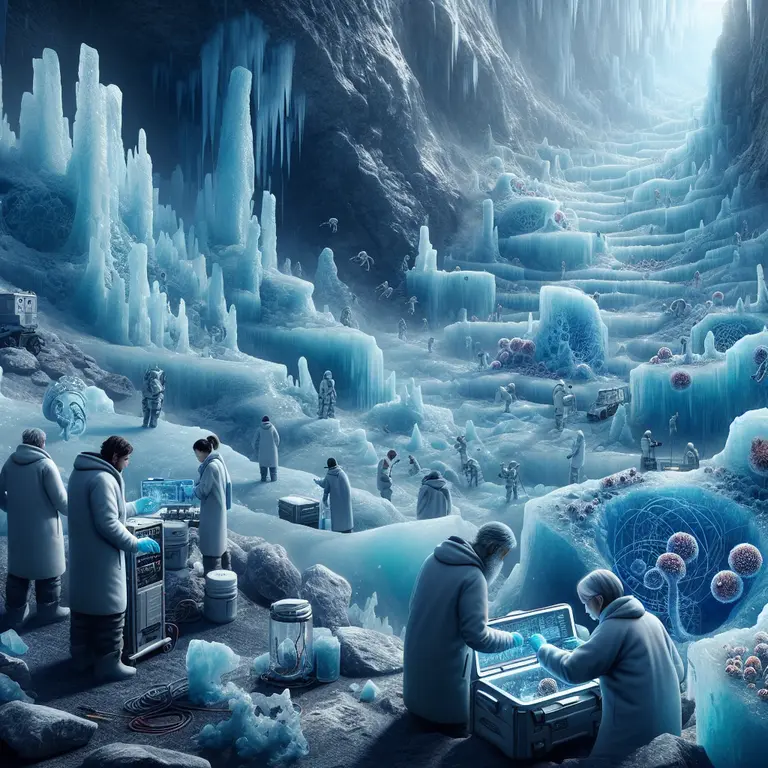
Microbiologists working across the world’s major glacial regions have confirmed that glacial ice harbors an extraordinary diversity of living organisms. Bacteria, archaea, viruses, and even microscopic algae survive in brine veins — thin channels of liquid water that persist within ice even at temperatures well below freezing. These veins, sometimes only a few micrometers wide, form a hidden liquid network threading through what appears to the naked eye to be solid, impenetrable ice. Within these channels, organisms have not merely survived; they have thrived. In many cases, they have adapted, reproduced, and evolved over timescales that dwarf the entirety of recorded human civilization.
In 2022, a team from the Chinese Academy of Sciences published findings from ice cores drilled on the Tibetan Plateau, reporting the presence of 33 virus groups — 28 of which had never been documented before in any scientific literature. The cores were approximately 15,000 years old. Crucially, these were not fossilized remnants or inert biological residue. Many of the recovered viruses showed structural integrity consistent with potential viability. The implications of that word — viability — are difficult to overstate. It means that organisms sealed inside ice during the last great glacial period, long before the first human cities were built, may still be capable of biological activity under the right conditions.
This discovery builds on decades of earlier work demonstrating that life in extreme cold is not the exception but a well-established biological strategy. Psychrophilic, or cold-loving, microorganisms have been found metabolizing at temperatures as low as -20 degrees Celsius. Some bacterial species found in Antarctic ice have been shown to repair DNA damage and maintain minimal but measurable metabolic activity even in conditions that would kill virtually any other known organism. The picture that emerges is not of glaciers as frozen graveyards but as densely layered biological archives, each stratum of ice representing a snapshot of the microbial world at a particular moment in Earth’s history.
Cryoconite: The Darkest Ecosystem on Earth
On the surface of glaciers, a peculiar, visually striking phenomenon creates one of the most productive ecosystems on the planet, given its size. Cryoconite holes are cylindrical wells that form when dark particles — dust, soot, biological debris, and industrial pollution — absorb solar radiation and melt downward into the ice, creating small pockets of liquid water that can persist through entire summer seasons. These holes, typically a few centimeters wide and deep, function as isolated bioreactors, sealed from the surrounding environment and powered entirely by sunlight filtering through the ice above them.
Inside cryoconite holes, entire food webs operate with a complexity that would not seem out of place in a temperate pond ecosystem. Cyanobacteria fix atmospheric nitrogen, algae photosynthesize and produce organic carbon, rotifers graze on microbial mats, and tardigrades — the near-indestructible microscopic animals famous for surviving the vacuum of space, intense radiation, and pressures six times greater than the deepest ocean trench — actively hunt the rotifers that share their frozen world. The energy flows through these communities in ways that mirror much larger and warmer ecosystems, compressed into a cylinder of meltwater no wider than a human thumb.
What makes cryoconite ecologically significant beyond its considerable curiosity value is its measurable role in accelerating glacial melt. The dark biological material within these holes lowers surface albedo — the technical term for a surface's reflectivity — causing the ice to absorb more solar heat rather than reflect it back into the atmosphere. This process, known as bioalbedo reduction, has been studied extensively in Greenland, where algae and cyanobacteria blooming across the ice surface now account for an estimated five to ten percent of total surface darkening. When combined with black carbon from fossil fuel combustion and dust from exposed soils, the biological component represents a meaningful and underappreciated driver of melt acceleration.
The unsettling ecological irony here is worth pausing on. The organisms living on and within glacier surfaces, through the ordinary biological processes of growth and metabolism, are engineering the destruction of the very habitat that sustains them. They darken the ice, the ice absorbs more heat, more ice melts, and the meltwater eventually carries those organisms — along with everything else preserved in the glacier — into rivers, lakes, and oceans where their fate remains largely unstudied.
Ancient Ice as a Pathogen Archive
The most alarming dimension of glacial microbiology involves not what lives inside the ice but what is released when the ice melts. In 2016, a Siberian heatwave thawed permafrost on the Yamal Peninsula in Russia, exposing the partially preserved carcass of a reindeer that had been frozen for over 75 years. The animal had died of anthrax, and the thawing released viable spores into the surrounding soil and waterways. More than 2,300 reindeer died in the subsequent outbreak, dozens of people were hospitalized, and at least one child was killed. This was not a theoretical risk modeled in a computer simulation. It was a documented, fatal outbreak caused directly by the thawing of ancient biological material, and it happened within living memory.
Researchers have since identified frozen reservoirs of far older and potentially more concerning biological material. A 2021 study published in the Proceedings of the National Academy of Sciences recovered intact giant viruses — known as Pithoviruses and Molliviruses — from Siberian permafrost dating back 48,500 years. These viruses were successfully revived in the laboratory and demonstrated the ability to infect amoeba cells. While these particular strains are not known to infect humans or other mammals, their revival confirmed a fundamental and deeply important principle: deep cold is not a sterilizer. It is a preservative. The difference between those two concepts is the difference between a freezer and an incinerator, and the world’s glaciers and permafrost layers have been functioning as freezers for hundreds of thousands of years.
The question of what else might be preserved — including strains of influenza from the 1918 pandemic, smallpox from populations buried in permafrost, or entirely unknown pathogens for which no modern immune system has any prepared response — is now a legitimate field of epidemiological concern rather than speculative science fiction. The World Health Organization and several national health agencies have begun preliminary discussions about surveillance frameworks for what some researchers are calling paleoviruses: ancient viral agents with no corresponding immunity in modern human or animal populations. The field is nascent, underfunded, and racing against a timeline it did not set.
The Race to Sample Before It Disappears
There is a profound and painful scientific irony at the center of this entire field of research. The same climate change that is releasing potentially dangerous ancient microbes is also destroying the very archives that scientists need to study them. Ice cores are the primary tool for reconstructing Earth’s atmospheric, climatic, and biological history across deep time, and the glaciers that hold them are retreating at rates that were considered worst-case scenarios only fifteen years ago. Some glaciers projected to persist until the end of this century in the early 2000s have already effectively disappeared.
The Glacier Archive project, coordinated by researchers at Ohio State University and international partners including institutions in France, China, and Peru, has been racing to extract and preserve ice cores from glaciers projected to disappear within decades. The cores are transported to repositories maintained at minus 20 degrees Celsius, preserving not just climate data encoded in trapped air bubbles but the biological material embedded within each layer. This includes pollen, fungal spores, bacteria, and viruses from every era in which the glacier accumulated ice, some stretching back hundreds of thousands of years and encompassing biological communities that predate modern humans entirely.
The logistical and financial challenges of this work are immense. Drilling operations must be conducted at high altitudes, often in remote, politically complex regions. The cores must remain continuously frozen throughout transport across multiple continents. The repositories themselves require ongoing maintenance and institutional commitment that span generations of scientists and funding cycles. And yet the scientific community pursuing this work understands that the window for collecting these samples is closing rapidly and will not reopen. Once a glacier is gone, its biological contents are dispersed into the environment or destroyed, and the record they contained is permanently erased.
Conclusion
What is unfolding inside the world’s glaciers is not simply a story about climate change or microbiology in isolation. It is a convergence of several of the most consequential scientific and public health questions of our time. Life has been persisting in a frozen state for timescales that challenge human comprehension, and the rapid warming of the planet is now beginning to unlock that archive in ways that are simultaneously scientifically invaluable and potentially dangerous. The organisms thriving in cryoconite holes are accelerating the very melt that will eventually destroy their habitat. The viruses preserved in ancient permafrost are being exposed to a world that has no immunity to them. And the scientists who most urgently need to study these phenomena are in a race against the disappearance of the very material they depend on. The glaciers are not dead. They are, in fact, one of the most consequential living systems on Earth — and we are only beginning to understand what we stand to lose when they are gone.