
A Medieval Banking System That Burned Down Parliament
For over 700 years, the English government kept its financial records not on paper or parchment, but on notched sticks — and their destruction accidentally burned down Parliament.
 Watch on YouTube
 Watch on Rumble
The Tally Stick: Britain’s Wooden Banking System
Imagine walking into a modern bank and being handed a piece of hazel wood as your receipt. Absurd? For roughly 700 years, this was essentially how the English Crown managed its finances — and the system worked so well that it outlasted the Roman Empire, the Black Death, and the invention of the printing press. The tally stick is one of those rare historical artifacts that sits at the intersection of cryptography, carpentry, political economy, and architectural catastrophe. It is a story about how an ancient piece of notched wood quietly shaped the language of modern finance, anticipated the logic of digital computing, and ultimately burned down one of the most important buildings in British history — not through sabotage or warfare, but through the mundane negligence of bureaucratic housekeeping.
How the System Actually Worked
A tally stick was a piece of wood — usually hazel or willow, chosen for its straight grain and workability — into which a scribe carved notches of varying widths and depths to represent specific monetary amounts. The system was precise and standardized. A deep, thumb-width notch might represent one thousand pounds; a thinner cut, one pound; a small nick, a single penny. The denomination of each mark was understood and consistent across the Exchequer’s operations, meaning that a trained clerk could read a tally stick as fluently as a modern accountant reads a spreadsheet.
Once the notches were carved, the stick was split lengthwise. The debtor kept one half, known as the foil, and the creditor — most often the Royal Exchequer itself — retained the other, known as the stock. This is, remarkably, where we get the modern financial terms' stock' and 'stockholder'. When you hold stock in a company today, you are linguistically inheriting a tradition that began with a medieval clerk splitting a piece of wood in two. The etymology is not metaphorical. It is literal.
The genius of the system was its built-in fraud prevention, and this is where the tally stick becomes genuinely impressive as a piece of engineering. Because the grain of the wood ran continuously across both halves before the split, a forged or altered stick would almost never match its counterpart when the two pieces were reunited. The fibers, knots, and natural irregularities of the wood created a unique biological fingerprint that no forger could replicate. In an era without standardized paper currency, reliable ink, or institutional oversight mechanisms, this was cutting-edge security technology. The wood itself was the authentication protocol.
The System That Refused to Die
The tally stick system was formally introduced to English royal finance around 1100 CE under Henry I, and it remained the official accounting method of the Exchequer until 1826 — a span of more than seven centuries. That endpoint is worth dwelling on. By 1826, the steam engine had already transformed British industry. The Napoleonic Wars had been fought and won. Jane Austen had written all six of her novels. The Bank of England had been issuing paper banknotes for over a century. And yet, buried inside the administrative machinery of the British government, clerks were still carving notches into sticks and splitting them in half as the official record of royal debt.
This was not because the system was secretly superior to paper ledgers. It was because bureaucratic inertia is one of the most powerful forces in human civilization. The tally stick had become embedded in the procedural DNA of the Exchequer so thoroughly that no one had found a compelling enough reason to uproot it. Institutional habits, once established, tend to persist long past the point of usefulness, and the English Exchequer was a particularly conservative institution. The sticks kept accumulating, year after year, decade after decade, filling storage rooms in Westminster with the compressed wooden memory of centuries of royal debt.
When Parliament finally abolished the system in the 1820s, it was left with an enormous and rather awkward inheritance: a vast stockpile of obsolete tally sticks that no one quite knew what to do with. They had no monetary value. They had no obvious practical use. They were simply old wood, carved with the financial records of a system that the modern world had finally agreed to leave behind.
The Fire That Remade British Architecture
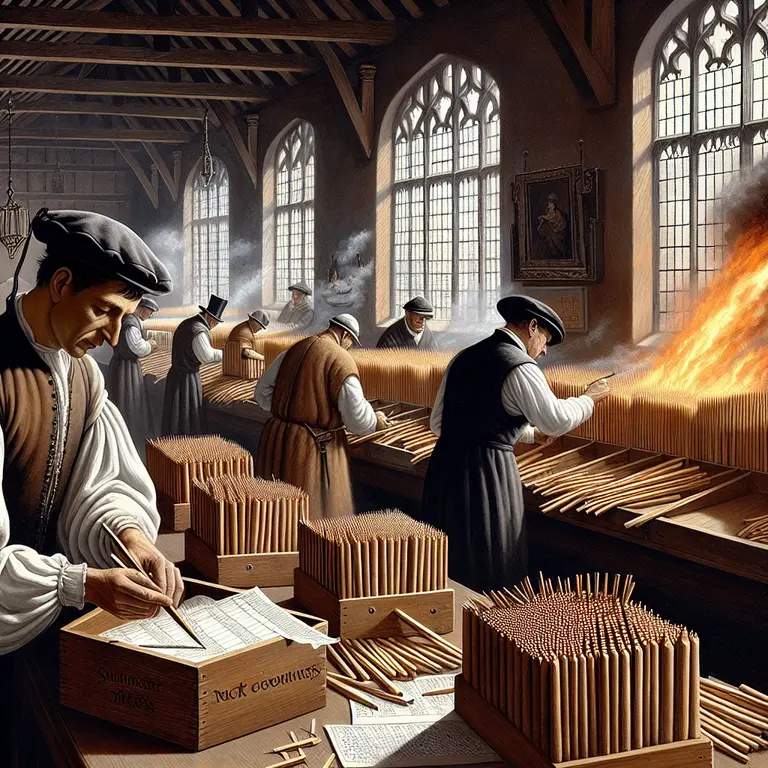
The decision about what to do with the accumulated tally sticks was eventually delegated to the kind of minor official who handles exactly this sort of unglamorous administrative problem. The solution chosen was incineration. In October 1834, workers began feeding the sticks into the furnaces beneath the Houses of Parliament, which heated the building through a system of underfloor flues. It was a sensible enough idea in principle. The execution was catastrophic.
The furnaces were overloaded with more material than they were designed to handle. The heat built beyond safe levels. The flues, running beneath floors and inside walls that had stood since the medieval period, began to conduct that heat into the building's fabric. By the afternoon of October 16, 1834, the Palace of Westminster was on fire. By nightfall, the blaze had grown into one of the most dramatic conflagrations London had witnessed in living memory. The medieval palace, which had served as the seat of the English and then British government for centuries, was almost entirely destroyed.
The fire drew enormous crowds to the banks of the Thames. Among those watching was the painter J.M.W. Turner, who was already one of the most celebrated artists in Britain and who had a lifelong fascination with light, atmosphere, and the drama of natural and industrial forces. Turner sketched the fire from a boat on the river, capturing the spectacle with the rapid, observational intensity that characterized his working method. He later translated those sketches into two finished oil paintings, the most famous of which, The Burning of the Houses of Lords and Commons, now hangs in the Philadelphia Museum of Art. It is considered one of his masterworks — a painting of extraordinary luminosity and emotional force, born entirely from the decision to burn a pile of old receipts.
A Proto-Digital Technology Hidden in Plain Sight
The story of the tally stick does not end with the fire, because the technology's intellectual implications deserve serious attention. Tally sticks are not merely a historical curiosity. They are, in a meaningful structural sense, a proto-digital system, and the parallels to modern information technology are striking enough that information theorists have taken notice.
The tally stick's logic is binary at its core. A notch is either present or absent. It is either deep or shallow, wide or narrow. These distinctions encode information in discrete, unambiguous units in a way that maps with surprising directness onto the 1⁄0 logic of modern computing. The stick is not storing analog information — it is storing digital information, in the precise sense that the data exists as distinct, enumerable states rather than as a continuous spectrum.
More remarkable still is the split-stick verification method, which anticipates the conceptual architecture of modern cryptographic key pairs. In contemporary digital security, systems like RSA encryption work by generating two mathematically linked keys — one public, one private — that can authenticate a transaction without ever being combined until the moment of verification. The tally stick operates on exactly the same principle. The two halves are generated together from a single source, separated, and held independently until the moment when the debt needs to be settled or verified. The wood grain is the shared mathematical relationship. The split is the key generation. The reunion is the authentication event.
The hazel stick and the RSA encryption algorithm share the same idea, separated by nine centuries and an enormous difference in substrate.
Conclusion
The tally stick asks us to reconsider a comfortable assumption that most people carry without examining it — the assumption that financial sophistication arrived in a clean historical sequence, moving from primitive barter to coins to paper to digital systems, with each stage representing a clear improvement on the last. The tally stick disrupts this narrative. It was robust, fraud-resistant, scalable, and conceptually elegant. It encoded information in a way that anticipated digital logic. It secured transactions using a principle that modern cryptography would later rediscover independently.
And then, after seven centuries of reliable service, it burned down Parliament.
There is something almost philosophical in that ending. The tally stick was not defeated by a superior technology or rendered obsolete by innovation. It was simply abandoned, left to accumulate in a storage room until someone decided the most practical thing to do was set it on fire. The receipts became the weapon. The filing system became a catastrophe. And out of that catastrophe came one of the great paintings of the nineteenth century, hanging today in Philadelphia, still glowing with the light of a fire that should never have been lit.