
The Wooden Ledgers That Ran an Empire — Then Burned It Down
For over 700 years, England's royal treasury ran almost entirely on notched wooden sticks — and their destruction in 1834 accidentally burned down Parliament.
 Watch on YouTube
 Watch on Rumble
Introduction: The Most Consequential Accounting Tool You’ve Never Heard Of
For roughly 700 years, the English Exchequer kept its official financial records not in leather-bound ledgers, not on parchment, and certainly not in any digital system, but on hazel wood sticks. These were called tally sticks, and they were, in their own strange way, one of the most sophisticated financial instruments the medieval world ever produced. They were also, ultimately, responsible for one of the most dramatic acts of accidental institutional self-destruction in recorded history.
The story of the tally stick is the kind of story that collapses the comfortable distance we like to maintain between the ancient and the modern. It is a story about fraud prevention, cryptographic logic, the hidden dangers of institutional change, and the strange chain of accidents that gave London one of its most recognizable skylines. It begins with a piece of wood and a knife, and it ends with a parliament in flames.
How a Notched Stick Ran the Royal Treasury
The mechanics of the tally stick were deceptively simple, which was precisely the point. When a tax payment or royal loan was recorded, a clerk would carve a series of notches into a hazel rod. The size of each notch corresponded to a specific denomination: a deep, wide notch might represent a thousand pounds, a shallower cut a hundred, and a thin score a single shilling. The carved rod was then split lengthwise. The debtor kept one half, called the foil, and the Exchequer retained the other, called the stock. To verify a transaction at any future point, you simply match the two halves together. Because the grain of wood is entirely unique to each individual piece, and because the notches had been carved through both halves simultaneously before splitting, the match was essentially impossible to forge.
This system began under Henry I in the early 12th century and persisted, with relatively little modification, until Parliament formally abolished it in 1826. That is a longer operational lifespan than the printed spreadsheet has yet achieved. During those seven centuries, tally sticks recorded royal debts, tax obligations, loans to the Crown, and payments to government creditors. They were the backbone of English public finance during the Crusades, the Hundred Years' War, the Black Death, and the entire Tudor dynasty.
One small linguistic artifact of this system has survived into everyday English without most people recognizing its origin. The word stockholder derives directly from the tally stick. To hold stock was, in the most literal possible sense, to hold your half of a wooden stick — the physical evidence of a financial claim against another party. When modern investors speak of holding stock in a company, they are using language that traces back to a medieval clerk splitting a piece of hazel in a stone-floored counting house.
Cryptography Before Cryptography: A Medieval Zero-Trust System
What makes tally sticks genuinely remarkable from a modern perspective is not simply that they worked, but how they worked, and what that method reveals about the underlying logic of secure information exchange. The tally stick system represents an early, intuitive implementation of what computer scientists now call a shared secret authentication scheme — the same fundamental concept that underlies modern two-factor authentication, cryptographic key pairs, and zero-trust network architecture.
Consider the system's structure in abstract terms. Two parties each hold a unique piece of information — or in this case, a unique physical object — that is meaningless in isolation but becomes verifiable proof when combined with the corresponding piece held by the other party. Neither half alone proves anything. Together, they authenticate a transaction without requiring either party to trust the other or a central authority to vouch for the record. The grain of the wood serves as what cryptographers would call a shared secret: something that cannot be replicated, cannot be forged, and can only be verified through direct comparison.
Medieval English peasants and Exchequer clerks were, without any awareness of the conceptual framework, practicing the essential logic of zero-trust security. They had arrived at it not through abstract reasoning but through practical necessity, in a world where literacy was rare, paper was expensive, and the temptation to falsify financial records was as strong as it has ever been. The tally stick elegantly and cheaply solved the authentication problem by using nothing more than the natural uniqueness of biological material.
This cross-disciplinary resonance is not merely a clever observation. It points to something important about the history of ideas: that fundamental logical structures tend to be discovered and rediscovered across radically different contexts and technologies. The hazel stick and the cryptographic key pair are separated by nine centuries and a vast technological gulf, yet they solve the same problem with the same underlying architecture.
The Disposal Decision That Destroyed a Palace
Here is where the story tips from interesting into extraordinary.
When Britain finally modernized its accounting systems in the early 19th century, Parliament officially abolished the tally stick system in 1826. By 1834, the Exchequer had accumulated centuries' worth of hazel sticks — a vast wooden archive of the English state's financial history from the age of the Crusades onward. These sticks were stored in the basement of the Palace of Westminster, which had served as the seat of English parliamentary government since the 11th century.
Someone decided the most efficient solution was to burn them.
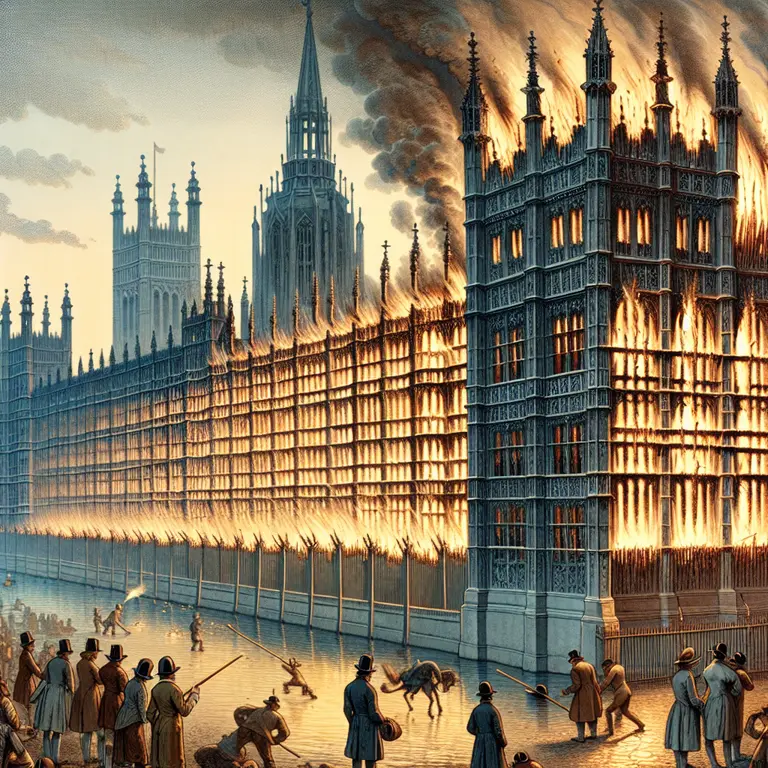
On the evening of October 16, 1834, two workers were assigned the task of feeding the old tally sticks into the furnaces beneath the House of Lords. There were considerably more sticks than anyone had properly accounted for. The furnaces were overloaded. The flues overheated. By nightfall, the Palace of Westminster was engulfed in flames.
The fire burned for two days. Crowds gathered on the banks of the Thames to watch. Among the spectators were the painters J.M.W. Turner and John Constable, both of whom made sketches of the blaze. Turner later produced two oil paintings of the conflagration, which now hang in major museums and are considered among his finest works. Almost the entire medieval palace was destroyed in the fire, including the House of Commons chamber and much of the ancient complex that had stood since the reign of Edward the Confessor. Westminster Hall, the oldest surviving part of the complex, was saved largely through the efforts of firefighters who made it a specific priority.
The rebuilding effort, launched through an architectural competition in 1836 and begun in earnest around 1840, produced the neo-Gothic structure that stands today. The architect Charles Barry won the competition, with the interior design and decorative detail largely the work of Augustus Pugin. The result is the building the entire world now associates with British democracy: the towers, the river facade, the elaborate Gothic stonework, and the iconic clock tower that houses the bell known as Big Ben. The Parliament building that defines London’s skyline, that appears on millions of postcards and serves as the visual shorthand for British governance in every television broadcast and film, exists in its current form because someone in 1834 decided to burn too many accounting sticks in an undersized furnace.
Why This Matters Beyond the Anecdote
The tally stick story is entertaining on its surface, but it carries deeper implications that historians of technology and institutional change have taken seriously.
The first implication concerns our assumptions about technological sophistication. There is a persistent tendency to equate older with cruder, and to assume that earlier technologies were simply inferior versions of what came later, waiting to be replaced by something better. The tally stick complicates this narrative considerably. It was fraud-resistant in ways that written records were not, because it relied on physical uniqueness rather than the authority of a signature or seal. It required no literacy, which made it well-suited to a population that was overwhelmingly illiterate. It was durable, portable, and cheap to produce. In the specific context for which it was designed — recording financial obligations in a pre-literate, pre-institutional society — it was arguably better suited to its environment than the written ledger systems that eventually replaced it. The replacement was not straightforwardly an improvement in every dimension; it was a trade-off that made sense as literacy and institutional capacity increased.
The second implication concerns the risks of institutional change itself. Historians of technology use the 1834 fire as a case study in what they call legacy system disposal risk—the danger that arises not from the continued use of an old system but from the process of getting rid of it. The tally sticks themselves, during their centuries of active use, had never caused a catastrophic failure. It was the decision to retire them carelessly, without adequate planning for the sheer physical scale of what had accumulated, that produced the disaster. This pattern recurs throughout the history of technology and institutions: the transition is often more dangerous than the steady state, and the accumulated weight of legacy material can become a liability precisely at the moment of attempted modernization.
Conclusion: A Piece of Wood at the Center of Everything
The tally stick is a wooden notch that somehow connects medieval taxation, the origins of financial terminology, the prehistory of cryptographic logic, the career of J.M.W. Turner, and the architectural identity of modern London. It ran the finances of the English state for seven centuries, embedded itself permanently in the English language, anticipated fundamental principles of information security by nine hundred years, and then, in its retirement, accidentally destroyed one of the oldest legislative buildings in the world and gave rise to the Gothic Revival palace that now stands in its place.
There is something almost poetic about the fact that an object designed to prevent fraud and verify trust ended its institutional life by burning down the institution that had relied on it. But there is also something genuinely instructive about it. The tally stick reminds us that the history of technology is not a clean upward line from primitive to sophisticated. It is a record of ingenious solutions to specific problems, of systems that outlast the conditions that created them, and of transitions that carry their own unpredictable costs. Sometimes the most consequential moment in the life of a technology is not when it is invented, but when someone decides to throw it in a furnace.
All of this from a piece of hazel wood.