
Mind Control Fungus: The Hidden Architect of Ant Behavior
How a single parasitic fungus, Ophiocordyceps, manipulates ant behavior with surgical precision — and what it reveals about the hidden architecture of ecological control.
 Watch on YouTube
 Watch on Rumble
A Parasite With a Plan
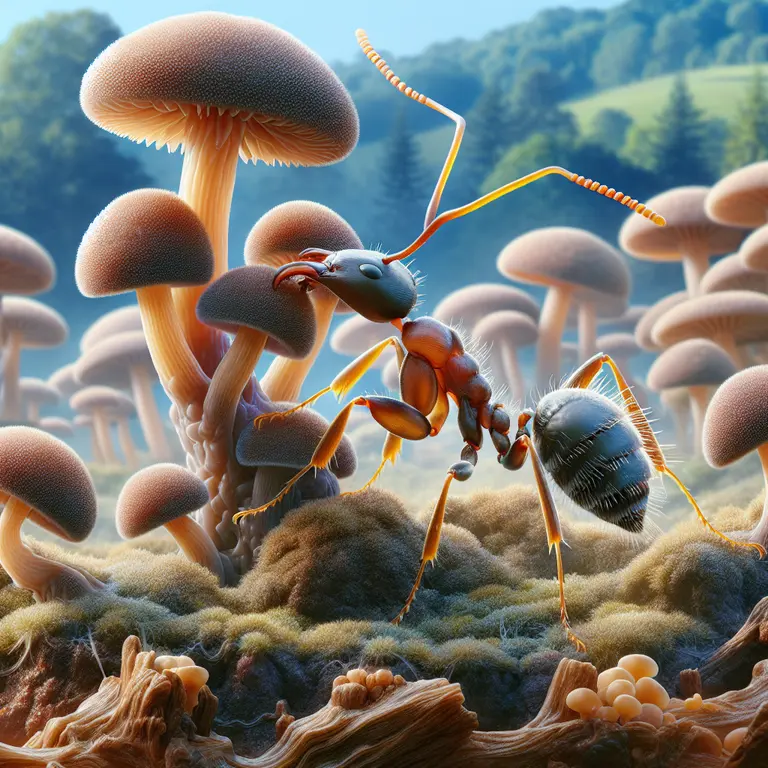
In the rainforests of Thailand, Brazil, and Ghana, carpenter ants occasionally abandon their colonies, climb the stem of a nearby plant to a very specific height — usually between 25 and 30 centimeters above the forest floor — clamp their mandibles into the underside of a leaf vein, and die. The precision of this sequence is no coincidence. It is the final act of a fungus that has been quietly steering the ant’s nervous system for days.
The organism responsible is Ophiocordyceps unilateralis, a parasitic fungus that has been manipulating insect behavior for at least 48 million years. A fossilized leaf discovered in the Messel Pit in Germany, dating to the Eocene epoch, bears the distinctive bite marks of an infected ant — the same clamp-shaped wound pattern found on leaves in modern tropical forests today. The fungus has been doing this, with remarkable consistency, since before humans existed, before most modern mammal lineages diverged, and before the Alps had fully formed. That continuity alone deserves pause. Most behavioral strategies in nature shift and drift across geological time. This one has remained essentially unchanged across epochs, suggesting that what Ophiocordyceps evolved is not merely effective but close to optimal.
The Mechanics of Mind Control
For decades, scientists assumed that Ophiocordyceps worked by directly invading the ant’s brain. The reality, uncovered through a 2017 study led by David Hughes at Penn State University, is stranger and arguably more disturbing. When researchers used electron microscopy and 3D imaging to map fungal cells within infected ants, they found that the fungus does not significantly colonize the brain. Instead, it infiltrates the ant’s muscle fibers throughout the body, surrounding individual muscle cells and forming a dense, interconnected network of fungal threads that effectively encase the musculature from within.
The fungus appears to release compounds that physically interfere with the sarcomere — the basic contractile unit of muscle — causing the muscles controlling the mandibles to seize in a locked position. The ant’s brain remains largely intact throughout this process. The creature is, in a horrifying sense, a prisoner in its own body, its muscles commandeered while its nervous system watches. This distinction matters enormously, both scientifically and conceptually. The fungus is not rewriting the ant’s mind. It is bypassing it entirely, acting on the body’s hardware while leaving the software running in a state of enforced irrelevance.
Researchers also found evidence that the fungus produces compounds that interact with neurotransmitter pathways, likely manipulating the ant’s locomotion and spatial orientation during the days before the final climb. The exact cocktail of chemicals involved is still being mapped, but includes compounds structurally related to known psychoactive and neuromodulatory substances. The infected ant does not simply stumble toward its death. It navigates. It selects. The behavioral sequence it follows is too consistent across individuals and too geographically specific to be a random degradation of the nervous system. Something is steering, and it is not the ant.
The chosen location matters enormously. The specific microclimate at 25 centimeters above the forest floor — with its particular humidity, temperature, and air circulation — is optimal for the fungus to grow its fruiting body, called a stroma, through the back of the ant’s head and release spores onto the foraging trails below, where new ant victims will walk. The height is not approximate. Studies across multiple forest sites have found that infected ants cluster within a remarkably narrow vertical band, as though following an instruction written in chemistry rather than language.
An Ecosystem Shaped by Infection
What makes Ophiocordyceps ecologically remarkable is that it does not simply kill. It sculpts. Ant colonies have developed behavioral responses to the fungus that amount to a form of collective immune system, one shaped not by antibodies but by social behavior refined over millions of years of coevolution. When workers detect an infected nestmate — often before any visible symptoms appear — they carry it far from the colony and abandon it. This behavior, called necrophoresis, is common across social insects as a general hygiene strategy, but in the presence of Ophiocordyceps it takes on an almost ritualized urgency.
Some species have reorganized their entire foraging geography around known infection zones, creating what researchers call graveyards of dead ants at the colony periphery. These are not random accumulations of the dead. They are the spatial record of a colony’s ongoing negotiation with a pathogen it cannot eliminate, only manage. The colony learns, in a distributed, behavioral sense, where danger concentrates, and it routes its living members accordingly.
This pressure has, over millions of years, contributed to the spatial structure of ant colonies in tropical forests. The threat of Ophiocordyceps is one reason many carpenter ant species build their nests in the forest canopy rather than at ground level, keeping the vulnerable brood out of the fungal-killing zone below. A parasite that never directly touches the majority of a colony has nonetheless shaped where that colony lives, how it moves, how it processes death, and how it organizes its relationship to the surrounding forest. The fungus, in this sense, is an invisible architect of ant society.
Furthermore, Ophiocordyceps itself is parasitized. Hyperparasitic fungi, including Escovopsis-related species and others in the order Hypocreales, can infect Ophiocordyceps before it successfully sporulates, preventing it from completing its life cycle. This creates a three-layer ecological relationship: ant, fungus, and the fungus that hunts the fungus. Each layer exerts selective pressure on the others, driving an arms race conducted entirely in biochemistry. The forest floor, in this sense, is not simply a place where things decompose. It is an arena of layered chemical warfare operating below the threshold of ordinary observation, where the combatants have no nervous systems, no intentions, and no awareness of the extraordinary sophistication of what they are doing to one another.
What This Tells Us About Control
Ophiocordyceps has attracted serious attention from pharmacologists and neuroscientists not merely as a curiosity but as a demonstration of what targeted chemical manipulation of motor systems can achieve. The fungus, through evolution, has essentially solved a problem that human medicine continues to struggle with: how to selectively interfere with specific muscle groups or behavioral circuits without destroying the broader organism. The precision required to lock a single set of muscles — the mandibles — while leaving locomotion and orientation intact is not trivial. It implies a degree of biochemical targeting that researchers are only beginning to understand.
The compounds Ophiocordyceps deploys include sphingosine, a lipid that disrupts cell signaling at the membrane level, and various alkaloids that interact with octopamine receptors — the invertebrate analog of adrenaline receptors in vertebrates. These are not blunt instruments. They are targeted interventions that exploit the specific architecture of insect neuromuscular systems. Some researchers have proposed that studying this chemical toolkit could yield insights into treatments for movement disorders such as dystonia or spasticity, where the therapeutic goal is to modulate muscle control with precision rather than suppress it wholesale. The fungus arrived at solutions through 48 million years of trial and error that human pharmacology has barely begun to explore.
There is also a philosophical dimension that the fungus quietly raises, one that tends to surface in neuroscience seminars and philosophy-of-mind discussions with equal frequency. The ant that climbs the plant stem and bites down is, by any behavioral measure, acting purposefully. It moves with apparent intention. It selects a specific location from among thousands of possible surfaces. It executes a complex motor sequence that serves a goal — a goal that happens to be entirely alien to its own survival. The fact that this purpose belongs entirely to another organism forces a question about the relationship between behavior and agency that extends well beyond entomology.
We tend to assume that purposeful behavior implies an interior life, a subject behind the action. Ophiocordyceps complicates that assumption in a way that is difficult to dismiss. The ant is not acting on its own behalf, but it is acting. The fungus has no brain, no intention in any philosophical sense, and yet it produces behavior in another organism that is more precisely goal-directed than most things humans do deliberately. What the fungus has evolved is not intelligence. It is something stranger: the ability to insert a behavioral program into a foreign nervous system and run it reliably across millions of individual hosts, across millions of years, in dozens of ecosystems, with a success rate that has kept the strategy not merely viable but dominant.
Conclusion
Ophiocordyceps unilateralis is often described as nature’s mind-control fungus, a label that is accurate but undersells the depth of what it represents. It is a 48-million-year experiment in the outsourcing of behavior, a demonstration that the boundary between one organism’s actions and another’s can be made entirely permeable by chemistry. It has shaped ant evolution, restructured forest ecologies, and produced a biochemical toolkit that human science is only beginning to decode.
What the fungus ultimately reveals is that control, in biological systems, does not require a controller in any conventional sense. It requires only the right molecules, delivered to the right receptors, at the right moment in the right sequence. The ant climbs. The ant bites. The fungus grows. And somewhere in that chain of events, the question of who is responsible dissolves into something far more interesting than a simple answer could contain.