
Unveiling Slime Mold's Secrets in Computing and Navigation
How the foraging behavior of slime mold—a brainless organism—has quietly revolutionized network design, urban planning, and artificial intelligence, revealing that evolution solved optimization problems centuries before silicon ever could.
 Watch on YouTube
 Watch on Rumble
Introduction: A 26-Hour Miracle on a Map
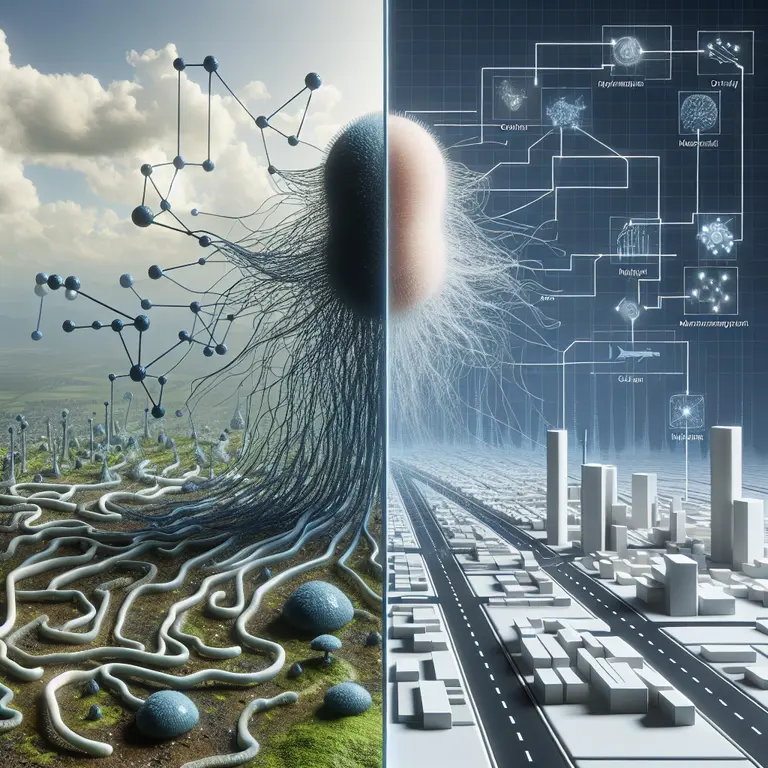
In 2010, a team of Japanese and British researchers published a paper in Science that stopped the engineering world in its tracks. They had placed oat flakes on a map of the Tokyo metropolitan area, positioned at coordinates matching each major city hub, and introduced Physarum polycephalum — a bright yellow slime mold — at the point representing Tokyo itself. Within 26 hours, the organism had extended its tendrils across the map and constructed a nutrient-delivery network that, by nearly every measurable standard, was functionally identical to the Tokyo rail system. It had taken Japanese engineers decades and billions of dollars to build. The slime mold did it before breakfast.
What makes this more than a charming anecdote is what it reveals about the deep logic of optimization — and how human institutions are only now beginning to catch up to a creature that has no neurons, no brain, and no planning committee. The story of Physarum polycephalum is not, in the end, really about slime mold at all. It is about the assumptions buried inside the way we design systems, allocate resources, and define intelligence itself. Those assumptions, it turns out, may have been wrong for a very long time.
What Physarum Actually Is
Physarum polycephalum is technically classified as a protist, not a fungus, though it was long mistaken for one and still carries the informal label in popular writing. It exists in a peculiar biological liminal zone: during part of its life cycle, it behaves like an amoeba, during another, it forms a sprawling, multinucleate mass that can cover several square meters of forest floor, rotting wood, or laboratory map. It has no central nervous system. It cannot think in any conventional sense. And yet it solves problems with a consistency and elegance that has forced biologists, computer scientists, and philosophers to reconsider what problem-solving actually requires.
The organism forages by extending pseudopods — thin tubes of cytoplasm — outward in all directions from its current position. When a pseudopod finds food, chemical signals cause the tubes leading to that food source to widen and strengthen, while tubes leading to dead ends thin and eventually retract entirely. The result is a self-organizing network that continuously balances three competing pressures: efficiency, meaning the shortest workable path between nutrients; redundancy, meaning backup routes in case one tube is blocked or damaged; and cost, meaning the minimization of total biomass invested in maintaining tubes. Keeping tubes open is metabolically expensive, so the organism cannot simply keep everything. It must choose, and it chooses well.
This is, in formal terms, a multi-objective optimization problem. It is also, not coincidentally, exactly the problem that network engineers face when designing internet backbones, power grids, municipal water systems, and transportation infrastructure. Human engineers spend careers and enormous institutional resources trying to balance these same three pressures. Physarum balances them continuously, in real time, using nothing more sophisticated than the physics of fluid flow and a few elegant chemical feedback loops.
The Tokyo Experiment and Its Replications
The 2010 study by Toshiyuki Nakagaki, Andrew Adamatzky, and colleagues was not a one-off curiosity. It was the culmination of nearly a decade of increasingly sophisticated experiments. Earlier work had shown that Physarum could solve simple maze problems — finding the shortest path between two food sources — with a reliability that startled biologists. The Tokyo experiment scaled this up dramatically, placing the organism in a situation that mimicked the real-world complexity of a major metropolitan transit system and implicitly asking whether it could find solutions that matched what human planners had arrived at through generations of deliberate effort.
When the researchers analyzed the slime mold’s network, they found it matched the rail system not just in topology but in its engineering trade-offs. The Tokyo rail network was designed with deliberate redundancy — extra routes that appear inefficient in isolation until a primary line goes down, at which point they become essential. The slime mold, operating under no such engineering brief and with no knowledge of Tokyo, had arrived at the same compromise between efficiency and fault tolerance. It had essentially reinvented a core principle of resilient infrastructure design using cytoplasm and chemistry.
Subsequent replications placed Physarum on maps of the Iberian Peninsula, the United Kingdom, the United States interstate highway system, and ancient Roman road networks. In nearly every case, the organism’s network bore a striking resemblance to the infrastructure humans had built, and in some cases, it suggested improvements or alternative configurations that engineers found genuinely interesting. The Roman road comparison was particularly striking. Those roads were built over centuries of military and commercial logic, optimized by emperors and engineers who had no knowledge of graph theory or formal network science, and yet they aligned with the slime mold’s solution to a degree that suggested both were converging on the same underlying mathematical truth — that certain topological arrangements are simply more efficient than others, and that sufficiently strong selection pressure, whether evolutionary or economic, tends to find them.
The Algorithm Hiding Inside the Organism
What computer scientists recognized almost immediately was that Physarum was running a form of what mathematicians call a minimum-cost flow algorithm, but with a critical biological twist: it was solving it in analog, in parallel across its entire body, without any central processor coordinating the effort. There is no headquarters in a slime mold. There is no subroutine that surveys the whole network and issues instructions. Each local section of the tube responds only to the flow passing through it, and the globally optimal solution emerges from the aggregate of all those local responses.
This inspired a new class of computational models called Physarum-inspired algorithms, or more broadly, slime mold algorithms. These are now applied in network routing optimization, where internet service providers use variants to dynamically reroute traffic around congestion points without requiring a central traffic manager. They appear in urban planning simulations, where city planners and researchers model how organic transit networks might emerge if designed from the bottom up rather than imposed from the top down. Robotics researchers have used Physarum-derived rules to enable swarm robots to map unknown terrain without central coordination, each unit responding only to its immediate environment while the group collectively builds an accurate picture of the whole. In biomedical engineering, the tube-widening principle is being applied to design microfluidic systems that self-optimize flow distribution for drug delivery applications.
A 2022 paper from researchers at the University of Sydney demonstrated that a Physarum-inspired algorithm outperformed conventional approaches in designing resilient water distribution networks for cities with irregular topography — precisely the kind of problem where human engineering intuition tends to fail because the interactions between variables are too numerous and nonlinear to reason through directly. The slime mold approach, by contrast, simply lets the system find its own equilibrium, and the equilibrium it finds tends to be a good one.
The Deeper Counterintuitive Finding: Intelligence Without a Center
Here is where the story becomes philosophically unsettling and reaches beyond biology into questions that touch on economics, governance, and the theory of mind. For decades, the dominant assumption in both engineering and institutional design was that optimization requires intelligence, and that the more complex the problem, the more sophisticated the planner needed to be. Central planning, in both its political and technical forms, was premised on this idea. The assumption was so deeply embedded that it was rarely stated explicitly; it simply structured how institutions were built and how problems were approached.
Slime mold demolishes this assumption. The organism demonstrates that local rules, applied consistently across a distributed system, can produce globally optimal solutions without any agent ever knowing what the global solution looks like. No node in the Physarum network has any information about the network as a whole. Each tube widens as the flow through it increases and narrows as the flow decreases. The intelligence, such as it is, lives in the rules, not in any ruler. The wisdom is encoded in the feedback mechanism, not in a planning authority that surveys the situation and issues directives.
This has profound implications that extend well beyond biology. Economists studying market dynamics have noted the structural similarity between Physarum’s tube-widening logic and the role of price signals in decentralized markets, where no central authority knows the optimal allocation of resources, but the system approximates it through the aggregation of local responses to local conditions. Urban theorists like Geoffrey West at the Santa Fe Institute have used related principles to explain why cities, which no one designs as a whole, tend to develop similar scaling laws regardless of culture, geography, or historical period. The slime mold is, in a sense, a living proof-of-concept for the power of emergence — the phenomenon by which complex, adaptive, globally coherent behavior arises from simple, locally applied rules with no designer overseeing the result.
An Unexpected Connection: Mapping the Cosmic Web
The cross-disciplinary reach of Physarum’s influence goes further still, into territory that would have seemed absurd to predict. In 2020, a team of astrophysicists at the University of California, Santa Cruz, used a Physarum-inspired algorithm to map the cosmic web — the vast filamentary structure of dark matter and diffuse gas that connects galaxies over billions of light-years. The cosmic web had long been observed in galaxy surveys and predicted by cosmological simulations, but it was notoriously difficult to trace precisely, because the filaments connecting galaxy clusters are dim, diffuse, and easily lost in the noise of observational data.
The researchers trained their algorithm on the slime mold’s tube-widening logic and applied it to galaxy distribution data, enabling it to find the paths of least resistance between known concentrations of matter, just as Physarum finds paths between food sources. The result was the most detailed map of cosmic filaments ever produced at that time, revealing connections between galaxy clusters that had been invisible to previous methods and providing new data relevant to questions about the large-scale structure of the universe and the distribution of dark matter.
The irony is almost poetic in its extremity. A brainless organism that lives in rotting logs and leaf litter, solving foraging problems on a scale of centimeters over hours, provided the conceptual key to mapping structures spanning hundreds of millions of light-years and billions of years of cosmic history. The same feedback logic that helps a slime mold decide which direction to send its next pseudopod helped astronomers see the skeleton of the observable universe more clearly than they ever had before.
What We Still Do Not Understand
Despite more than two decades of sustained research, the precise biochemical mechanism by which Physarum computes remains incompletely understood. Researchers know that oscillating contractions of the cytoplasm create flow through the tubes, and that flow rates influence tube diameter through some form of mechanochemical feedback, but the full signaling chemistry that translates increased flow into molecular-level structural tube widening is still being worked out. The organism, in this sense, is still keeping some of its secrets.
There is also a genuine, unresolved debate over whether Physarum constitutes a form of memory. A 2016 study by researchers at the CNRS in Montpellier showed that Physarum could be conditioned to ignore a mild chemical repellent after repeated exposure, and that this learned tolerance persisted for hours after the conditioning stimulus was removed. More remarkably, when a conditioned organism was fused with a naive one — slime molds can merge their bodies when they encounter each other — the naive organism acquired the tolerance, as though the memory had been physically transferred through shared cytoplasm. The slime mold was, in some functional sense, remembering and teaching, without neurons, synapses, or any of the biological hardware we associate with those capacities.
Whether this constitutes cognition, or merely chemistry that mimics the functional outputs of cognition, is a question that cuts to the heart of what intelligence actually means. It raises the uncomfortable possibility that our definitions of mind and memory have always been too narrow, too anchored in the specific biological architecture of vertebrate nervous systems, and too quick to assume that the substrate determines the capacity.
Conclusion: Rethinking the Hierarchy of Minds
The story of Physarum polycephalum is, ultimately, a story about the limits of our assumptions. For most of human history, we assumed that complexity required a commander — a brain, a planner, a central authority with the intelligence and information to coordinate the parts into a coherent whole. Our institutions, our engineering traditions, and our theories of mind were all built on some version of this premise. The slime mold suggests, with quiet insistence, that the premise was never as solid as we believed.
Evolution, operating over hundreds of millions of years, arrived at solutions to optimization problems that human engineers rediscovered only in the twentieth century, and that our most powerful computers still struggle to solve efficiently at scale. The organism did not need to understand graph theory, network topology, or the mathematics of flow optimization. It simply needed to survive, and survival required finding food efficiently, which in turn required building good networks, which in turn required exactly the kind of distributed, feedback-driven, self-organizing logic that computer scientists now study deliberately and with great effort.
There is a lesson in that convergence — one that applies equally to network design, urban planning, ecological management, economic policy, and the architecture of artificial intelligence systems. The most elegant and resilient solutions are often the ones that distribute intelligence rather than concentrate it, that encode wisdom in rules and feedback mechanisms rather than in rulers and planners, and that trust the process of local adaptation to find global coherence without any single agent needing to see the whole picture.
We have spent centuries building systems premised on the intelligence of the center. The slime mold has spent hundreds of millions of years demonstrating the intelligence of the edge. We are still catching up, and the catching up is proving to be one of the more humbling and productive intellectual adventures of our time.