
The Ancient Japanese Art of Kintsugi: Embracing Imperfection
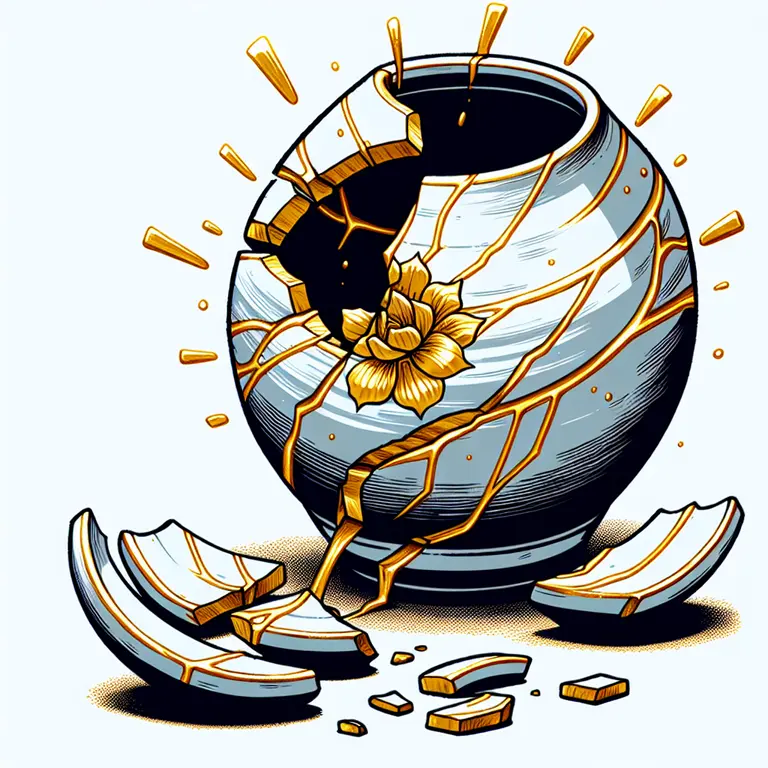
Kintsugi is an ancient Japanese practice that repairs broken pottery with gold, turning mending into art.
The Golden Art of Imperfection: Understanding Kintsugi
Kintsugi (金継ぎ), which translates to “golden joinery,” is a centuries-old Japanese art form deeply rooted in the philosophy of wabi-sabi, which finds beauty in imperfection and transience. Originating in the 15th century, Kintsugi involves repairing broken pottery using lacquer mixed with powdered gold, silver, or platinum. At first glance, this might seem like a simple craft technique, a practical solution to a broken cup or cracked bowl. But to reduce Kintsugi to mere repair work is to miss its profound significance entirely. This practice goes beyond fixing a fractured object; it transforms it into something uniquely beautiful, something that could not have existed without the breaking in the first place. In a world increasingly defined by disposability and the relentless pursuit of perfection, Kintsugi offers a radically different way of seeing — one that treats damage not as a defect to be hidden, but as a defining chapter in an object’s ongoing story.
Historical Background
The origins of Kintsugi are often attributed to the story of Ashikaga Yoshimasa, a 15th-century shogun who broke his favorite tea bowl and sent it to China for repairs. Unsatisfied with the results, which typically involved unsightly metal staples driven through the ceramic to hold the pieces together, he asked his craftsmen to find a more aesthetically pleasing method. What emerged from that request was not merely a new repair technique but an entirely new artistic philosophy. Hence, Kintsugi was born.
The timing of its emergence is historically significant. The 15th century in Japan was a period of considerable cultural refinement, particularly around the tea ceremony, or chado, which had become a central ritual of samurai culture and Zen Buddhist practice. The tea bowl, or chawan, was not simply a vessel for drinking; it was an object of deep aesthetic and spiritual contemplation. Repairing such an object with visible gold seams was, in this context, a statement about the nature of beauty itself. It declared that a bowl’s history, including its moments of damage and restoration, was part of what made it worthy of attention.
Over time, this technique became so celebrated that some collectors and tea masters were rumored to intentionally break their valuable ceramics, simply to have them repaired in this unique way. Whether or not these accounts are entirely accurate, they speak to the extraordinary cultural value that Japanese society placed on the Kintsugi aesthetic. What began as a practical challenge posed by a dissatisfied shogun had evolved into one of the most philosophically rich artistic traditions in Japanese history.
Philosophical Underpinnings
Kintsugi is more than an artistic endeavor; it reflects centuries of Japanese thinking on life’s imperfections, the passage of time, and the nature of beauty. It ties most directly to the concept of wabi-sabi, a worldview that finds aesthetic and emotional value in things that are imperfect, incomplete, or impermanent. Where Western aesthetics have historically tended toward ideals of symmetry, flawlessness, and permanence, wabi-sabi celebrates the moss on the stone, the asymmetry of a handmade cup, and the crack that reveals a bowl’s age. A piece repaired through Kintsugi embodies this principle completely. Its cracks are not erased but illuminated, not hidden but honored.
Equally relevant is the concept of mottainai, a Japanese term that expresses regret over waste and encourages the thoughtful use of resources. Mottainai is sometimes translated as “what a waste,” but its meaning runs deeper than simple frugality. It carries with it a spiritual dimension, a recognition that objects have inherent value and that discarding them carelessly is a kind of moral failure. Kintsugi is mottainai made visible. Rather than throwing away a broken object, the craftsman invests time, skill, and precious materials into restoring it, acknowledging that the object still has life and worth.
There is also a psychological dimension to Kintsugi that has resonated strongly with modern audiences. Therapists, writers, and philosophers have drawn on the metaphor of golden repair to discuss human resilience, trauma, and recovery. The idea that a person, like a ceramic bowl, can be broken and yet become more interesting, more layered, and, in some ways, more valuable as a result of that experience speaks to something deep in the human condition. This cross-cultural resonance has helped Kintsugi travel far beyond Japan, becoming a touchstone in conversations about mental health, grief, and personal transformation.
The Technique
The Kintsugi process is as demanding and deliberate as the philosophy behind it. It begins with the meticulous collection of all the pieces of the broken item, a task that itself requires patience and care. No fragment is considered too small or too insignificant. The craftsman then cleans each piece thoroughly before beginning the repair process, which can take weeks or even months to complete properly.
The adhesive used in traditional Kintsugi is urushi lacquer, a substance derived from the sap of the Toxicodendron vernicifluum tree, commonly known as the lacquer tree. Urushi has been used in Japanese craft for thousands of years, prized for its extraordinary durability and its ability to harden into a surface that is both water-resistant and exceptionally strong. Working with urushi requires considerable expertise, as the sap is a potent allergen in its raw form and must be handled with care. It also requires specific humidity and temperature conditions to cure correctly, which means the craftsman must be attentive to environmental factors throughout the process.
Once the pieces are joined using multiple layers of urushi lacquer, each layer allowed to cure fully before the next is applied, the distinctive decorative stage begins. Gold powder, and sometimes silver or platinum, is carefully dusted or painted onto the lacquered seams. This step requires a steady hand and a refined sense of proportion. The goal is not to obscure the repair but to make it the most visually prominent feature of the piece. The finished result is a network of luminous veins running across the surface of the object, each one tracing the path of a former fracture.
This meticulous process requires immense patience but ultimately yields a product many consider more valuable than before it was damaged. The repaired piece is unique in a way that no mass-produced piece, or even a hand-thrown original, can be. Its specific pattern of breaks and repairs belongs to it alone, a fingerprint of its particular history.
A Living Philosophy for a Modern World
Kintsugi pieces are not just repaired but reborn, each carrying a story that could not have been told without the breaking. The visible mends create a distinctive beauty that celebrates the item’s history and resilience, refusing to pretend that damage never occurred. In this way, Kintsugi stands as a quiet but powerful challenge to the assumptions of consumer culture, which tends to treat imperfection as grounds for replacement and age as a reason for disposal.
In recent decades, Kintsugi has found new audiences far beyond Japan. Artists, designers, and therapists around the world have adopted its principles as a framework for thinking about sustainability, emotional healing, and the value of repair over replacement. Museums have mounted exhibitions dedicated to the tradition, and contemporary ceramic artists have developed modern interpretations that blend the ancient technique with new materials and contexts.
What makes Kintsugi enduringly compelling is that it does not offer comfort through denial. It does not pretend that breaking is painless or that damage is unimportant. Instead, it insists that the broken thing, and by extension the broken person, is worth the effort of careful, loving repair. The gold does not erase the crack. It follows it, traces it, and makes it shine. That ancient practice continues to inspire and remind us of the profound value of embracing our flaws and finding, within the very lines of our fractures, something genuinely beautiful.