
The Enigmatic Soundscape of Greece’s Melissani Cave Lake
Melissani Cave Lake in Greece has an unusual acoustic quality that makes it a natural amphitheater, providing unique sound experiences.
Introduction
Melissani Cave Lake, located on the island of Kefalonia in the Ionian Sea off the western coast of Greece, is a geological phenomenon that is simultaneously ancient and startling. Known primarily for its intense natural beauty, featuring crystal-clear turquoise waters, dense Mediterranean forestry crowding its edges, and a collapsed roof that acts as a celestial skylight illuminating its depths at midday, Melissani Cave offers far more than a photographer’s paradise. It is a place where geology, mythology, acoustic science, and human history converge in ways that continue to surprise researchers and visitors alike.
What makes Melissani genuinely unusual is not just what the eye can see, but what the ear can detect. The cave possesses acoustic properties so refined and unexpected that they have attracted the attention of engineers, archaeologists, and musicians. To stand inside this subterranean lake chamber is to experience something that defies easy categorization, a natural space that behaves like a concert hall, a cathedral, and an open ocean simultaneously.
A Brief History Rooted in Myth and Mystery
The cave was first officially discovered and documented by spelunkers in 1951, though local Kefalonians had known of its existence for generations. What the 1951 expedition uncovered, however, was more than a hidden body of water. Archaeologists working in the region subsequently found ancient clay figurines and pottery fragments inside the cave, including a disc depicting the god Pan surrounded by nymphs. These artifacts, now housed in the Archaeological Museum of Argostoli, confirm that the site was a place of religious significance during the Mycenaean period, roughly between 1600 and 1100 BCE.
Ancient Greeks considered the cave sacred to the nymphs, and it is sometimes referred to as the Cave of the Nymphs. According to local mythology, a nymph named Melissanthi drowned herself in the lake after the god Pan rejected her love, which is thought to be the origin of the cave’s name. This mythological framing is not merely decorative. Scholars of ancient religion have noted that the Greeks frequently designated acoustically unusual natural spaces as sacred, suggesting that the cave’s unusual sonic properties may have directly contributed to its status as a holy site. The amplified whispers, the way sound moved unpredictably through the chamber, and the eerie resonance of voices over water would have seemed genuinely supernatural to ancient visitors.
The cave’s physical structure is the result of thousands of years of chemical weathering and tectonic activity. The collapsed roof, which creates the dramatic skylight effect, is believed to have caved in during an earthquake approximately three to four thousand years ago, transforming what was once a fully enclosed cavern into the partially open chamber that exists today. This geological accident was responsible for both the cave’s most celebrated visual feature and a significant part of its acoustic character.
The Acoustic Enigma That Continues to Puzzle Scientists
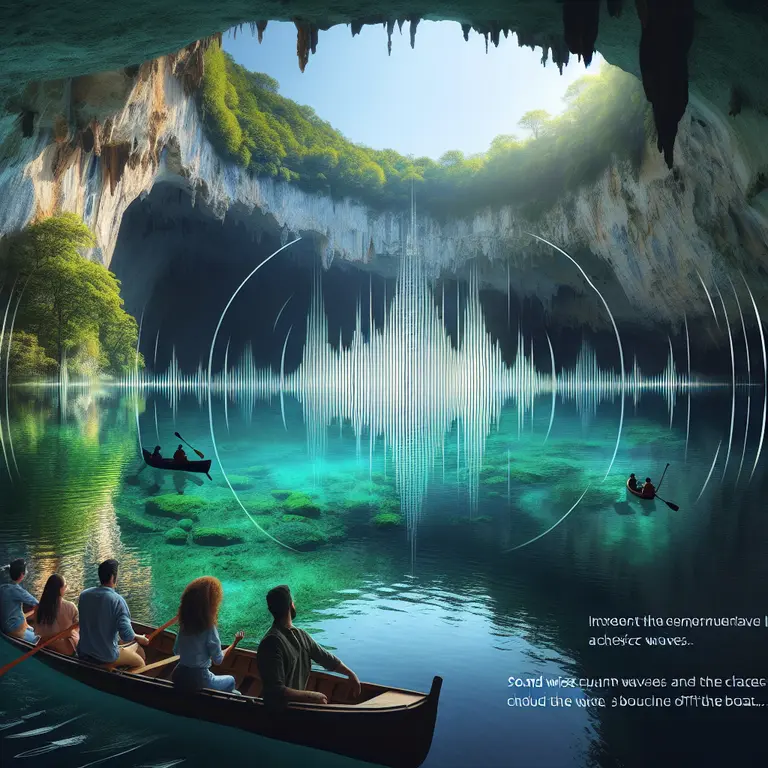
While Melissani is primarily celebrated for its visual spectacle, visitors consistently report peculiar and disorienting acoustic experiences within the cave. Whispers carry across the full length of the lake chamber with startling clarity. Sounds that should dissipate over open water instead seem to gather and travel, arriving at the listener’s ear not as echoes but as something closer to a direct transmission. The effect is subtle enough that many visitors attribute it to imagination, yet persistent enough to have attracted serious scientific inquiry.
The phenomenon results from a unique combination of the cave’s geometry, the behavior of sound over water, and the curvature of the limestone ceiling and walls. The chamber functions as a natural acoustic reflector, similar in principle to a whispering gallery, a structure in which curved surfaces redirect sound waves along their contours rather than allowing them to scatter. Famous architectural examples of this effect include the dome of St. Paul’s Cathedral in London and the Gallery of the Palais Royal in Paris, but Melissani achieves it without any human design whatsoever.
Acoustic engineers from the Athens Polytechnic University, working in collaboration with marine biologists studying underwater sound propagation, conducted experiments within the cave that confirmed and expanded on visitor reports. They found that even low-volume sounds produced at one end of the lake could be detected with unusual fidelity at the opposite end, a distance that would normally render sound nearly inaudible in an open environment. The cave’s particular geometry concentrates and channels sound in ways that remain an active subject of study.
The Science Behind the Sound
The acoustic properties of Melissani are shaped by an intersection of factors that would be nearly impossible to replicate artificially without enormous effort. The first and most fundamental is the water's purity and salinity. The lake is fed by a remarkable hydrological system that begins at a sinkhole called Katavothres on the opposite side of Kefalonia, where seawater disappears underground, travels approximately fourteen kilometers through the island’s limestone interior, and re-emerges inside the cave. This journey filters the water to extraordinary clarity and gives it a specific density that affects how sound waves behave at the air-water interface.
The second major factor is the presence of thermoclines within the water column. These are layers where water temperature changes sharply with depth, and they act as acoustic mirrors, bending and redirecting sound waves back toward the surface rather than allowing them to be absorbed into the depths. Combined with the curved limestone ceiling, which performs a similar redirecting function for sounds traveling through air, the cave creates what acousticians describe as a layered reflective system operating in two different media simultaneously.
Air pockets trapped along the underbellies of curved rock formations add a further dimension. These pockets sustain certain tonal frequencies longer than would be possible in open air or in caves with flat surfaces, producing a subtle reverberation that visitors often describe as the cave itself humming. Comparisons have been drawn to the acoustic management strategies employed in great architectural spaces such as the Sistine Chapel and the ancient Greek theater at Epidaurus, both of which were deliberately designed to manipulate sound. The difference at Melissani is that no architect was involved. The result is a naturally occurring acoustic environment that rivals the most carefully engineered human structures, leading some researchers to speculate that ancient builders may have studied natural spaces like this one as models.
The Experience of Visiting Melissani
For those fortunate enough to visit, the experience of Melissani begins before the cave is even entered. A short path leads down to an underground tunnel, through which flat-bottomed wooden boats carry visitors in near darkness for a brief but disorienting passage. The transition from the tunnel into the main chamber is one of the more genuinely dramatic moments available to a traveler in Greece. The darkness gives way suddenly to an explosion of color as the open roof admits full sunlight, turning the water beneath into shifting planes of blue and green that seem to glow from within.
The midday hours, when the sun is positioned directly above the opening, produce the most celebrated visual effect. Light strikes the water at an angle, causing it to refract through the limestone walls, casting moving patterns of reflected color across surfaces that have never seen direct sunlight. Boat operators time their tours to coincide with this window when possible, and the effect on visitors is consistently described as overwhelming.
Yet the acoustic dimension of the visit is equally affecting, even if less immediately obvious. As the boat moves across the lake, sounds from other vessels, the guide’s narration, and the natural environment of the cave arrive with uncanny clarity and presence. Paddle strokes produce resonances that seem to linger a moment longer than they should. Voices carry in directions that do not correspond to their source. The overall effect is one of heightened sensory awareness, a feeling that the environment itself is paying close attention.
Conclusion
Melissani Cave Lake stands as one of the more persuasive arguments that nature, given sufficient time and the right geological conditions, can produce spaces of aesthetic and scientific complexity that human ingenuity has rarely matched. The cave is a place where ancient religious intuition, modern acoustic science, and geological accident have combined to create something that continues to generate genuine surprise among experts across multiple disciplines.
Its history as a sacred site suggests that earlier civilizations recognized something remarkable about this space long before they had the scientific vocabulary to describe it. The nymphs of Greek mythology may have been an attempt to explain what visitors were experiencing: sounds that moved strangely, water that seemed to glow, a space that felt inhabited by something invisible and attentive. Modern science has provided more precise explanations, but has not entirely dispelled the sense of wonder. Melissani Cave Lake remains, above all, a reminder that the most extraordinary discoveries are sometimes not made in laboratories or observatories, but in places that have been waiting quietly underground for someone to listen carefully enough.