
Bob Ross's Tv Masterpieces Generously Donated to the Public
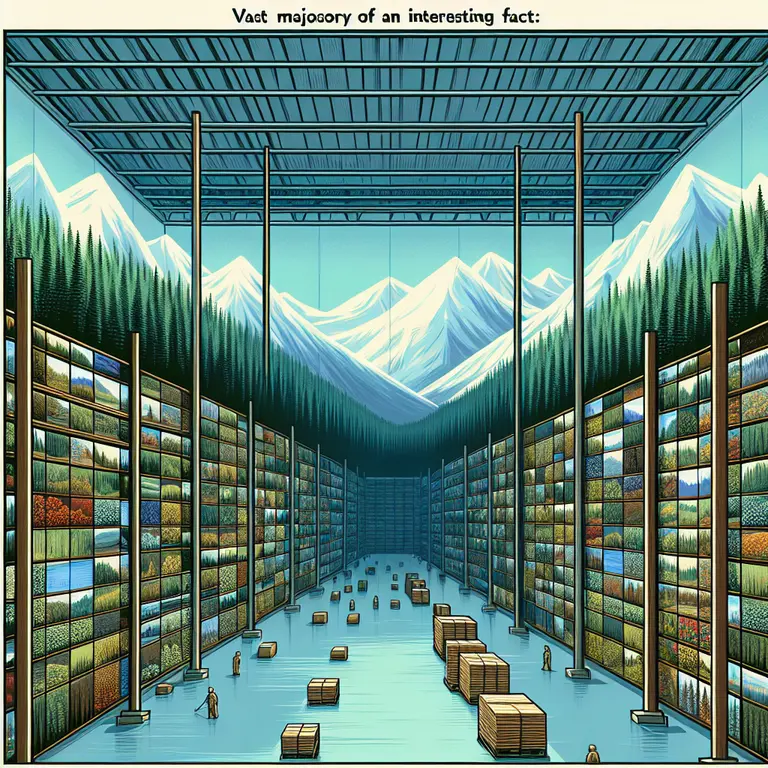
Almost all of Bob Ross's landscape paintings, created for his PBS show 'The Joy of Painting,' are stored in a Smithsonian warehouse.
Introduction
Bob Ross is one of those rare cultural figures whose influence seems to grow stronger with each passing decade, long after his television program stopped airing new episodes. His soft-spoken manner, his signature afro, and his reassuring insistence that there are no mistakes in painting — only happy accidents — have made him a beloved figure across generations of Americans who may never have picked up a paintbrush themselves. The Joy of Painting ran on PBS from 1983 to 1994, and in that time Ross became something far greater than a television art instructor. He became a symbol of patience, accessibility, and the quiet joy of creating something with your own hands.
Yet despite his enormous cultural footprint, there are significant aspects of Ross’s life and artistic output that remain surprisingly obscure, even to devoted fans. Chief among these mysteries is a deceptively simple question: what actually happened to all those paintings? Ross produced an extraordinary volume of work over the course of his television career, and the fate of that work tells a story not just about one man, but about the economics of public broadcasting, the nature of artistic legacy, and the strange relationship Americans have with art they admire from a distance but rarely encounter in person.
From the Air Force to the Canvas
Bob Ross was born in Daytona Beach, Florida, in 1942 and spent much of his early adult life in the United States Air Force. It was during his military service, while stationed in Alaska, that he first encountered the sweeping wilderness landscapes that would come to define his artistic identity. The jagged mountain ranges, the dense pine forests blanketed in snow, and the vast open skies of the Alaskan interior made a lasting impression on him, and he began teaching himself to paint what he saw.
His early technique was significantly shaped by a painting method called wet-on-wet oil painting, also known in German as alla prima. This approach involves applying fresh paint directly onto still-wet layers rather than waiting for each coat to dry, which allows for rapid blending and soft transitions that became Ross’s visual signature. He learned this method from a painter named Bill Alexander, who hosted his own instructional television program and eventually became something of a complicated figure in Ross’s biography. Ross later adapted and commercialized the technique under his own brand, which caused some tension between the two men, though Ross always credited Alexander as an important influence on his development.
What made Ross’s painting style so culturally significant was not necessarily its technical sophistication, but its radical accessibility. He worked quickly and confidently, completing an entire landscape in roughly twenty-six minutes to fit the format of a half-hour television program. Watching him paint, viewers were given the impression that mastery was within reach — that with the right brush, the right paint, and a little courage, anyone could produce something beautiful. This was a genuinely democratic vision of art at a time when fine art culture could feel intimidating and exclusionary to ordinary people.
The Three-Painting System
One of the most surprising and least-discussed aspects of Ross’s television career is the method he used to produce each episode. Most viewers assumed they were watching an artist work spontaneously, guided by instinct and the happy accidents he so frequently celebrated on screen. In reality, each episode was the product of a carefully structured three-painting process that very few people outside his production team were aware of at the time.
Before filming each episode, Ross would complete a fully realized version of the painting he planned to demonstrate. This served as a reference piece, allowing him to plan his composition, work out any technical challenges in advance, and ensure the episode would run smoothly within its tight time constraints. During the actual filming of the episode, he would produce the painting that television audiences watched him create. Then, after filming concluded, he would paint a third version of the same subject, this one rendered with greater detail and refinement, intended for use in his instructional books and educational materials.
This means that for every episode of The Joy of Painting, there were potentially three distinct paintings in existence. Over the course of the show’s 403-episode run across 31 seasons, this system produced a staggering volume of work. The scale of his output, when understood in this context, reframes Ross not merely as a television personality but as an extraordinarily prolific working artist whose total production rivals that of many painters considered far more seriously by the art establishment.
The Question of Where the Paintings Went
Ross never sold the paintings he produced for his television program. This decision was consistent with his public persona and his stated values around art as a practice meant for everyone rather than a commodity reserved for the wealthy. Instead, many of the paintings from the show were donated to PBS stations across the United States, where they were used as fundraising prizes during pledge drives. The logic was straightforward and mutually beneficial: stations received a genuinely compelling item to offer donors, and Ross’s work reached a wider audience while supporting the public broadcasting infrastructure that had made him famous.
A significant portion of the remaining collection eventually found its way to the Smithsonian’s National Museum of American History in Washington, D.C., through a donation from Bob Ross Inc., the company that manages his estate and brand. This gift marked a formal recognition of Ross’s place in American cultural history, situating his work alongside artifacts and collections that document the broader sweep of national life. The Smithsonian acquisition was reported by the New York Times in 2019 and prompted a wave of public interest in the question of where his paintings had been all along.
The answer, however, came with a notable caveat. The vast majority of the paintings held at the Smithsonian are stored rather than displayed, kept in archival conditions that are inaccessible to the general public and even to most art enthusiasts. For a painter whose entire career was built on the idea of making art visible, approachable, and emotionally available to ordinary people, there is something quietly ironic about his work residing in storage, unseen by the fans who watched him create it week after week.
Conclusion
The story of Bob Ross and his paintings is, at its core, a story about what we choose to preserve and what we choose to share. Ross spent over a decade inviting millions of Americans into the creative process, insisting that beauty was achievable and that art belonged to everyone. His three-painting system, his refusal to sell his television work, and his decision to support public broadcasting through donations all reflect a coherent set of values that prioritized access over profit and generosity over personal gain.
His eventual place in the Smithsonian collection confirms what popular culture had already decided long before any museum took notice: Bob Ross matters. His influence on how Americans think about creativity, self-expression, and the quiet satisfaction of making something with their hands is difficult to overstate. Whether his paintings ever make it out of storage and onto gallery walls where the public can stand before them remains an open question. But the legacy they represent — of a man who believed that painting deeply was not a talent you either had or lacked, but a skill anyone could learn with patience and practice — is already fully on display.