
The Quiet War Being Fought Inside Your Drinking Water
How bacteriophages — viruses that hunt and destroy bacteria — are being weaponized to combat antibiotic-resistant pathogens in municipal water systems and human bodies, and why this century-old science is suddenly the world's most urgent medical frontier.
 Watch on YouTube
 Watch on Rumble
The Virus That Kills Only Killers
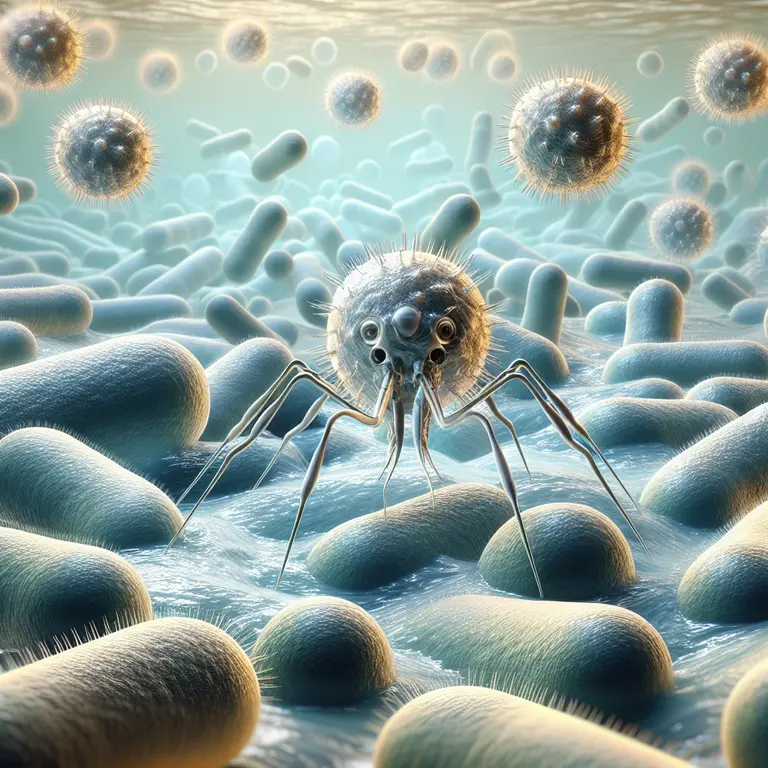
In 1915, British bacteriologist Frederick Twort noticed something strange happening in his petri dishes. Colonies of bacteria were developing glassy, transparent patches — areas where the microbes simply ceased to exist. He had no framework to explain it. Two years later, French-Canadian microbiologist Félix d’Hérelle gave the phenomenon a name: bacteriophage, from the Greek for bacteria-eater. He proposed that invisible predators were hunting bacteria, and he was right. Bacteriophages — phages for short — are viruses that infect only bacteria, leaving human cells entirely untouched. They are the most abundant biological entities on Earth, outnumbering bacteria by roughly 10 to 1, with an estimated population of 10^31 individual particles in the biosphere. That number exceeds the count of stars in the observable universe by several orders of magnitude.
For decades, phage therapy — the deliberate use of these viruses to treat bacterial infections — was practiced primarily in Soviet Georgia, where the Eliava Institute in Tbilisi became a world center for phage research after d’Hérelle himself helped establish it in the 1930s. D’Hérelle was a figure of unusual intensity, a self-taught microbiologist who had already made significant contributions to locust plague research before stumbling into virology. His collaboration with Georgian bacteriologist Giorgi Eliava produced an institution that would continue operating through the Soviet era, the Cold War, and the collapse of the USSR, surviving largely because it served a genuine medical need in a region where pharmaceutical supply chains were unreliable. Patients from across Eastern Europe and the former Soviet republics traveled to Tbilisi to receive phage preparations for infections that had resisted conventional treatment, and many reported recoveries that Western medicine at the time had no equivalent framework to offer.
When penicillin swept the Western world after World War II, phage therapy was largely abandoned in Europe and North America. It was considered crude, poorly understood, and unnecessary. That dismissal is now being recognized as one of the costlier scientific oversights of the twentieth century. The irony is sharp: the very success of antibiotics created the conditions for their failure. Decades of broad-spectrum use in human medicine, agriculture, and livestock production have exerted relentless selective pressure on bacterial populations, accelerating the emergence of resistance at a pace that now threatens to outrun every available pharmaceutical countermeasure.
Antibiotic Resistance and the Return of the Phage
The World Health Organization currently identifies antimicrobial resistance as one of the top ten global public health threats facing humanity. Each year, drug-resistant infections kill approximately 1.27 million people directly and contribute to nearly five million deaths when broader complications are included. Bacteria such as Klebsiella pneumoniae, Acinetobacter baumannii, and certain strains of Staphylococcus aureus have developed resistance to virtually every antibiotic in clinical use. The pharmaceutical pipeline for new antibiotics has been nearly dry for decades, largely because developing antibiotics is financially unattractive — patients take them for days or weeks, not years, unlike drugs for chronic conditions. The economic model that drives pharmaceutical investment simply does not favor the development of medicines designed to be used for as short a time as possible.
This is the vacuum into which phage therapy is now rushing. In 2017, a case at UC San Diego Medical Center drew international attention. Tom Patterson, a professor, contracted a multidrug-resistant strain of Acinetobacter baumannii while traveling in Egypt. He fell into a coma. His wife, infectious disease specialist Steffanie Strathdee, began contacting phage researchers around the world in what she later described as a desperate and largely improvised search through the scientific literature and personal networks. Phages were sourced from laboratories in Texas, Maryland, and the Navy’s collection, purified, and administered intravenously. Patterson recovered. The case, documented in the book The Perfect Predator, catalyzed a wave of clinical interest that has not slowed since.
What made the Patterson case scientifically significant beyond its human drama was the methodology it forced researchers to improvise. Because no established protocol existed for intravenous phage administration in a critically ill patient, the team had to develop safety assessments, dosing estimates, and monitoring frameworks in real time. The experience revealed both the therapeutic potential and the regulatory gaps that surround phage medicine in the West. It also demonstrated that phage therapy need not be a last resort born of desperation — with appropriate infrastructure, it could become a first-line option for infections caused by organisms for which antibiotics have already failed in a given patient’s history. Several hospitals in the United States and Europe have since established compassionate use programs, and the number of documented clinical cases has grown substantially, even as large randomized trials remain relatively few.
Water Systems as the Next Battlefield
While human medicine captures headlines, a parallel, less publicized application of phage science is unfolding within municipal water infrastructure. Biofilms — structured communities of bacteria encased in a self-secreted polymer matrix — colonize the interior surfaces of water pipes and are extraordinarily resistant to chlorine disinfection. These biofilms are not simply clusters of bacteria sitting on a surface. They are organized communities with internal communication systems, nutrient-sharing networks, and physical architectures that protect interior cells from chemical attack. A disinfectant that kills 99 percent of free-floating bacteria in a water column may eliminate less than one percent of the same species living inside a mature biofilm.
These biofilms can harbor Legionella pneumophila, the bacterium responsible for Legionnaires disease, as well as opportunistic pathogens like Pseudomonas aeruginosa, which poses severe risks to immunocompromised individuals. Legionella outbreaks in hospital water systems, cooling towers, and large residential buildings have caused dozens of deaths in individual incidents, and the difficulty of eradicating the organism from established biofilms is a persistent challenge for facility managers and public health officials alike. Conventional remediation often involves superheating water systems or flushing with high concentrations of biocides — interventions that are expensive, temporarily effective, and damaging to infrastructure over time.
Researchers at institutions including Ghent University in Belgium and the University of Glasgow have been studying phage cocktails specifically engineered to penetrate and disrupt biofilms in water distribution systems. Unlike chemical disinfectants, phages can replicate at the site of infection — the more bacteria present, the more phages are produced, creating a self-amplifying response. Once bacterial populations drop below a threshold, phage replication naturally slows, theoretically preventing the ecological imbalances that chemical treatments can cause. This self-limiting quality is one of the features that distinguishes phage-based interventions from most other antimicrobial approaches. Pilot programs in several European cities have begun testing phage-based biofilm control in hospital water systems, where the risk from resistant pathogens is highest and where conventional disinfection has repeatedly failed.
The regulatory landscape remains the primary obstacle. In the United States, the FDA classifies phages as biological drugs, meaning each phage preparation requires extensive approval processes designed for conventional pharmaceuticals that map imperfectly onto entities that evolve, replicate, and interact with their targets in fundamentally different ways than chemical compounds do. The European Medicines Agency has similarly cautious frameworks. The irony is that phages are already present in every glass of untreated water humans have ever consumed throughout history — they are not foreign introductions but native inhabitants of aquatic environments being redirected with purpose. Regulatory systems built on the assumption that a therapeutic agent is inert and stable are poorly suited to evaluating something alive, adaptive, and ancient.
Precision and the Problem of Specificity
One of the most counterintuitive aspects of phage biology is that what makes phages medically promising also makes them logistically difficult. Each phage strain typically infects only one or a narrow range of bacterial species, and sometimes only specific strains within a species. This extreme selectivity is the result of evolutionary coevolution — phages and their bacterial hosts have been locked in an arms race for billions of years, with each developing increasingly sophisticated mechanisms of attack and defense. The phage’s receptor proteins must match specific surface structures on the bacterial cell wall with near-perfect complementarity in order for infection to occur. A phage that devastates one strain of E. coli may be entirely ineffective against a closely related strain isolated from a different patient.
This is the opposite of broad-spectrum antibiotics, which kill indiscriminately across many bacterial types. Phage specificity means treatment must be tailored to the exact pathogen a patient carries, requiring rapid and accurate bacterial identification before therapy can begin — a process that a critically ill patient may not have time for. It also means that a phage preparation effective against one patient’s infection may be useless for another patient with a nominally identical diagnosis, because the bacterial strains involved are subtly different at the molecular level. This degree of personalization is without precedent in mainstream infectious disease medicine and requires a fundamental rethinking of how treatments are developed, approved, and distributed.
This has driven investment in what researchers call phage banks and adaptive phage therapy protocols. The UC San Diego Center for Innovative Phage Applications and Therapeutics, one of the few dedicated phage therapy centers in North America, maintains a library of characterized phages and works with international partners to match patient pathogens to appropriate viral predators. Some researchers are going further, using CRISPR-based engineering to modify phages so they can target a wider range of bacterial strains or carry genetic payloads that directly disrupt bacterial resistance mechanisms. A 2019 case at Great Ormond Street Hospital in London involved the first use of a genetically engineered phage to treat a disseminated mycobacterial infection in a teenage girl with cystic fibrosis. The infection had resisted all available antibiotics. The engineered phage therapy resulted in significant clinical improvement, and the case was published in Nature Medicine, drawing attention from researchers across multiple disciplines who had not previously followed phage science closely.
The Ecological Dimension Nobody Discusses
Beyond medicine and water treatment, phages play a role in planetary ecology that most people have never considered. In the world’s oceans, phages are responsible for killing approximately 20 to 40 percent of all marine bacteria every single day. This mass lysis releases enormous quantities of dissolved organic carbon into seawater, a process known as the viral shunt, which redirects nutrients away from larger organisms and back into microbial loops. Without this process, the ocean’s food web would function very differently — more carbon would travel up the food chain through grazing, and less would be recycled through microbial decomposition. The viral shunt effectively short-circuits the classical food chain, keeping a substantial portion of oceanic productivity cycling within the microbial world rather than reaching fish, marine mammals, or the atmosphere.
This process significantly influences global carbon cycling and, by extension, climate regulation. Some estimates suggest that phage activity in the oceans sequesters hundreds of millions of tons of carbon annually by causing bacterial cells to rupture and sink rather than be consumed and respired by predators. When a bacterium is consumed by a larger organism, the carbon it contains is metabolized and eventually released as carbon dioxide. When a phage kills that same bacterium, the cellular contents are released as dissolved organic matter and particulate debris, some of which sinks to the ocean floor and is effectively removed from the active carbon cycle for extended periods. The difference in outcome, multiplied across the trillions of bacterial deaths that phages cause every second in the global ocean, adds up to a climatically significant quantity of sequestered carbon.
The implications for climate science are only beginning to be modeled seriously. As ocean temperatures rise due to climate change, bacterial community composition shifts, altering which phage populations dominate and changing the dynamics of the viral shunt, which feeds back into carbon flux. It is a chain of consequences that connects the smallest biological entities on Earth to the largest atmospheric systems, mediated by interactions too small to see and too numerous to fully count. Researchers studying ocean virology have noted that even modest shifts in phage community structure in response to warming could alter carbon export rates in ways that current climate models do not yet account for, representing a meaningful source of uncertainty in long-range projections.
The century-old curiosity that d’Hérelle observed in his petri dishes turns out to have been, all along, one of the foundational mechanisms keeping the planet habitable. The transparent patches spreading across his bacterial colonies were not anomalies or contamination events. They were windows into an invisible ecology of predation, competition, and chemical cycling that underlies nearly every biological system on Earth. That it took humanity the better part of a century to begin taking phages seriously as medical tools, environmental agents, and ecological actors is less a story of scientific failure than a reminder of the complexity that persists beneath the surface of the world we think we understand.