
The Quiet Death of Dark Sky: Light Pollution's New Frontier
As satellite constellations multiply and urban sprawl intensifies, astronomers and ecologists are sounding alarms about a form of pollution most people never think about — artificial light — and the surprising ways it is reshaping biology, culture, and our view of the cosmos.
 Watch on YouTube
 Watch on Rumble
A Sky That No Longer Belongs to Everyone
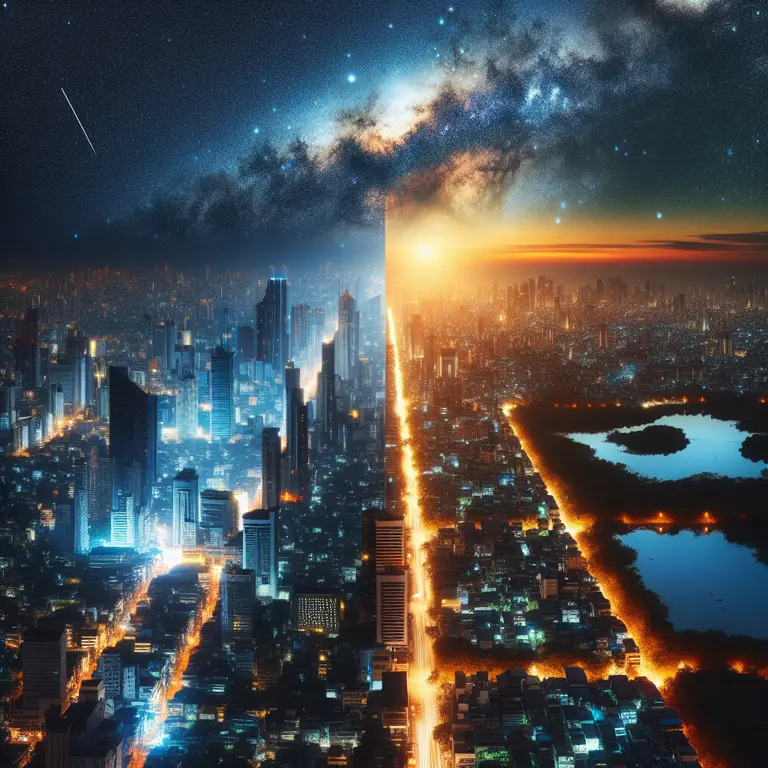
Somewhere around 2016, researchers at the Light Pollution Science and Technology Institute in Italy published a landmark global atlas of artificial night sky brightness. Their finding was stark: more than 80 percent of the world’s population now lives under light-polluted skies. In North America and Europe, that figure climbs to 99 percent. For the first time in human history, the Milky Way — that dense, luminous band of roughly 100 billion stars arching overhead — is invisible to the majority of people living on Earth. This is not a metaphor or an abstraction. It is a measurable, documented shift in the shared human environment that has accelerated dramatically in the past decade.
The mechanism is straightforward, but its consequences are not. Cities, highways, industrial facilities, and now satellite networks emit light that scatters through the atmosphere in a phenomenon called skyglow. Even in areas with no direct artificial lighting, skyglow from distant urban centers can wash out fainter celestial objects. A rural observer in Kansas may be 200 miles from the nearest major city and still experience skies three to five times brighter than natural darkness levels, according to measurements by the Globe at Night citizen science program. What was once a universal inheritance — the nightly spectacle of a dark and star-filled sky — has become a luxury available only to those with the means and mobility to seek it out.
The speed of this transformation is worth pausing on. As recently as the mid-twentieth century, the Milky Way was visible from the outskirts of most major cities. A 1994 earthquake that knocked out power across Los Angeles prompted hundreds of residents to call emergency services, alarmed by an unfamiliar silver cloud overhead. It was the Milky Way, seen for the first time by many of those callers. That story, often repeated, captures something essential about how completely and how quietly this loss occurred. A feature of the night sky that had oriented human beings for hundreds of thousands of years had vanished from lived experience within a single generation, and most people never noticed it going.
The Biological Cost Nobody Predicted
Light pollution was long treated as an aesthetic inconvenience — unfortunate for stargazers, irritating for astronomers, but otherwise harmless. That assumption has been dismantled by two decades of ecological research. The consequences for living systems are now understood to be profound and, in some cases, irreversible on human timescales.
Melatonin suppression in humans from blue-spectrum artificial light is well documented, but the disruption extends far beyond sleep quality. Epidemiological studies have linked chronic exposure to artificial light at night with elevated rates of breast cancer, metabolic disorders, depression, and cardiovascular disease. The World Health Organization classified night shift work as a probable carcinogen in 2007, partly on the basis of this evidence. But the biological cost is not confined to human bodies. A 2019 study published in Science found that artificial light at night reduces the abundance of insect populations attracted to light sources by up to 49 percent in affected areas, collapsing local food webs that depend on nocturnal insects as a base. Sea turtle hatchlings, which navigate toward the ocean by detecting the natural brightness of the horizon over open water, are disoriented by beachfront lighting and crawl inland in enormous numbers, dying before they reach the sea. Migratory birds, which orient using star patterns, collide with illuminated buildings at a rate estimated at up to one billion fatalities per year in the United States alone.
Perhaps most surprisingly, trees in urban environments near streetlights have been observed retaining their leaves weeks longer than rural counterparts, disrupting seasonal carbon cycling and altering the timing of insect emergence that depends on leaf drop. The light does not merely illuminate — it chemically and behaviorally restructures ecosystems. Firefly populations, which use bioluminescent signals to locate mates, are being silenced by ambient light that drowns out their displays. Coral reefs, which time their mass spawning events to lunar cycles and nocturnal light levels, are showing disrupted reproductive timing in areas near coastal development. The full accounting of these cascading effects has barely begun, and researchers working in this field frequently describe a sense of racing against a problem that is growing faster than it can be studied.
The transition to LED streetlighting, widely promoted as an environmental improvement due to its energy efficiency, has, in many respects, worsened the biological impact. LEDs emit a higher proportion of blue-spectrum light than the sodium vapor lamps they replaced, and blue light is the wavelength most effective at suppressing melatonin in mammals and disrupting circadian rhythms across a wide range of species. A city that reduces its energy consumption by switching to LEDs may simultaneously increase its ecological footprint in ways that do not appear on any energy bill.
Starlink and the New Overhead Economy
The ground-level problem has now acquired an orbital dimension. SpaceX’s Starlink constellation, which surpassed 6,000 active satellites in 2024, has introduced a new category of light pollution that no municipality can regulate and no dark sky reserve can escape. Each satellite reflects sunlight during twilight hours, producing streaks across long-exposure astronomical images and interfering with survey telescopes designed to detect near-Earth asteroids and transient cosmic events.
The Vera C. Rubin Observatory in Chile, a facility designed to photograph the entire visible sky every few nights and expected to transform our understanding of the dynamic universe, will lose a significant fraction of its usable image data to satellite trails. Early modeling by the observatory’s team suggested that between 30 and 40 percent of short exposures taken during twilight would be compromised. SpaceX and other operators, including Amazon’s Project Kuiper and OneWeb, have experimented with darkening coatings and adjusted orbital orientations, with some measurable improvement, but astronomers argue these are partial solutions to a structural problem.
By 2030, the number of satellites in low Earth orbit is projected to exceed 100,000 if current licensing trajectories hold. The International Astronomical Union has formally called for binding international agreements governing satellite reflectivity, but as of mid-2025, no such framework exists. The night sky, which has no national jurisdiction, occupies a legal gray zone analogous to the high seas — a commons that everyone uses and no one governs. The Federal Communications Commission, which licenses satellite operators in the United States, has no formal mandate to consider the astronomical or ecological impacts of its approvals. This regulatory gap means that the transformation of the night sky into a grid of moving lights is proceeding entirely within the law, without any requirement to assess or mitigate the consequences.
There is also a deeper irony embedded in this situation. Satellite internet constellations like Starlink are genuinely expanding digital access to remote and underserved communities worldwide. The same technology that is degrading one form of universal access — the shared experience of a dark sky — is extending another. This tension has no clean resolution, and it illustrates the broader difficulty of governing a commons in an era when the tools of disruption operate at a planetary scale while the institutions of oversight remain local, slow, and fragmented.
Dark Sky Preserves and the Cultural Archaeology of Night
The responses from communities, scientists, and governments have sparked an unexpected cultural movement. The International Dark-Sky Association, founded in 1988, now certifies more than 200 dark sky places worldwide, ranging from small urban parks to entire island territories. The island of Sark in the English Channel, with a population of roughly 500 people and no motor vehicles, became the world’s first dark sky island in 2011. The Canary Islands have enacted some of the most comprehensive light pollution legislation in the world, limiting lamp types, shielding requirements, and operating hours across the entire archipelago.
Beyond ecology and astronomy, this effort also includes cultural archaeology. Many Indigenous traditions are inseparable from the night sky. The Navajo Nation, the Aboriginal Australians, the Andean Quechua, and dozens of other cultures structured calendars, navigation, mythology, and agricultural timing around stellar observation. The loss of sky access is, for these communities, not merely inconvenient but a severing of living knowledge systems. Several Indigenous-led observatories and dark-sky initiatives have emerged in recent years, explicitly framed as acts of cultural preservation rather than scientific infrastructure.
The Aotearoa Dark Sky Project in New Zealand, developed in collaboration with Maori communities, treats access to the celestial sphere as a form of indigenous rights. The stars, in this framing, are not a backdrop to human civilization but an active participant in it — and their disappearance behind a dome of artificial light is a loss that cannot be fully quantified in lumens or lux readings alone. What is being extinguished, these communities argue, is not just photons but perspective.
This framing points toward something that purely scientific arguments sometimes miss. The night sky has functioned throughout human history as a shared reference point — a commons of meaning as much as of light. Philosophers, poets, navigators, farmers, priests, and children have all looked at the same stars and drawn from them orientation, wonder, and a sense of scale. The awareness that one is standing on a small planet in an incomprehensibly large universe is not an abstract piece of information. It is an experience that requires darkness. A civilization that cannot see the stars is not merely inconvenienced. It is operating with a diminished sense of its own situation.
Conclusion
The loss of the night sky is one of the few environmental changes that is simultaneously global in scale, measurable in precise physical units, and almost entirely invisible in public discourse. It does not produce dramatic images of bleached coral or burning forests. It happens slowly, incrementally, and in the absence of something rather than its presence. That quality of absence makes it easy to overlook and difficult to grieve.
But the evidence accumulated over the past two decades makes clear that what is being lost is not trivial. Ecosystems are being restructured by a stimulus that did not exist at any significant level a century ago. Scientific infrastructure designed to answer fundamental questions about the nature of the universe is being compromised before it is fully operational. Cultural and indigenous knowledge systems that depend on celestial observation are being severed from the skies they require. And the simple human experience of standing under a truly dark sky — of feeling the particular kind of smallness and wonder it produces — is becoming inaccessible to most people alive today.
Some of these losses can still be reversed or limited. Lighting ordinances, shielding requirements, spectral standards, and satellite reflectivity agreements are all technically feasible. What they require is the political will to treat the night sky as something worth protecting — not as a luxury or a scientific instrument, but as a commons that belongs, in some meaningful sense, to everyone who has ever looked up. The stars have not moved. The question is whether we will choose to see them again.