
The Forgotten Parasite That Saved Millions of Rabbits
How a deliberate infection with one parasite protected rabbits from extinction by another
 Watch on YouTube
 Watch on Rumble
The Accidental Discovery of Microbial Counterbalance
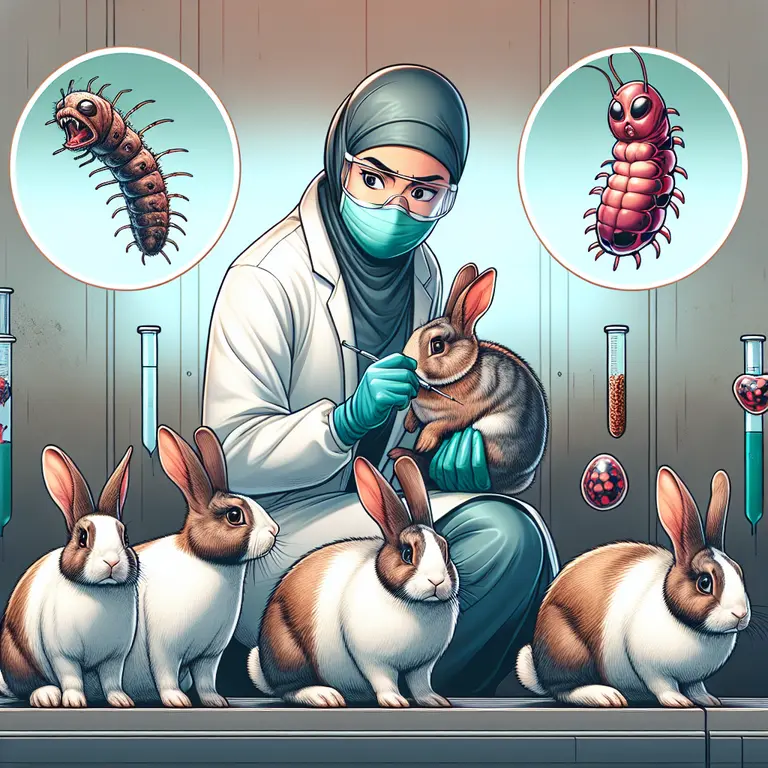
In the 1950s, European rabbits in Australia faced extinction from the devastating myxoma virus, which had been deliberately introduced to control their overwhelming population. The virus that causes myxomatosis was killing up to 99.8% of infected rabbits. But then something unexpected happened: scientists discovered that rabbits infected with a relatively benign intestinal parasite called Eimeria stiedae (which causes rabbit coccidiosis) were surviving the deadly myxoma virus at much higher rates.
This accidental discovery emerged during routine field monitoring when wildlife biologists noticed unusual survival patterns among rabbit populations across different regions of Australia. The correlation between Eimeria infection and myxoma survival wasn’t immediately obvious—it required careful examination of tissue samples from hundreds of rabbit specimens and meticulous documentation of infection patterns across multiple sites. Dr. Frank Fenner, who had been studying myxomatosis since its introduction, led the team that first documented this surprising interaction in 1953, though its significance wasn’t fully appreciated until several years later.
The finding challenged the prevailing understanding of host-pathogen relationships. Until this point, conventional wisdom held that animals weakened by one infection would be more susceptible to others, not less. The rabbit-parasite interaction suggested something far more complex was occurring at the immunological level—a phenomenon that would eventually reshape scientific understanding of how immune systems respond to multiple concurrent challenges.
From Eradication to Equilibrium: A Policy Reversal
This accidental discovery led to one of the strangest wildlife management decisions in history. Australian scientists deliberately infected rabbit populations with the mild Eimeria parasite to protect them from complete extinction by the myxoma virus. This counterintuitive approach—using one infection to mitigate another—worked because the Eimeria parasite stimulated the rabbits’ immune systems in ways that provided cross-protection against the more lethal myxoma virus.
The decision wasn’t made lightly. The Commonwealth Scientific and Industrial Research Organisation (CSIRO) had spent years developing myxomatosis as a biocontrol agent, investing significant resources and political capital in the program. Pivoting to protect the very species they had worked to control required overcoming institutional resistance and public confusion. Documents from the period reveal heated internal debates among scientists and policymakers about whether to intervene at all.
Implementation presented logistical challenges as well. Teams of field workers cultivated Eimeria in laboratory settings, then developed methods to introduce the parasite into wild rabbit populations by placing contaminated feed near warrens. The program targeted specific regions where rabbit populations had crashed below ecologically sustainable levels, while leaving other areas untreated to maintain the agricultural benefits of reduced rabbit numbers.
What makes this story particularly surprising is the ethical reversal it represents. The same government agencies that had introduced the myxoma virus to kill rabbits were now working to ensure rabbit survival through controlled parasitic infection. Their motivation wasn’t compassion for rabbits, but rather ecosystem stability—complete rabbit extinction would have triggered cascading effects through the food web, potentially causing even greater ecological damage.
The Immunological Revolution and Modern Parallels
The phenomenon, now understood as immune priming, represents an early example of what immunologists today call “trained immunity”—where exposure to one pathogen can create broad-spectrum protection against unrelated pathogens.
When Eimeria infects a rabbit, it triggers production of interferon and activates macrophages—components of the innate immune system that form the body’s first line of defense. This heightened state of immune alertness creates an inhospitable environment for the myxoma virus to establish itself. Research in the 1970s demonstrated that rabbits with active Eimeria infections showed elevated levels of natural killer cells and enhanced cytokine production that inhibited viral replication.
This historical example of biological intervention has surprising parallels to modern microbiome research, where scientists are exploring how certain bacterial populations can protect against more dangerous pathogens. It also foreshadowed contemporary conservation strategies that sometimes employ controlled exposure to disease to build resistance in endangered populations—a technique now being considered to protect amphibians from chytrid fungus and bats from white-nose syndrome.
In human medicine, the concept finds echoes in the hygiene hypothesis and emerging treatments using parasitic worms (helminth therapy) to modulate autoimmune conditions. Some researchers have even suggested that carefully managed exposure to certain pathogens could potentially provide broad protection against novel viral threats—though such approaches remain highly experimental and ethically complex.
Evolutionary Insights from an Unplanned Experiment
The rabbit-parasite interaction also revealed a fundamental principle of evolution: the myxoma virus gradually evolved to become less lethal over time, as killing hosts too quickly proved counterproductive to its own transmission. This real-world demonstration of pathogen attenuation has informed mathematical models of disease evolution still used today in pandemic planning.
By the 1970s, the original strain of myxoma virus that killed nearly 100% of infected rabbits had been largely replaced by variants causing mortality rates closer to 50%. Simultaneously, rabbit populations were developing genetic resistance. This evolutionary arms race created a natural laboratory that continues to yield insights. Recent genomic studies of Australian rabbits have identified specific genetic markers associated with myxoma resistance, providing one of the clearest examples of rapid evolutionary adaptation in a vertebrate species.
Perhaps most counterintuitively, this case represents one of the first documented examples where human intervention in natural selection—first to eliminate a species, then to partially save it—created a living laboratory for evolutionary biology that continues to yield insights decades later.
Legacy of the Parasite Paradox
The Australian rabbit story transcends its historical context to inform modern approaches to disease ecology and conservation biology. The deliberate use of Eimeria to modulate myxoma impacts established an important precedent for thinking about ecological systems as complex networks rather than simple predator-prey or host-pathogen dyads.
Today’s researchers studying emerging infectious diseases frequently reference the rabbit-myxoma-Eimeria interaction when discussing the unpredictable consequences of biological interventions. The case demonstrates how even well-studied systems can behave in surprising ways when multiple pathogens interact within a host species.
As humanity faces growing challenges from emerging diseases, invasive species, and ecosystem disruption, this historical example reminds us that ecological relationships rarely follow linear patterns. Sometimes, the solution to one biological problem may come from a seemingly counterintuitive direction—even from another problem organism itself. The lesson of fighting a parasite with another parasite suggests that in complex living systems, balance rather than elimination may often be the more sustainable goal.