
Linguistic Fossils: How Ancient Clicks Reveal Human Origins
Recent linguistic research reveals how click consonants in certain African languages provide crucial evidence for human migration patterns and evolutionary history.
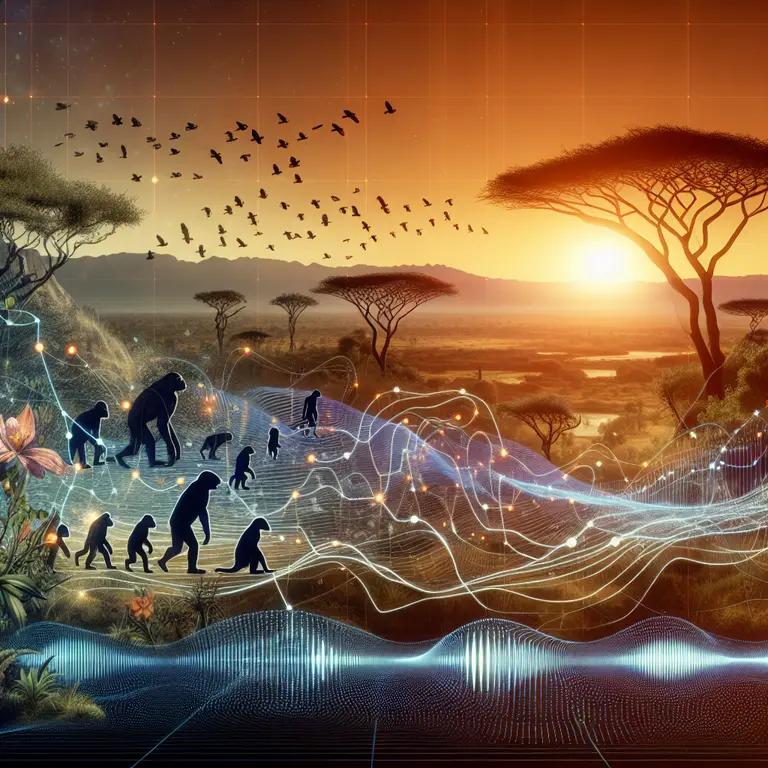
The Sound of Ancient Humanity
In the semi-arid plains of the Kalahari, speakers of languages like Ju|‘hoansi and !Xóõ communicate using sounds that most humans can barely reproduce—a complex symphony of clicks, pops, and inhalations that represent some of humanity’s oldest linguistic features. Recent research published in the Journal of Language Evolution suggests these distinctive speech sounds aren’t merely linguistic curiosities but actual “acoustic fossils” that help trace human migration patterns dating back over 100,000 years. These phonological relics provide a unique window into our species’ past, offering insights that complement genetic and archaeological evidence about human origins and dispersal.
The discovery that click consonants may represent humanity’s earliest speech sounds has profound implications for our understanding of language evolution. Unlike material artifacts that deteriorate over millennia, these sounds have been preserved through continuous cultural transmission across countless generations. This preservation offers linguists, anthropologists, and evolutionary biologists an unprecedented opportunity to study living elements of ancient human communication systems that would otherwise be lost to time.
Click Languages as Living Artifacts
Click consonants—sounds produced by creating suction between the tongue and different parts of the mouth—appear in only about two dozen languages worldwide, nearly all concentrated in southern and eastern Africa. Languages like Xhosa (famously featured in “Black Panther”) contain up to 45 distinct click sounds. These phonemes are categorized based on their place of articulation: dental clicks (symbolized as |), lateral clicks (ǁ), alveolar clicks (ǃ), bilabial clicks (ʘ), and palatal clicks (ǂ).
Dr. Sheena Shah of SOAS University of London, lead author of the groundbreaking study, explains: “These click phonemes represent a linguistic time capsule. Unlike archaeological artifacts, these are living fossils still in daily use.”
The research team combined genetic data, archaeological evidence, and computational linguistic models to demonstrate that click consonants likely represent the original speech sounds used by early Homo sapiens. Most human languages subsequently lost these sounds during migrations out of Africa, creating a linguistic marker that aligns remarkably well with genetic evidence of human dispersal.
The geographic distribution of click languages today closely corresponds to areas inhabited by populations carrying some of humanity’s oldest genetic lineages. The San and Khoe peoples of southern Africa, whose languages contain the richest inventories of click consonants, also possess genetic markers suggesting they diverged from other human populations approximately 100,000-200,000 years ago. This correlation between linguistic and genetic evidence strengthens the hypothesis that clicks represent a preserved feature from early human language rather than a later innovation.
Challenging Linguistic Assumptions
This research upends conventional wisdom in historical linguistics, which has traditionally viewed clicks as later innovations rather than preserved ancient features. The study provides compelling evidence that the San and Khoe peoples of southern Africa, who speak languages with the most extensive click inventories, likely represent a linguistic lineage closer to humanity’s original speech patterns than any other living populations.
“We’ve been thinking about language evolution backward,” notes computational linguist Dr. Tao Zhang of MIT, who wasn’t involved in the study. “Rather than asking how clicks developed, we should be asking why most languages lost them.”
The prevailing theory now suggests that as human populations migrated out of Africa and adapted to new environments, selective pressures favored simplified phonological systems that were easier to teach to offspring and newcomers. Click consonants, while information-dense and efficient in certain communicative contexts, require precise articulatory control and are difficult for non-native speakers to master. As human groups expanded and encountered other populations, languages with fewer clicks may have been more easily shared and learned.
Another hypothesis suggests that clicks may have originally served functions beyond ordinary language, possibly including ritual communication, hunting signals, or specialized forms of expression. The Hadza people of Tanzania, for instance, still use a specialized click-heavy register when hunting, as these sounds can resemble natural environmental sounds and are less likely to alert prey animals than ordinary speech.
Cross-Disciplinary Implications
Surprisingly, this linguistic research has implications far beyond language studies. Medical researchers at the University of Cape Town have discovered that speakers of click languages develop distinctive neural pathways and muscular adaptations in their vocal tracts. These adaptations appear to offer unexpected benefits for treating certain speech disorders and may inform novel approaches to rehabilitation following stroke or traumatic brain injury.
Additionally, acoustic engineers are studying click consonants to develop more efficient audio compression algorithms. The precisely timed air pressure manipulations in clicks represent information-dense sound packets that could inspire new approaches to digital signal processing.
The biomechanics of click production have also attracted attention from evolutionary biologists studying the development of human speech capabilities. The complex coordination required between the tongue, soft palate, and glottis during click production suggests that early humans possessed sophisticated neural control over their vocal apparatus much earlier than previously thought. This challenges timelines for when fully modern speech capabilities evolved and raises questions about the potential linguistic abilities of archaic human species such as Neanderthals and Denisovans.
Cognitive scientists have noted that click languages often feature exceptionally fine-grained semantic distinctions in certain domains, particularly regarding spatial relationships and environmental features. This linguistic precision may reflect cognitive adaptations crucial to early human survival in challenging environments, preserving cognitive patterns that were once universal but have since been lost in most human populations.
Preservation Urgency
The study takes on added urgency as most click languages are critically endangered. Of the approximately 24 click languages documented, at least 8 have fewer than 1,000 speakers remaining, and several have only a handful of elderly speakers. Economic pressures, educational policies favoring dominant languages, and social stigmatization have all contributed to the rapid decline of these linguistic treasures.
“When these languages disappear, we lose not just cultural heritage but irreplaceable evidence about human cognitive evolution and migration patterns,” warns Dr. Shah. “It’s equivalent to losing a crucial fossil record that happens to still be alive.”
International efforts to document and preserve these linguistic treasures have accelerated, with the Endangered Languages Documentation Programme recently launching a dedicated initiative focused specifically on click languages. This work involves creating comprehensive audio and video recordings, developing dictionaries and grammars, and supporting community-led language revitalization efforts.
Some indigenous communities have embraced digital technologies to preserve their languages, creating smartphone apps and online learning resources that make their unique linguistic heritage accessible to younger generations. The Khwe community in Namibia, for instance, has partnered with linguists to develop a digital archive of their click-rich language, including stories, songs, and cultural knowledge that might otherwise be lost.
The Future of Linguistic Archaeology
As research techniques advance, linguists are developing new methods to analyze the acoustic properties of clicks with unprecedented precision. Ultrasound imaging now allows researchers to visualize tongue movements during click production, while computational models can simulate the evolution of phonological systems over time. These approaches are generating testable hypotheses about how and why click consonants emerged and persisted in certain populations.
The study of click languages represents a new frontier in what might be called “linguistic archaeology”—using living languages to reconstruct ancient patterns of human communication, migration, and cognition. Unlike traditional archaeology, which relies on material remains, linguistic archaeology examines the living structure of human communication systems to reveal patterns that may date back to the dawn of our species.
As humanity reaches toward the stars and develops increasingly sophisticated technologies, these ancient sounds remind us that some of our most valuable scientific resources might be hiding in plain hearing—preserved in the everyday speech of communities whose languages have maintained connections to our deepest human origins. The clicks, pops, and inhalations that characterize these endangered languages may yet reveal secrets about human evolution that no bone fragment or stone tool could ever tell us.