
How Potato Chips Were First Discovered and Popularized
Potato chips, a well-loved snack worldwide, were actually discovered accidentally.
Introduction
Some of the most transformative inventions in human history were never planned. They emerged not from laboratories, research grants, or years of deliberate experimentation, but from moments of accident, irritation, or sheer improvisation. The potato chip is one of the most delicious examples of this phenomenon. What began as a petty act of culinary defiance in an upstate New York resort kitchen in 1853 would eventually grow into a global snack industry worth tens of billions of dollars. The story of the potato chip is, at its core, a story about human temperament, the unpredictability of innovation, and the strange ways in which everyday frustration can accidentally reshape culture.
A Moment of Frustration in the Kitchen
On a summer afternoon in 1853, George Crum was working as a chef at the Moon Lake Lodge resort in Saratoga Springs, New York. The resort was a fashionable destination, attracting wealthy visitors who expected refined service and well-prepared meals. Among the dishes on the menu were fried potatoes, a popular and relatively common offering at the time. Thick-cut and pan-fried, they were served in the style that most diners of the era would have recognized and accepted without complaint.
On this particular afternoon, however, one guest proved to be an exceptional nuisance. The customer repeatedly sent his plate of fried potatoes back to the kitchen, each time insisting that the slices were too thick, too soft, or otherwise unsatisfactory. Whether this patron was a genuine connoisseur of texture or simply someone who enjoyed exercising authority over kitchen staff, the repeated rejections wore down Crum’s patience. He was a skilled and proud cook, and the repeated dismissal of his work stung.
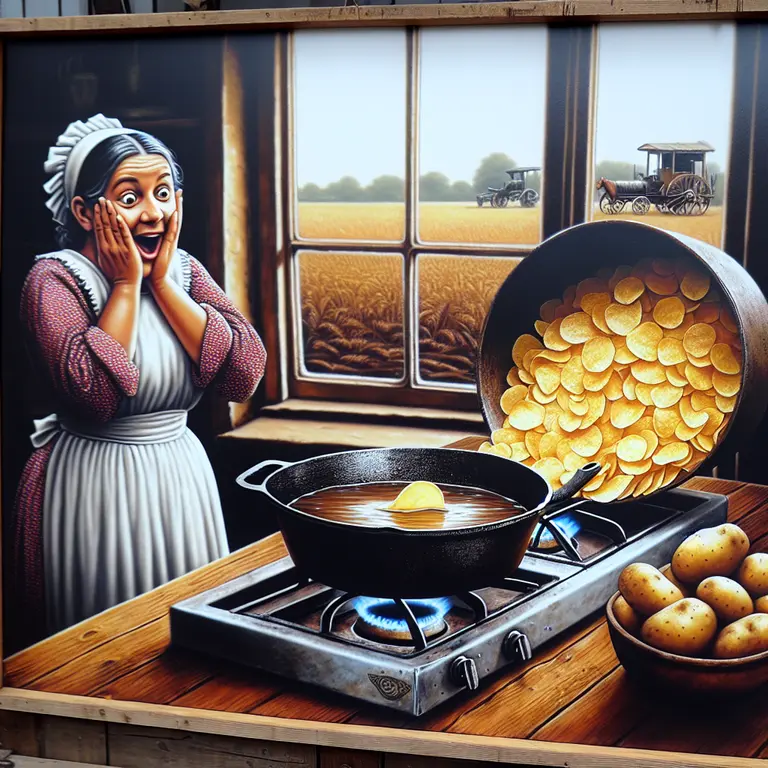
What happened next was less a stroke of genius and more an act of exasperated retaliation. Crum sliced a fresh batch of potatoes as thin as he possibly could, far thinner than any reasonable serving would require. He dropped them into boiling oil and fried them until they were stiff, brittle, and golden. He then doused them heavily with salt, reasoning that the combination of excessive crunch and aggressive seasoning would make the dish so unpleasant or ridiculous that the difficult customer would finally have nothing left to complain about, or would simply give up.
The plan backfired spectacularly. The customer loved them.
The Birth of Saratoga Chips
Rather than storming out or demanding something different, the finicky diner was reportedly delighted by Crum’s thin, crispy, salty creation. Word spread quickly through the dining room, and soon other guests at the Moon Lake Lodge were asking for the same thing. The texture's novelty, the satisfying crunch, and the bold saltiness made the dish immediately appealing, in a way Crum could not have anticipated when he was slicing potatoes in a fit of professional irritation.
The creation quickly acquired a name that reflected its origins: Saratoga Chips. The dish became a signature item at the resort and a local point of pride in the Saratoga Springs area. Crum himself reportedly embraced the invention and later opened his own restaurant, where Saratoga Chips were placed on every table as a complimentary offering, a practice that would feel remarkably familiar to anyone who has ever sat down at a modern American restaurant and found a basket of something crunchy waiting for them.
It is worth pausing to consider just how unlikely this origin story is. Crum was not trying to create something new. He was not experimenting with flavor profiles or expanding the culinary possibilities of the potato. He was trying to annoy someone. The fact that his act of kitchen sabotage produced something universally beloved rather than universally rejected is one of the more entertaining ironies in the history of food.
There is some historical debate around the details of this account. A few alternative versions of the story suggest that Crum’s sister, Catherine Wicks, may have accidentally dropped a potato slice into hot oil and discovered the result, or that the difficult customer in question may have been the railroad magnate Cornelius Vanderbilt. These variations do not significantly alter the essential character of the story, which, in nearly every version, involves an accident, irritation, and an unexpected triumph.
Rise to Popularity and Industrial Transformation
For several decades after their invention, potato chips remained a relatively regional and artisanal product. They were made fresh in restaurants and homes, served immediately, and did not travel well. The lack of reliable preservation methods meant that chips could not be packaged and sold like shelf-stable goods. This limited their reach considerably, keeping them as a novelty rather than a staple.
The transformation of the potato chip from a local curiosity into a mass-market product required a technological leap, and it came in the early twentieth century. In 1926, a woman named Laura Scudder in California began selling potato chips in wax paper bags that were sealed by ironing the tops closed. This innovation addressed the central problem of freshness and portability, allowing chips to be manufactured in larger quantities, packaged, and distributed to stores. The humble chip had entered the industrial age.
Further developments accelerated the chip’s rise. The invention of continuous conveyor belt fryers in the 1920s and 1930s allowed manufacturers to produce chips at a scale that hand-slicing and batch frying could never achieve. Flavor technology advanced steadily throughout the mid-twentieth century, and by the 1950s and 1960s, manufacturers were experimenting with seasoning blends that went well beyond simple salt. Barbecue flavoring appeared, then sour cream and onion, then a seemingly endless procession of regional and experimental varieties. Today, potato chip flavors range from the straightforward to the genuinely strange, with offerings that include truffle, dill pickle, lobster bisque, and, in various international markets, flavors that reflect entirely different culinary traditions.
The global potato chip market is now valued at well over $30 billion annually, with consumption spanning virtually every country on Earth. Different cultures have adapted the basic concept in ways that reflect local tastes, producing variations in thickness, oil type, seasoning intensity, and even the base ingredient itself, with some regions producing chips from cassava, taro, or other starchy vegetables that follow the same fundamental logic as Crum’s original creation.
Legacy and the Broader Lesson of Accidental Innovation
The story of the potato chip sits comfortably within a larger tradition of accidental invention that includes penicillin, the microwave oven, safety glass, and Post-it Notes. In each of these cases, something unexpected happened in the course of ordinary activity, and a perceptive person either recognized the potential of the accident or stumbled into success without fully understanding what they had done. George Crum’s case is unusual in that he was not even trying to succeed. He was trying to fail in a particular direction, and the universe declined to cooperate.
This story raises an interesting question about how we think about creativity and discovery. We tend to imagine inventors as people who set out with a clear goal and achieve it through discipline and vision. The reality is frequently messier, more human, and more amusing than that. Crum’s chip reminds us that some of the most enduring contributions to everyday life emerged not from ambition but from accident, and not from patience but from its opposite.
Conclusion
The next time you reach into a bag of potato chips and hear that familiar crunch, it is worth taking a moment to consider the improbable chain of events that produced it. A difficult customer, an exasperated cook, and a kitchen act of spite somehow combined to create one of the most universally recognizable snack foods in human history. George Crum did not set out to change the way the world snacks. He set out to make a point, and in doing so, accidentally made history. It is a reminder that innovation does not always announce itself with fanfare. Sometimes it arrives quietly, salted and crispy, on a plate that was never meant to please anyone.