
Discover the Tiny Yet Crucial Bone Hidden in Your Ear
The smallest bone in the human body is found in your ear.
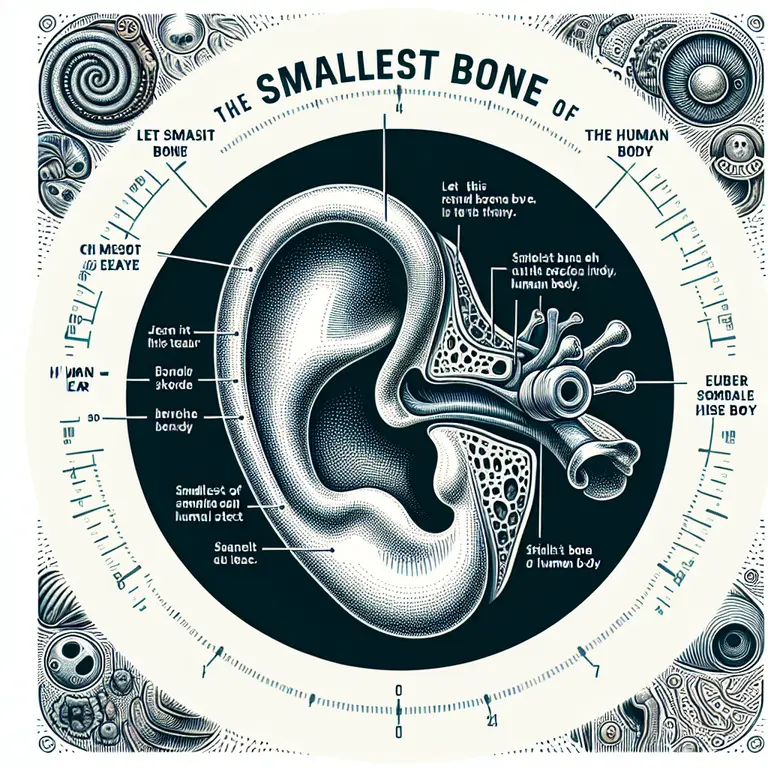
The Smallest Bone with the Biggest Job: The Remarkable Stapes
Often overshadowed by more prominent components of the human body, the stapes bone — also known as the stirrup bone — holds the distinction of being the smallest bone in the entire human skeleton. Despite measuring only about 2.8 millimeters in length, roughly equivalent to a grain of rice or a quarter teaspoon in volume, the stapes plays a vital and irreplaceable role in one of our most important senses: hearing. Its story is one of elegant biological engineering, evolutionary history, and medical significance that reaches far beyond what its microscopic size might suggest.
Anatomy of the Middle Ear and the Ossicular Chain
To understand the stapes, one must first appreciate the remarkable architecture of the middle ear in which it resides. Tucked inside the temporal bone of the skull, the middle ear is a tiny air-filled cavity that serves as the mechanical bridge between the outer world of sound and the fluid-filled inner ear. Within this cavity sits a trio of bones collectively known as the ossicles, the smallest bones in the human body, working in coordinated sequence to relay acoustic information.
The three ossicles are the malleus, the incus, and the stapes — named after the Latin words for hammer, anvil, and stirrup, respectively, each name reflecting the bone’s distinctive shape. When sound waves travel through the ear canal and strike the eardrum, or tympanic membrane, the membrane vibrates in response. These vibrations are first picked up by the malleus, which is attached directly to the eardrum. The malleus then transfers the motion to the incus, which in turn connects to the stapes. This chain reaction happens in milliseconds and with extraordinary precision, allowing the auditory system to respond to an enormous range of sound frequencies and intensities.
The stapes is the final link in this mechanical chain. Its footplate sits against the oval window, a membrane-covered opening that leads directly into the fluid-filled cochlea of the inner ear. When the stapes rocks back and forth against the oval window, it sets the cochlear fluid into motion, initiating the next stage of the hearing process. The entire ossicular chain acts as an amplifier, compensating for the energy that would otherwise be lost when sound transitions from air into the denser fluid of the inner ear. Without this amplification, the human hearing system would lose roughly 99.9 percent of incoming sound energy.
The Stapes in Detail: Structure and Function
The stapes is not simply a small bone — it is a precisely engineered structure whose form is inseparable from its function. Shaped unmistakably like a stirrup used in horseback riding, it consists of a head, two curved limbs called crura, and a flat base known as the footplate. The head articulates with the incus through a small joint, while the footplate seals against the oval window with a flexible ring of ligament tissue that allows controlled movement.
This shape is critical. The arch formed by the two crura reduces the bone’s mass while maintaining structural integrity, allowing it to vibrate with minimal inertia. The lighter a vibrating structure, the more efficiently it can respond to rapid changes in sound frequency. The stapes must be capable of vibrating thousands of times per second to convey the full range of audible frequencies, which in healthy human hearing spans from about 20 Hz to 20,000 Hz. Its design accomplishes this with remarkable efficiency.
The stapes also participates in a protective reflex known as the acoustic reflex. When exposed to very loud sounds, the stapedius muscle — the smallest skeletal muscle in the human body — contracts, pulling on the stapes to stiffen the ossicular chain and reduce the transmission of sound energy. This reflex helps protect the delicate hair cells of the inner ear from damage caused by sudden loud noises, though it reacts too slowly to guard against instantaneous sounds like gunshots.
When the Stapes Fails: Disease, Disorder, and Surgery
Given how central the stapes is to the hearing process, any disruption to its normal movement can have significant consequences. One of the most well-known conditions affecting this bone is otosclerosis, a disease in which abnormal bone remodeling causes the stapes footplate to become fused to the oval window. Rather than vibrating freely, the stapes becomes locked in place, preventing sound from entering the inner ear. The result is a progressive, often debilitating conductive hearing loss that typically begins in early adulthood.
Otosclerosis affects approximately 0.3 to 0.4 percent of the general population and has a notable hereditary component, though its exact causes are still being studied. For centuries, those affected had no recourse. However, in the 1950s, American surgeon John Shea Jr. pioneered a procedure called stapedectomy, in which the fixed stapes is removed and replaced with a prosthetic implant. This operation, which involves working in a surgical field only a few millimeters wide, is considered one of the most delicate procedures in all of medicine. Its success rates are high, and it remains one of the few surgical interventions that can dramatically restore lost hearing.
Beyond otosclerosis, the stapes can also be affected by trauma, infection, and congenital malformations. In some cases, individuals are born with a malformed or absent stapes, leading to hearing impairment from birth. Advances in microsurgery and implant technology have made it increasingly possible to address even these complex cases, though outcomes vary depending on the extent of the abnormality.
An Evolutionary Perspective on a Tiny Bone
The stapes has a deeper story than its role in modern human hearing. From an evolutionary standpoint, the ossicles represent one of the most fascinating examples of biological repurposing in vertebrate history. In fish and early reptiles, the bone that would eventually become the stapes, then called the hyomandibula, was part of the jaw suspension system. Over hundreds of millions of years of evolution, as the jaw structure of early mammals became more complex, certain jaw bones were gradually co-opted into the hearing system.
This evolutionary transition is documented in the fossil record with remarkable clarity. Transitional species show intermediate stages in which jaw bones were simultaneously functioning in both chewing and hearing, a dual role that seems almost implausible yet is supported by substantial paleontological evidence. The stapes, therefore, is not just a marvel of anatomy — it is a living record of the evolutionary journey that produced the mammalian auditory system.
Conclusion
The stapes, though the smallest bone in the human body, plays one of the most critical roles in the auditory process. As the final link in the ossicular chain, it facilitates the transmission of sound vibrations from the eardrum to the fluid-filled inner ear, enabling the conversion of mechanical energy into the nerve impulses that the brain interprets as sound. Its precisely engineered shape, its participation in protective reflexes, its vulnerability to disease, and its deep evolutionary origins all speak to a structure of extraordinary significance.
In the broader context of human biology, the stapes serves as a compelling reminder that size is no measure of importance. The smallest components of the body are often the ones performing the most delicate and indispensable work. This tiny bone, invisible to the naked eye when viewed from the outside, is the reason we can hear a whisper across a quiet room, appreciate the nuance of music, or respond to a voice calling our name. Its contribution to human life is, in every sense, larger than itself.