
The Birth of Digital Photography: Steven Sasson's Legacy
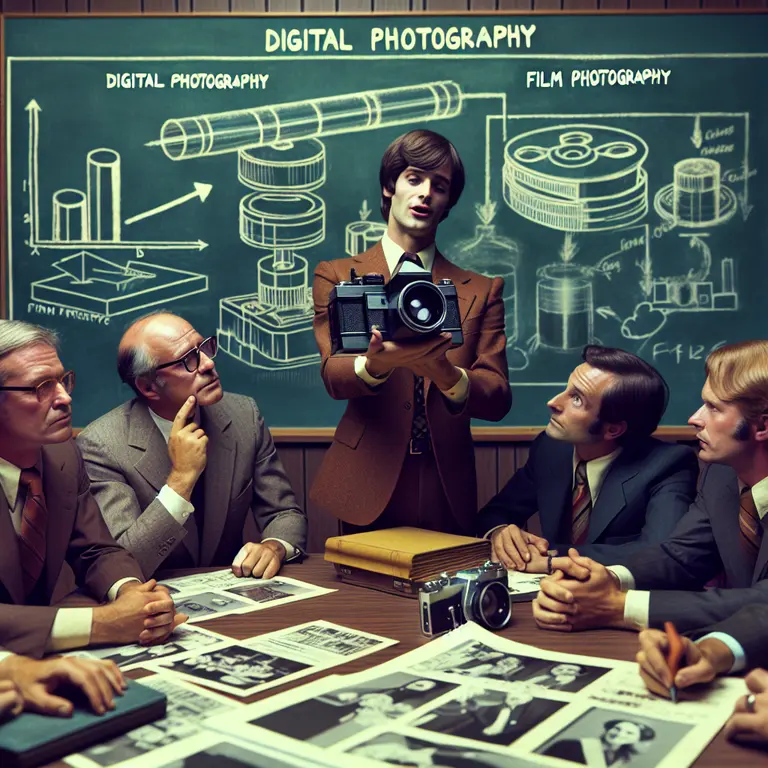
The digital camera was initially invented by an engineer at Eastman Kodak in 1975, but the company made a decision against it due to the fear of this invention undermining the photographic film industry.
Introduction
In 1975, a young engineer named Steven Sasson sat in a Kodak laboratory in Rochester, New York, and assembled something the world had never seen before. Using a collection of off-the-shelf components, a charge-coupled device sensor, and a modified Super 8 movie camera lens, he built the world’s first digital camera. The device was ungainly, heavy, and slow. It took 23 seconds to capture a single black-and-white image and another 23 to display it on a television screen. The resulting photograph was grainy, low-resolution, and far from beautiful. And yet, what Sasson had created in that modest laboratory was nothing less than the seed of a revolution that would eventually upend an entire industry.
What makes this story remarkable is not the invention itself, but what happened next. The company that held this technology in its hands, a company that dominated global photography with an iron grip, chose to look away. Kodak’s decision to suppress, delay, and ultimately ignore its own breakthrough is now studied in business schools around the world as one of the most consequential strategic failures in corporate history. It is a story about fear, short-term thinking, and the very human tendency to protect what we already have at the expense of what we could become.
The Invention of the First Digital Camera
Steven Sasson’s invention marked the first practical demonstration of digital imaging technology applied to photography. Unlike traditional cameras, which relied on chemically treated film to record light, Sasson’s prototype used a digital sensor to convert incoming light into electrical signals. Those signals were then processed and stored as numerical data on a cassette tape, which could later be read and displayed on a standard television set. The entire concept was alien to everything Kodak had built its empire upon.
The camera weighed approximately eight pounds and produced images with a resolution of just 0.01 megapixels, a figure so low that the resulting pictures were barely recognizable compared to what film could produce at the time. The device required a separate playback unit to decode the cassette and render the image on screen. By any modern standard, it was primitive. But Sasson and those who understood the underlying technology recognized that the limitations were temporary. The principles were sound. The direction was clear. What existed as a rough prototype in 1975 could, with investment and refinement, become something transformative.
Sasson presented his invention to Kodak executives, who received it with a mixture of curiosity and unease. According to Sasson himself, the response was not outright rejection so much as institutional paralysis. Executives asked when digital cameras might threaten film sales. When Sasson suggested the timeline might be around 15 to 20 years, the company’s leadership effectively decided the problem could be dealt with later. The invention was quietly shelved, classified as a research curiosity rather than a commercial priority. Kodak applied for a patent in 1977, which was granted, but the technology remained locked away from the market for years.
Kodak’s Decision to Prioritize Film
To understand why Kodak made the choices it did, it is necessary to appreciate just how dominant the company was in the 1970s and 1980s. At its peak, Kodak controlled roughly 90 percent of the U.S. film market and about 85 percent of camera sales. The company was not merely successful; it was synonymous with photography itself. The phrase “Kodak moment” has entered everyday language to describe any experience worth preserving. Film was not just a product for Kodak. It was the foundation of an entire corporate identity.
This dominance created a structural problem that strategists now call the innovator’s dilemma. When a company is generating enormous profits from an existing product, any new technology that threatens that product also threatens its revenue streams, jobs, manufacturing infrastructure, and the brand identity built around it. Kodak’s leadership understood, at some level, that digital photography could eventually replace film. That understanding was precisely what made them reluctant to pursue it. Aggressively embracing digital cameras would mean cannibalizing their own most profitable business before a competitor forced them to do so. It was a rational fear, but it led to an irrational outcome.
The company continued to invest in film development, chemical processing, and print services throughout the late 1970s and into the 1980s. Internally, engineers and researchers who advocated for digital investment were often sidelined or found their proposals buried under layers of institutional resistance. The culture at Kodak had been built around film, and that culture proved extraordinarily difficult to change even as the external environment began to shift.
The Rise of Digital Photography and Kodak’s Decline
While Kodak looked inward, the rest of the technology world moved forward. Sony introduced the Mavica in 1981, an electronic camera that stored images on small magnetic disks. Though it was not a true digital camera in the modern sense, it demonstrated that consumers and manufacturers were interested in filmless photography. Throughout the 1980s and into the 1990s, companies including Canon, Nikon, Casio, and Fujifilm began developing and refining digital imaging products. Each generation of cameras became smaller, faster, and more capable. Resolution improved. Storage became more convenient. Prices began to fall.
Kodak was not entirely absent from this process. The company did produce digital cameras and invested in some digital imaging research during this period. In fact, Kodak released a professional digital camera system in 1991 and held a significant portfolio of digital imaging patents. However, these efforts were always secondary to the film business, treated as supplements rather than successors. The company’s digital products were often priced too high, marketed too cautiously, or developed too slowly to make a meaningful impact on the emerging market.
By the early 2000s, the shift was undeniable and irreversible. Digital cameras had become affordable enough for ordinary consumers, and the convenience of instant, filmless photography proved overwhelmingly attractive. Film sales collapsed with a speed that surprised even those who had predicted the transition. Between 2000 and 2010, global film sales declined by more than 90 percent. Kodak’s revenues fell sharply, its workforce shrank dramatically, and the company struggled to find a viable path forward. In January 2012, Kodak filed for Chapter 11 bankruptcy protection, a moment that felt less like a business event and more like the end of a cultural era.
The Missed Opportunity
The full scale of what Kodak lost becomes clear when you consider the trajectory of the companies that did embrace digital photography. Canon and Nikon successfully transitioned their core businesses from film to digital, retaining their reputations for optical quality while building new revenue streams around sensors, software, and digital accessories. Sony leveraged its early interest in electronic imaging to become one of the world’s leading manufacturers of image sensors, components that now appear in smartphones produced by Apple, Google, and others. The photography market did not disappear when film died. It expanded enormously, and the companies positioned to serve that expanded market grew with it.
Kodak held patents, expertise, brand recognition, and consumer trust that most competitors would have envied. Had the company committed meaningfully to digital development in the late 1970s or early 1980s, it would have had every resource necessary to lead the transition rather than be destroyed by it. Instead, the window closed. By the time Kodak’s leadership recognized the existential threat posed by digital photography, the company lacked the financial strength and market position to compete effectively against rivals who had spent decades building digital expertise.
Lessons from Kodak’s Failure
Kodak’s story has become a standard reference point in discussions about corporate strategy, disruptive innovation, and organizational change. The lessons it offers are not abstract. They are directly applicable to any organization navigating a period of technological transition.
The most fundamental lesson concerns the danger of defining a business too narrowly. Kodak understood itself as a film company rather than as an imaging company. That distinction proved fatal. Had executives asked not “how do we protect our film sales” but rather “how do we help people capture and preserve their memories using the best available technology,” the company’s strategic choices might have looked very different. The underlying need that Kodak served, the human desire to record visual experience, never went away. Only the technology used to meet that need changed.
A second lesson involves the relationship between short-term profit and long-term survival. Kodak’s film business was enormously profitable in the 1970s and 1980s, and protecting those profits felt like sound financial management. In reality, it was a form of deferred collapse. Every year spent optimizing the film business rather than building digital capabilities was a year of compounding disadvantage. The short-term gains from film were real, but they were purchased at the cost of the company’s future.
Finally, Kodak’s story illustrates the importance of organizational culture in determining strategic outcomes. The company’s culture was built around chemistry, manufacturing, and film. Engineers who understood digital technology existed within Kodak, but the culture did not empower them to drive change. Transforming a company’s direction requires not only recognizing a new opportunity but also building the internal conditions that enable people to pursue it.
Conclusion
The invention of the first digital camera by Steven Sasson in 1975 stands as one of the more poignant ironies in the history of technology. The company best positioned to lead the digital photography revolution was the same one that repeatedly and deliberately chose to delay it. Kodak’s decline was not the result of ignorance. The company knew what was coming. It was the result of institutional inertia, misaligned incentives, and a failure of imagination about what the company could become if it was willing to let go of what it already was.
The story does not end entirely in failure. Kodak emerged from bankruptcy, restructured, and continues to operate in commercial printing and imaging markets. But it does so as a shadow of the global giant it once was, a reminder that even the most powerful market positions are temporary when the underlying technology shifts. For any organization navigating a world of rapid change, Kodak’s history offers a warning that remains as relevant today as it was in 1975: the future does not wait for those who are too comfortable in the present.