
Restore Clarity: Fix Scratched Eyeglasses Using Toothpaste
A simple DIY trick for polishing minor scratches on eyeglasses using toothpaste
 Watch on YouTube
 Watch on Rumble
Introduction
Scratches on eyeglass lenses are one of those small but genuinely disruptive problems that accumulate over time. A single fine scratch caught in the wrong angle of light can scatter your vision at precisely the wrong moment, whether you are driving, reading, or working at a screen. Over weeks and months, a lens that once offered crystal clarity can become a patchwork of hairline abrasions that quietly degrade your quality of life. For many people, the instinctive response is to visit an optician and request a replacement, but that visit often comes with a price tag that feels disproportionate to the problem. Lens replacement can cost anywhere from modest to surprisingly steep, depending on your prescription, the lens material, and any specialist coatings involved.
What few people realize is that a tube of ordinary toothpaste sitting in the bathroom cabinet may offer a practical, low-cost alternative for addressing minor surface scratches. This is not a folk myth or internet rumor. The mild abrasive properties of certain toothpastes have a legitimate, if limited, application for buffing out superficial imperfections on lens surfaces. Understanding why this works, how to do it correctly, and when not to attempt it at all can save you money, preserve your lenses, and give you a useful skill for managing one of the most common frustrations faced by glasses wearers everywhere.
Why Toothpaste Works on Scratched Lenses
To understand the science behind this method, it helps to think about what toothpaste is actually designed to do. At its core, toothpaste is a mild polishing agent. It contains tiny abrasive particles, most commonly hydrated silica or calcium carbonate, that are fine enough to remove surface stains from tooth enamel without causing significant damage to the enamel itself. This same polishing action, when applied carefully to a lens surface, can gently abrade the edges of a shallow scratch and smooth the surrounding material, reducing the visual disruption the scratch creates.
The keyword here is shallow. A scratch on an eyeglass lens is essentially a channel or groove cut into the surface of the lens material. When light passes through a scratched lens, it scatters at the edges of that groove, creating the blurry or hazy effect that glasses wearers find so irritating. Toothpaste does not fill the scratch permanently or structurally. What it does is very lightly abrade the material on either side of the groove, feathering those edges and reducing the sharpness of the channel. The result is that light scatters less dramatically, and the scratch becomes less visually intrusive.
This is why the choice of toothpaste matters enormously. A plain, non-whitening, non-gel toothpaste with a creamy consistency and no added abrasive boosters is what you need. Whitening toothpastes often contain significantly coarser abrasive particles, chemical bleaching agents, or both. These formulations are designed to tackle stubborn surface stains on enamel, which is one of the hardest biological materials in the human body. Eyeglass lenses, by contrast, are far more delicate. Using a whitening or strongly abrasive toothpaste on lenses is likely to introduce new scratches rather than reduce existing ones, leaving you worse off than when you started.
The Step-by-Step Process
Before you begin, prepare your workspace and your lenses carefully. Start by washing your hands thoroughly to remove any oils, grit, or debris that could transfer to the lens surface during the process. Then clean the glasses with a proper lens cleaning solution and a microfiber cloth. This step is not optional. Any dust or dirt on the lens surface during the buffing process will act like sandpaper, dragging across the lens and causing new damage. Take your time here and make sure both lenses are genuinely clean before proceeding.
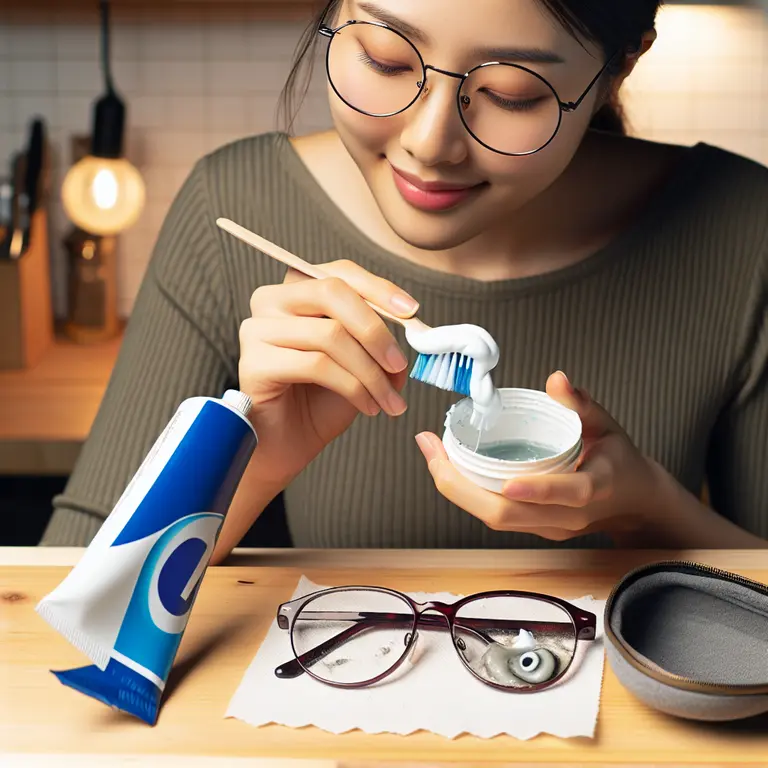
Once the lenses are clean and dry, squeeze a small amount of toothpaste onto a soft cotton cloth or a fresh microfiber cloth. The amount you need is genuinely small, roughly the size of a pea. More toothpaste does not mean better results. It simply means more residue to clean up afterward and a greater risk of the paste spreading to parts of the frame or lens where it is not needed.
Apply the toothpaste to the scratched area using gentle, circular motions. The circular motion is deliberate and important. Rubbing in a single direction can create linear marks on the lens surface, while circular buffing distributes the mild abrasive action more evenly. Keep your pressure light and consistent. You are not trying to sand down the lens aggressively. You are coaxing the surface into a slightly smoother state through patient, controlled movement. Continue for about 10 to 15 seconds per application, keeping the motion even and covering the full extent of the scratched area.
After buffing, rinse the lens thoroughly under lukewarm water. Cold water is fine too, but avoid hot water, which can stress certain lens materials or coatings. Make sure every trace of toothpaste is removed. Toothpaste residue left to dry on a lens will leave a cloudy film that is difficult to remove cleanly. After rinsing, dry the lens gently with a clean microfiber cloth and hold it up to a light source to assess the result. For minor scratches, you may notice an improvement after a single application. For slightly more prominent scratches, you can repeat the process 2 or 3 times, allowing yourself to evaluate progress between rounds.
Important Limitations and When to Avoid This Method
This technique comes with meaningful limitations that every glasses wearer should understand before reaching for the toothpaste. The most significant restriction involves lens coatings. Modern eyeglass lenses are rarely bare plastic or glass. They are almost universally treated with one or more specialized coatings, including anti-reflective coatings, anti-scratch coatings, blue-light-filtering layers, UV protection treatments, and hydrophobic or oleophobic surface finishes. These coatings are extremely thin and can be disrupted or stripped away by abrasive action.
If your lenses have an anti-scratch coating, the irony is that the toothpaste method may damage that coating while attempting to address the scratch beneath it, leaving you with a lens that is more vulnerable to future damage. Anti-reflective coatings are particularly delicate and can develop a crazing or peeling appearance if subjected to abrasive treatment. If you are not certain whether your lenses carry any of these coatings, check with your optician before attempting any home remedy. Most prescription lenses produced in the last decade include at least one coating as a standard feature.
The method is also ineffective for deep scratches. If a scratch is deep enough that you can feel it with a fingernail, toothpaste will not meaningfully improve it. Similarly, if your lenses are covered in numerous scratches distributed across a wide area, the cumulative abrasion from multiple rounds of buffing may do more harm than good. In these situations, lens replacement is the more sensible option.
When to Consult an Eye Care Professional
There are circumstances in which no home remedy is appropriate and professional advice is the only responsible course of action. If your vision has been meaningfully affected by the scratches, if you notice distortion or altered color perception through the damaged area, or if the scratches are located in the central optical zone of the lens directly in your line of sight, these are signs that the damage is affecting the optical performance of the lens in ways that a home fix cannot address.
An eye care professional can assess whether the scratch has compromised the lens structurally, advise you on whether your lenses are covered by any warranty or insurance that might make replacement more affordable, and offer professional polishing services for lenses that are eligible for such treatment. Many optical retailers also carry specialist scratch-filling products formulated specifically for lens surfaces and pose less risk than toothpaste for coated lenses.
Conclusion
The toothpaste method for treating minor eyeglass scratches is genuinely useful, but it is most valuable when applied with clear-eyed awareness of its scope. It works best on uncoated or minimally coated lenses with shallow surface scratches, and it requires the right type of toothpaste and a careful, patient technique. Used correctly, it can extend the usable life of a pair of glasses and spare you the cost of a premature replacement. Used carelessly or in the wrong circumstances, it risks making a manageable problem worse. Approach this method as what it is: a thoughtful, informed home remedy with real but defined limits, not a universal solution. When in doubt, the optician’s office remains the most reliable place to start.