
Historic Milestone: First Ever Virtual Surgery Conducted
The first remote surgery was performed by a robot
Introduction
In September 2001, a historic moment in medical technology occurred, forever changing the landscape of surgery. A robot named Zeus performed a successful surgical procedure on a patient in Strasbourg, France, while being controlled by a team of surgeons located thousands of miles away in New York, USA. This event marked the world’s first instance of remote surgery, or telesurgery, assisted by robotics. The feat demonstrated the incredible potential of combining advanced robotics with real-time telecommunications, opening the door to a new era of surgical practice that could transcend geographical barriers.
What made this moment so remarkable was not simply the technology involved, but the philosophical shift it represented. For centuries, surgery had been defined by physical proximity. A surgeon’s hands had to be in the room, guided by direct sight and touch. The Zeus operation shattered that assumption entirely. It proved that the boundary between a surgeon and a patient no longer needed to be measured in inches but could instead span entire continents. That single procedure in 2001 set in motion a transformation in medicine that continues to unfold today.
The Birth of Telesurgery: A Pioneering Event
The 2001 surgery performed by the Zeus robotic system was groundbreaking for multiple reasons. It showcased the ability of advanced robotic systems to enable surgeons to operate on patients in remote locations, overcoming the limitations of distance. The operation, which involved the removal of a patient’s gallbladder in a procedure known as a cholecystectomy, was a success, highlighting the precision and control that robot-assisted systems can provide.
The Zeus robotic system, designed by Computer Motion and later acquired by Intuitive Surgical, was operated by a team of highly skilled surgeons based in the United States. The surgeons used advanced telecommunications technology to control the robot’s instruments in real time, guiding the procedure with remarkable accuracy despite being thousands of miles away. High-speed data transmission and live video feeds enabled the surgical team to monitor the robot's movements in real time, ensuring the safety and success of the operation.
What is particularly striking about this achievement is how narrow the margin for error truly was. The entire procedure depended on a communication delay of less than 200 milliseconds, a threshold that engineers and surgeons had determined was the maximum tolerable lag before a surgeon’s movements and the robot’s responses would become dangerously out of sync. The fact that the team managed to maintain that precision across an Atlantic data link was, at the time, considered nearly as impressive as the surgery itself.
This revolutionary achievement demonstrated that surgical procedures could be performed remotely, setting the stage for future developments in robot-assisted surgery and expanding global access to healthcare. It also triggered serious academic and institutional interest in what had previously been considered a theoretical concept, pushing telesurgery from the realm of science fiction into active medical research.
How Telesurgery Works: The Role of Robotics and Telecommunications
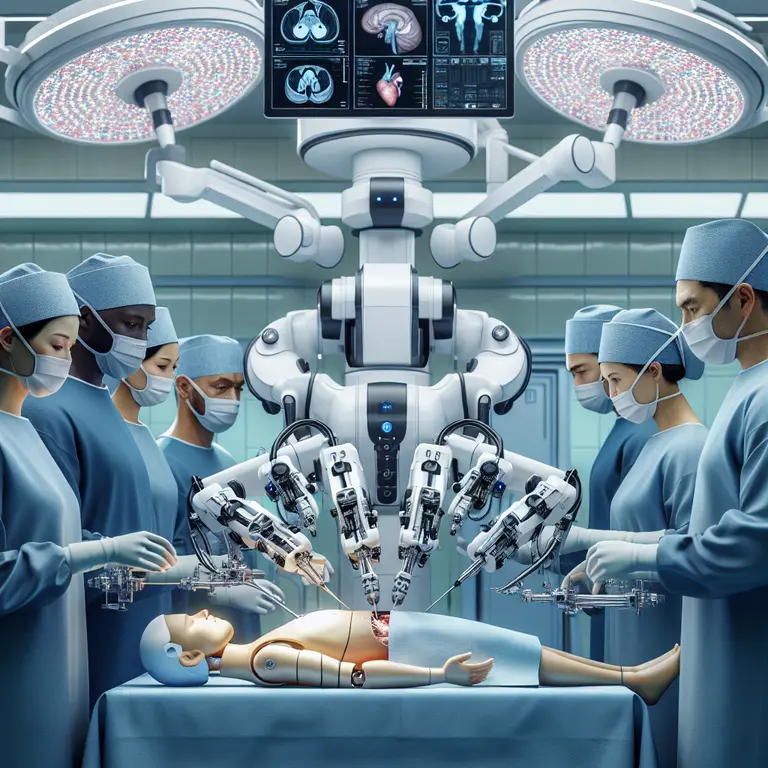
Telesurgery relies on two vital technological components: advanced surgical robots and real-time telecommunications infrastructure. The robotic systems used in telesurgery, such as Zeus or the more widely known da Vinci system, consist of robotic arms equipped with surgical instruments and cameras. Surgeons control these robots using a console, where they can view a high-definition, magnified, three-dimensional image of the surgical field and precisely manipulate the robotic arms with fine-motor inputs that the system translates into scaled, filtered movements.
The second critical component is the telecommunications technology that allows data to travel between the surgeon’s console and the robotic system positioned near the patient. During the 2001 procedure, high-speed internet connections and dedicated communication lines were used to ensure that the signals controlling the robot’s movements were transmitted without significant delay. This allowed the surgical team in the United States to operate as if they were physically present in the operating room in France.
One aspect of this technology that often goes underappreciated is the role of motion scaling and tremor filtration. Human hands, no matter how skilled, produce small involuntary tremors. Robotic surgical systems are programmed to filter out these micro-movements, translating a surgeon’s gestures into smoother, more precise actions than the human hand alone could achieve. This means that in some respects, the robot does not simply replicate a surgeon’s movements but actively refines them, producing a level of mechanical accuracy that has no direct equivalent in traditional surgery.
The success of the 2001 telesurgery procedure proved that, with the proper technological infrastructure, surgeries could be performed remotely with the same level of precision as traditional surgeries. This development laid the groundwork for expanding access to specialized medical care, particularly in areas where expert surgeons may not be readily available.
The Rise of Robot-Assisted Surgery
The success of the Zeus system and other robotic platforms in the early 2000s helped establish the field of robot-assisted surgery, which has since become a standard feature of modern surgical practice. Today, systems like the da Vinci surgical robot are used in thousands of hospitals worldwide to perform a wide range of procedures, from minimally invasive surgeries to more complex and delicate operations.
Robot-assisted surgery offers several critical advantages over traditional surgical methods. First and foremost, robotic systems provide increased precision. The robotic arms in these systems can make highly controlled, microscopic movements that would be difficult for even the most skilled human surgeon to replicate consistently over the course of a long procedure. This allows for more precise incisions and sutures, reducing the risk of complications and improving patient outcomes.
Another major benefit is the minimally invasive nature of many robot-assisted procedures. Rather than requiring large incisions to give a surgeon direct access to the operative site, robotic systems work through small entry points using slender instruments and cameras. This leads to significantly less trauma for the patient, shorter hospital stays, faster recovery times, and a lower risk of postoperative infection. For patients who might otherwise face lengthy recoveries from open surgery, this represents a meaningful improvement in quality of life.
The enhanced visualization provided by the three-dimensional, high-definition cameras in robotic systems also gives surgeons a far superior view of the surgical site than the naked eye can perceive during an open procedure. Structures that might be difficult to distinguish in traditional surgery become clearly visible, allowing for more accurate decision-making and reducing the likelihood of inadvertent damage to surrounding tissue.
Applications and the Future of Telesurgery
The success of telesurgery in 2001 opened up new possibilities for global healthcare. One of the most compelling potential applications is the ability to provide expert surgical care to patients in remote or underserved regions. In areas where access to highly trained specialists is limited, telesurgery could enable local healthcare providers to collaborate with world-class surgeons remotely, ensuring that patients receive the best possible care regardless of their geographic location.
Telesurgery also holds significant promise for disaster relief and military operations. In situations where it may be dangerous or logistically impossible for surgeons to be physically present, such as during a natural disaster or in a combat zone, telesurgery could enable doctors to perform life-saving procedures from a safe, stable location. Military medical researchers have explored this concept extensively, envisioning mobile surgical units that could be deployed to a battlefield while the operating surgeon remains at a command center far from harm.
Beyond remote surgery, robot-assisted procedures have already become transformative tools across numerous medical specialties. Prostatectomies, hysterectomies, heart valve repairs, colorectal surgeries, and even certain organ transplants have been successfully performed using robotic systems. These procedures are consistently associated with reduced blood loss, lower complication rates, and faster recoveries compared to their traditional open-surgery counterparts.
Looking ahead, the integration of artificial intelligence into surgical robotics is likely to represent the next major leap forward. AI systems are already being developed that can analyze intraoperative imaging in real time, flag anatomical structures to avoid, and even suggest adjustments to surgical technique based on outcomes data from thousands of prior procedures. The combination of robotic precision, telecommunications reach, and AI-driven decision support could eventually produce a surgical system capable of performing certain standardized procedures with minimal human intervention.
Conclusion: A New Frontier in Surgical Technology
The successful remote surgery performed by the Zeus robotic system in 2001 was a pivotal moment in the history of medicine. It demonstrated that the combination of advanced robotics and high-speed telecommunications could enable surgeons to perform precise, life-saving procedures remotely, fundamentally redefining what it means to be present in an operating room.
In the decades since that first transatlantic cholecystectomy, robot-assisted surgery has grown from a curiosity into a cornerstone of modern medical practice. It offers patients increased precision, reduced recovery times, and improved outcomes, while giving surgeons capabilities that extend well beyond what unassisted human hands can achieve. As costs continue to fall and technology improves, these tools are becoming accessible to a broader range of healthcare facilities worldwide.
The future of surgery lies at the intersection of robotics, telecommunications, and artificial intelligence, ushering in an era where the expertise of the world’s leading surgeons can be delivered to any patient, in any location, at any time. What began with a single gallbladder removal across an ocean has grown into one of the most consequential technological revolutions in the history of human medicine.