
Pioneering Pacemaker: The Plutonium-Powered Breakthrough
The earliest heart pacemakers had a radioactive twist: they were powered by plutonium.
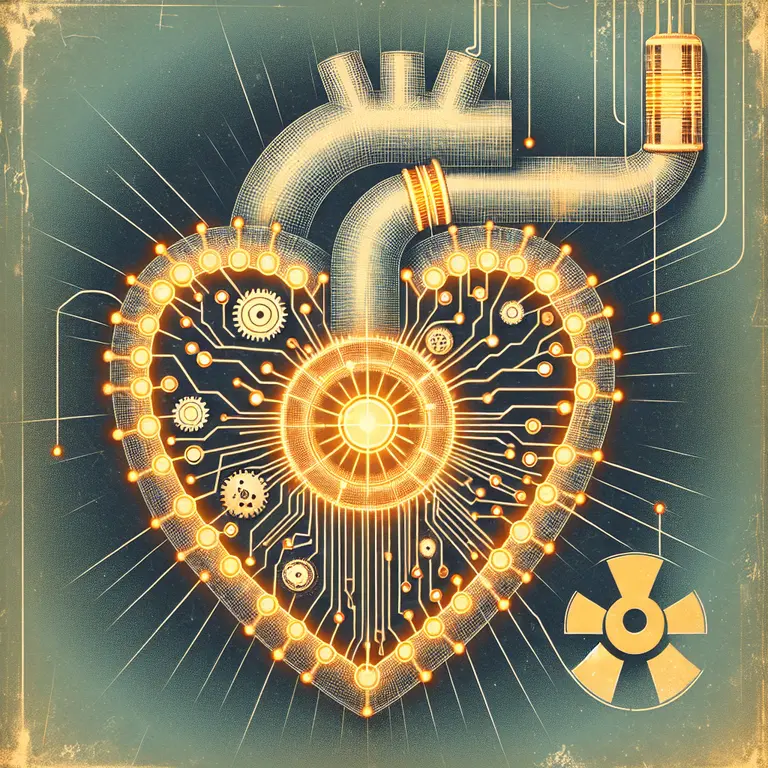
 Watch on YouTube
 Watch on Rumble
When Hearts Ran on Nuclear Power: The Strange History of Plutonium-Powered Pacemakers
Before the advent of lithium battery technology, early cardiac pacemakers faced a critical, often life-threatening challenge: providing a reliable, long-lasting power source to sustain the heart’s function for many years. Traditional battery technologies of the era were simply insufficient. They required frequent replacement due to their short operational lifespan, meaning patients faced repeated surgical procedures with all the associated risks of infection, anesthesia, and recovery. To address this pressing problem, a group of forward-thinking engineers turned to one of the most unconventional energy sources imaginable: the radioactive isotope plutonium-238. Through the natural process of radioactive decay, this isotope generates a steady, predictable stream of heat that could be converted into electrical energy to power the pacemaker indefinitely. It was a remarkable intersection of nuclear physics and cardiac medicine, producing one of the strangest chapters in the history of medical technology.
The Development of Plutonium-238 Powered Pacemakers
In the early 1970s, engineers and medical researchers were under considerable pressure to find a solution that would extend the operational life of cardiac pacemakers beyond what conventional battery chemistry could offer. The patients who depended on these devices were often elderly or seriously ill, and subjecting them to repeated surgical interventions purely to swap out a depleted battery was both medically risky and ethically troubling. The idea of using a radioactive material to power these devices stemmed from a desire to create a power source so long-lasting and stable that it would effectively outlive the patient entirely.
Plutonium-238, a radioisotope already in use by NASA for powering deep-space probes, became the focus of serious medical research. Unlike many other radioactive isotopes, plutonium-238 emits alpha particles during its decay process rather than the more penetrating gamma rays or beta particles. Alpha particles are relatively easy to shield and have an extremely limited range in biological tissue, allowing them to be effectively contained within a small, well-designed casing without posing significant radiation risk to surrounding organs or tissues. This property made plutonium-238 uniquely suited for implantation within the human body, a setting where radiation safety is of paramount importance.
The first plutonium-238-powered pacemaker was implanted in a human patient in 1973, marking a genuine milestone in both nuclear technology and cardiac medicine. These devices utilized a radioisotope thermoelectric generator, the same fundamental technology used in spacecraft like Voyager and Pioneer, which converted the heat produced by plutonium-238’s steady radioactive decay into a low but consistent electrical current. This system provided a remarkably stable power supply, with an estimated operational lifespan of up to 88 years, far surpassing not only the capabilities of existing battery technologies but also the life expectancy of virtually any patient who might receive such a device. For the first time in the history of cardiac care, the power source was no longer the limiting factor in a pacemaker’s useful life.
The Safety and Longevity of Plutonium-Powered Pacemakers
The use of plutonium-238 in pacemakers was, by the standards of the time and by most rigorous assessments since, considered acceptably safe for the individual patient. The isotope’s radiation was effectively contained within the device, and the pacemaker’s robust multi-layered casing ensured that no radioactive material could leak or migrate into surrounding tissue. Because alpha particles travel only a fraction of a millimeter through biological matter before losing all their energy, the plutonium-238 core posed a genuinely shallow risk of internal radiation exposure. The engineering behind these devices was meticulous, drawing heavily on the containment expertise developed by the nuclear industry and NASA’s space program.
For patients who relied on pacemakers to regulate their heartbeats, the potential to avoid frequent surgical procedures to replace a depleted power source was not merely a convenience but a meaningful improvement in quality of life. Pacemaker surgery, even when relatively routine, carries real risks, particularly for the elderly cardiac patients who make up the majority of recipients. Eliminating the need for battery replacement surgeries reduced cumulative surgical risk and spared patients considerable physical and psychological burden. In this respect, the plutonium-powered pacemaker was a genuine humanitarian achievement.
However, the safety picture was not entirely uncomplicated. Concerns began to emerge about what would happen to the plutonium after a patient passed away. Approximately 90 of these devices were implanted in patients across the United States and Europe during the 1970s, and tracking their eventual fate became a matter of some urgency. If a plutonium-powered pacemaker were buried with its deceased owner without prior removal, the device could theoretically become a localized source of radioactive contamination if the burial site were disturbed, excavated, or subjected to flooding. Cremation presented an even more immediate hazard, as the intense heat of a crematorium could potentially compromise the device’s containment casing and release radioactive material. Medical examiners and funeral directors had to be specifically trained to identify and safely remove these devices prior to cremation, a logistical challenge that added a layer of complexity to end-of-life care that no one had fully anticipated when the technology was first developed.
Transition to Lithium-Iodide Cell Technology
By the late 1970s, a new technological breakthrough in pacemaker power sources had emerged that would ultimately render the plutonium-powered device obsolete. Lithium-iodide batteries offered a safer, simpler, and more environmentally sustainable option while providing sufficient energy density to power pacemakers reliably for a decade or more. Although lithium-iodide batteries did not approach the theoretical 88-year lifespan of their plutonium counterparts, they were durable enough to represent a massive improvement over the earlier zinc-mercury batteries, which had necessitated frequent replacement. More importantly, they did not require the elaborate containment engineering, regulatory oversight, or specialized disposal protocols that came with implanting a nuclear material inside a human being.
The transition to lithium technology also reflected a broader shift in how the medical community and the public thought about acceptable risk in healthcare. The 1970s saw growing public awareness and concern about nuclear materials in all their forms, from weapons testing to power plant safety. Even if plutonium-powered pacemakers were demonstrably safe for individual patients, the optics of implanting nuclear devices in human hearts became increasingly difficult to defend in a cultural climate of nuclear anxiety. Lithium batteries eliminated these concerns entirely, offering a clean, predictable, and well-understood chemistry that physicians, patients, and regulators could all accept without reservation.
Once lithium-iodide cell technology became sufficiently advanced and reliable, the use of plutonium-238 in pacemakers was quietly phased out. No new plutonium-powered pacemakers were implanted after the early 1980s, and the transition marked the definitive end of an era in which radioactive isotopes were seriously considered as viable power sources for implantable medical devices.
The Broader Legacy and What It Reveals About Medical Innovation
Although plutonium-238 pacemakers are no longer in use, they represent a genuinely important chapter in the history of medical device innovation, one that reveals both the extraordinary creativity of mid-twentieth-century engineering and the complex web of ethical, environmental, and social factors that ultimately shape which technologies survive and which are abandoned. The devices were a remarkable solution to a real and serious problem, demonstrating the willingness of engineers and scientists to draw on the full breadth of available knowledge, including nuclear physics, space technology, and materials science, to extend and improve human life.
The story also illustrates a pattern that recurs throughout the history of technology: a bold and genuinely effective solution is developed to address an urgent problem, only to be superseded not because it failed on its own terms, but because a safer, more socially acceptable alternative eventually emerged. Plutonium-powered pacemakers worked. They kept hearts beating for years without a single battery replacement surgery. But they carried with them implications that extended far beyond the individual patient, touching on questions of environmental stewardship, regulatory governance, and the long tail of responsibility that comes with deploying radioactive materials in civilian contexts.
Conclusion: A Pioneering but Short-Lived Technology
The use of plutonium-238 in pacemakers was a pioneering development that addressed one of the central challenges in early cardiac care with genuine ingenuity and measurable success. With an operational lifespan of nearly 88 years, these devices offered patients a degree of freedom from surgical intervention that was simply unimaginable with earlier battery technologies. They drew on the same nuclear engineering principles that powered humanity’s first journeys to the outer solar system, and they did so in service of one of medicine’s most fundamental goals: keeping the human heart beating.
Yet the environmental and ethical concerns associated with radioactive materials in implantable devices proved to be obstacles that no amount of engineering elegance could fully overcome. Once lithium-iodide cell technology became viable, the calculus shifted decisively in favor of a simpler, cleaner, and less contentious solution. The transition to lithium batteries represented not a failure of nuclear medicine but a maturation of the field, a recognition that the best technology is not always the most powerful or the most long-lasting, but the one that best balances performance with the full range of human and environmental consequences it carries.
Today, the story of plutonium-238 pacemakers serves as a reminder of the innovative spirit that has always driven medical technology forward, and of the importance of asking not only whether something can be done, but whether it should be, and for how long.